



 Chat with AI
Exam 16: Long-Run Growth

Exam 1: The Scope and Method of Economics238 Questions
Exam 2: The Economic Problem: Scarcity and Choice220 Questions
Exam 3: Demand, Supply, and Market Equilibrium298 Questions
Exam 4: Demand and Supply Applications173 Questions
Exam 5: Introduction to Macroeconomics241 Questions
Exam 6: Measuring National Output and National Income292 Questions
Exam 7: Unemployment, Inflation, and Long-Run Growth297 Questions
Exam 8: Aggregate Expenditure and Equilibrium Output355 Questions
Exam 9: The Government and Fiscal Policy362 Questions
Exam 10: Money, the Federal Reserve, and the Interest Rate358 Questions
Exam 11: The Determination of Aggregate Output, the Price Level, and the Interest Rate243 Questions
Exam 12: Policy Effects and Cost Shocks in the Asad Model200 Questions
Exam 13: The Labor Market in the Macroeconomy287 Questions
Exam 14: Financial Crises, Stabilization, and Deficits260 Questions
Exam 15: Household and Firm Behavior in the Macroeconomy: a Further Look364 Questions
Exam 16: Long-Run Growth196 Questions
Exam 17: Alternative Views in Macroeconomics294 Questions
Exam 18: International Trade, Comparative Advantage, and Protectionism301 Questions
Exam 19: Open-Economy Macroeconomics: the Balance of Payments and Exchange Rates308 Questions
Exam 20: Economic Growth in Developing Economies133 Questions
Exam 21: Critical Thinking About Research105 Questions
Select questions type


Refer to the information provided in Table 16.1 below to answer the questions that follow.
Table 16.1
 -Refer to Table 16.1. During Period 1, labor productivity is equal to
 (Multiple Choice)
4.8/5  (80)
(80) Labor productivity growth is the growth rate of output per person in the economy.
(True/False)
4.7/5 (88)
(88) A company uses 100 workers and 30 units of capital to produce 500 units of output. If this company increases its capital to 50 units and, as a result, its output increases by 300 units, the productivity of labor ________ to ________ units per worker.
(Multiple Choice)
4.9/5 (86)
(86) In the absence of increases in the capital stock, increases in labor are subject to diminishing returns.
(True/False)
4.9/5 (85)
(85) Suppose that growth in output that can be attributed to growth in labor and capital is 2%. If output grows at a rate of 5%, it must be the case that
(Multiple Choice)
4.7/5 (70)
(70) Refer to the information provided in Figure 16.1 below to answer the questions that follow. 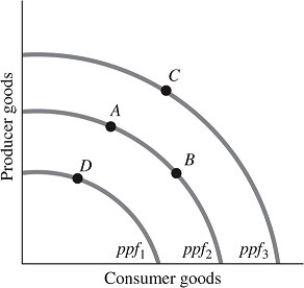 Figure 16.1
-Refer to Figure 16.1. Which of the following causes the ppf to shift from ppf2 to ppf1?
Figure 16.1
-Refer to Figure 16.1. Which of the following causes the ppf to shift from ppf2 to ppf1? (Multiple Choice)
4.9/5 (80)
(80) Convergence theory suggests that gaps in ________ tend to close over time.
(Multiple Choice)
4.8/5 (77)
(77) Refer to the information provided in Table 16.1 below to answer the questions that follow.
Table 16.1
-Refer to Table 16.1. From Period 1 to Period 2, the marginal return to labor is equal to
-Refer to Table 16.1. From Period 1 to Period 2, the marginal return to labor is equal to (Multiple Choice)
4.8/5 (74)
(74) The Millennium Development Goals adopted by the United Nations included targets for which of the following?
(Multiple Choice)
4.7/5 (92)
(92) Which of the following was not one of the likely causes of the productivity problem in the 1970s?
(Multiple Choice)
4.8/5 (95)
(95) Globally, from 1996-2013 the highest average growth rate per year occurred on the continent of Africa.
(True/False)
5.0/5 (80)
(80) Refer to the information provided in Table 16.2 below to answer the questions that follow.
Table 16.2
 -Refer to Table 16.2. During Period 4, output per capital is equal to
 (Multiple Choice)
4.9/5 (91)
(91) Refer to the information provided in Figure 16.1 below to answer the questions that follow. Figure 16.1
-Refer to Figure 16.1. A decrease in the labor force will cause a
Figure 16.1
-Refer to Figure 16.1. A decrease in the labor force will cause a (Multiple Choice)
4.7/5 (73)
(73) 
Filters
- Essay(0)
- Multiple Choice(0)
- Short Answer(0)
- True False(0)
- Matching(0)