



 Chat with AI
Exam 19: International Trade, Comparative Advantage, and Protectionism

Exam 1: The Scope and Method of Economics65 Questions
Exam 2: The Economic Problem: Scarcity and Choice107 Questions
Exam 3: Demand, Supply, and Market Equilibrium86 Questions
Exam 4: Demand and Supply Applications37 Questions
Exam 5: Introduction to Macroeconomics64 Questions
Exam 6: Measuring National Output and National Income84 Questions
Exam 7: Unemployment, Inflation, and Long-Run Growth81 Questions
Exam 8: Aggregate Expenditure and Equilibrium Output58 Questions
Exam 9: The Government and Fiscal Policy71 Questions
Exam 10: The Money Supply and the Federal Reserve System96 Questions
Exam 11: Money Demand and the Equilibrium Interest Rate96 Questions
Exam 12: The Determination of Aggregate Output, the Price Level, and the Interest Rate100 Questions
Exam 13: Policy Effects and Costs Shocks in the Asad Model89 Questions
Exam 14: The Labor Market in the Macroeconomy111 Questions
Exam 15: Financial Crises, Stabilization, and Deficits102 Questions
Exam 16: Household and Firm Behavior in the Macroeconomy: a Further Look92 Questions
Exam 17: Long-Run Growth59 Questions
Exam 18: Alternative Views in Macroeconomics88 Questions
Exam 19: International Trade, Comparative Advantage, and Protectionism63 Questions
Exam 20: Open-Economy Macroeconomics: the Balance of Payments and Exchange Rates105 Questions
Exam 21: Economic Growth in Developing and Transitional Economies48 Questions
Select questions type


Related to the Economics in Practice on p. 366 [678]: What is the impetus for many countries to cut tariffs on food when in the past these tariffs were vigorously supported by farmers?
(Essay)
4.8/5  (83)
(83) Explain what happens when nations don't trade. In addition, explain what happens after they decide to trade.
(Essay)
4.8/5 (71)
(71) Assume a manager of a major league baseball team has a player that is the best pitcher on team the team. However, he decides to to have him play right field instead. It turns out that he is not the best right fielder on the team. How might this manager defend his decision?
(Essay)
4.8/5 (80)
(80) 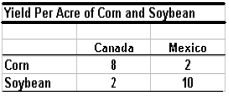 -According to the table above determine which country has the absolute advantage in corn and which in soybeans. In addition, determine which country has the comparative advantage in corn and which in soybeans. Make sure to support your answer by deriving the opportunity costs of each.
 (Essay)
4.8/5 (75)
(75) Some people argue that protection discourages dependency. Explain this argument.
(Essay)
4.8/5 (83)
(83) 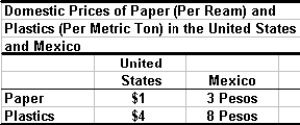 -According to the table above what would the flows of trade be between both countries if the exchange rate were $1 = 2.5 pesos?
 (Essay)
4.9/5 (72)
(72) Assume that the European Union passes a new trade policy that will only allow trade with South American countries that pass environmental laws that are the same as those of member countries in the EU. The argument that is made is that this will provide a level playing field for the EU in competing with South American nations in international trade. Critically evaluate this argument.
(Essay)
5.0/5 (90)
(90) Scenario 1
Two men live alone on an isolated island. To survive they must undertake a few basic economic activities like water carrying, fishing, cooking and shelter construction and maintenance. The first man is young, strong, and educated. He is also faster, better, and more productive at everything. He has an absolute advantage in all activities. The second man is old, weak, and uneducated. He has an absolute disadvantage in all economic activities. In some activities the difference between the two is great; in others it is small.
-Based on Scenario 1 above critically evaluate the following statement. "Because of the productivity differential between the two men we can conclude that the young man has a comparative advantage in the production of everything over the older man.
(Essay)
4.8/5 (79)
(79) Explain the "Unfair Trade Practices" argument as a case against free trade.
(Essay)
4.9/5 (79)
(79) 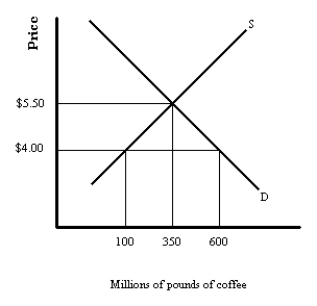 -Assume that the above figure represents the domestic supply and demand for coffee.The domestic price with no trade is represented by $5.50. The price with free trade is represented by $4.00. Assume that the government places a $1 per pound tariff on imported coffee, which decreases the domestic quantity demanded of coffee by 100 million pounds and increases domestic production by 100 million pounds. Draw the rectangle that would represent the amount of tax revenue that the government would realize from this tax and calculate the dollar figure.
(Essay)
4.9/5 (82)
(82) It is well documented that traveling on our nation's highways at lower speeds saves money on fuel and reduces accidents. Assume that a driver understands this but is unwilling to drive slower until he observes everyone else doing it. Can you make a parallel between this attitude and the case where countries will refuse to lower their tariffs unless their trading partners do the same?
(Essay)
4.9/5 (82)
(82) 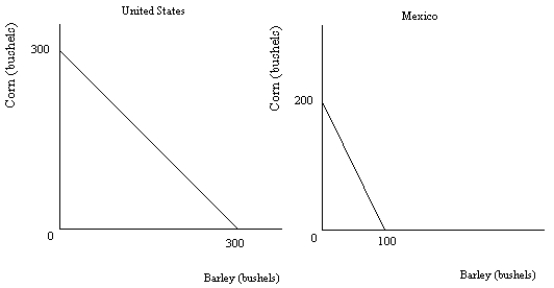 -Using the above figure determine which country has the comparative advantage in the production of corn. In addition, determine which has the comparative advantage in the production of barley.
 (Essay)
4.8/5 (82)
(82) 
Filters
- Essay(0)
- Multiple Choice(0)
- Short Answer(0)
- True False(0)
- Matching(0)