



 Chat with AI
Exam 19: International Trade, Comparative Advantage, and Protectionism

Exam 1: The Scope and Method of Economics65 Questions
Exam 2: The Economic Problem: Scarcity and Choice107 Questions
Exam 3: Demand, Supply, and Market Equilibrium86 Questions
Exam 4: Demand and Supply Applications37 Questions
Exam 5: Introduction to Macroeconomics64 Questions
Exam 6: Measuring National Output and National Income84 Questions
Exam 7: Unemployment, Inflation, and Long-Run Growth81 Questions
Exam 8: Aggregate Expenditure and Equilibrium Output58 Questions
Exam 9: The Government and Fiscal Policy71 Questions
Exam 10: The Money Supply and the Federal Reserve System96 Questions
Exam 11: Money Demand and the Equilibrium Interest Rate96 Questions
Exam 12: The Determination of Aggregate Output, the Price Level, and the Interest Rate100 Questions
Exam 13: Policy Effects and Costs Shocks in the Asad Model89 Questions
Exam 14: The Labor Market in the Macroeconomy111 Questions
Exam 15: Financial Crises, Stabilization, and Deficits102 Questions
Exam 16: Household and Firm Behavior in the Macroeconomy: a Further Look92 Questions
Exam 17: Long-Run Growth59 Questions
Exam 18: Alternative Views in Macroeconomics88 Questions
Exam 19: International Trade, Comparative Advantage, and Protectionism63 Questions
Exam 20: Open-Economy Macroeconomics: the Balance of Payments and Exchange Rates105 Questions
Exam 21: Economic Growth in Developing and Transitional Economies48 Questions
Select questions type


Sometimes you will hear economists argue that the infant industry argument against free trade is a weak one because these industries never seem to "grow up." What is meant by this argument?
(Essay)
4.9/5  (88)
(88) Why is it difficult for one country to determine if another country is guilty of the practice of dumping?
(Essay)
4.8/5 (78)
(78) 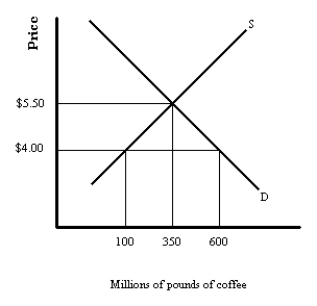 -Identify the two losses of efficiency associated with the imposition of a tariff.
 (Essay)
4.8/5 (86)
(86) Economists will often argue that an individual trade barrier designed to help a particular industry will work even though on net it won't help the economy as a whole. Explain what this means.
(Essay)
4.9/5 (82)
(82) Let's assume that two countries have imposed high tariffs on each other's products and services to the point where all trade between the two countries has disappeared. Assume a newly elected member of parliament in one of the countries makes a proposal for unilateral tariff reduction regardless of whether the other country wishes to follow suit. Explain why such a policy change would actually be a good idea.
(Essay)
4.9/5 (79)
(79) Suppose an attorney has hired a very well-educated secretary that is not only more productive in filing briefs but also more productive at typing than he is. Can you provide any explanation for why it might still make sense for him to continue filing briefs while the secretary continues to do the typing?
(Essay)
4.8/5 (86)
(86) Critically evaluate the following statement. "I am definitely in favor of free trade but only if it means fair trade."
(Essay)
4.9/5 (83)
(83) 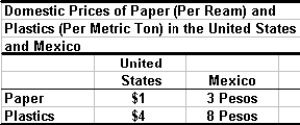 -According to the table above, would there be trade flows in both directions if the exchange rate were $1 = 1 peso?
 (Essay)
4.8/5 (77)
(77) bushels of corn. Draw the production possibilities for both countries assuming constant costs.
(Essay)
4.8/5 (84)
(84) When trade is free (unimpeded by government-instituted barriers) how are the patterns of trade and trade flows determined?
(Essay)
5.0/5 (77)
(77) Scenario 1
Two men live alone on an isolated island. To survive they must undertake a few basic economic activities like water carrying, fishing, cooking and shelter construction and maintenance. The first man is young, strong, and educated. He is also faster, better, and more productive at everything. He has an absolute advantage in all activities. The second man is old, weak, and uneducated. He has an absolute disadvantage in all economic activities. In some activities the difference between the two is great; in others it is small.
-Based on Scenario 1 above critically evaluate the following statement. "Because of the disparities in skills between these two men it will not be beneficial for them to trade with one another."
(Essay)
4.9/5 (79)
(79) Assume the United States has an absolute advantage in the production of everything compared to the African nation of Berundi. Can you think of any reason why both nations would still find it to their mutual advantage to trade with each other?
(Essay)
4.8/5 (84)
(84) Discuss the national security argument as a case against free trade. What is the problem with this argument?
(Essay)
4.8/5 (88)
(88) 
Filters
- Essay(0)
- Multiple Choice(0)
- Short Answer(0)
- True False(0)
- Matching(0)