



 Chat with AI
Exam 15: Financial Crises, Stabilization, and Deficits

Exam 1: The Scope and Method of Economics65 Questions
Exam 2: The Economic Problem: Scarcity and Choice107 Questions
Exam 3: Demand, Supply, and Market Equilibrium86 Questions
Exam 4: Demand and Supply Applications37 Questions
Exam 5: Introduction to Macroeconomics64 Questions
Exam 6: Measuring National Output and National Income84 Questions
Exam 7: Unemployment, Inflation, and Long-Run Growth81 Questions
Exam 8: Aggregate Expenditure and Equilibrium Output58 Questions
Exam 9: The Government and Fiscal Policy71 Questions
Exam 10: The Money Supply and the Federal Reserve System96 Questions
Exam 11: Money Demand and the Equilibrium Interest Rate96 Questions
Exam 12: The Determination of Aggregate Output, the Price Level, and the Interest Rate100 Questions
Exam 13: Policy Effects and Costs Shocks in the Asad Model89 Questions
Exam 14: The Labor Market in the Macroeconomy111 Questions
Exam 15: Financial Crises, Stabilization, and Deficits102 Questions
Exam 16: Household and Firm Behavior in the Macroeconomy: a Further Look92 Questions
Exam 17: Long-Run Growth59 Questions
Exam 18: Alternative Views in Macroeconomics88 Questions
Exam 19: International Trade, Comparative Advantage, and Protectionism63 Questions
Exam 20: Open-Economy Macroeconomics: the Balance of Payments and Exchange Rates105 Questions
Exam 21: Economic Growth in Developing and Transitional Economies48 Questions
Select questions type


What did Milton Friedman mean by his criticism of stabilization policy when be compared it to a "fool in the shower?"
(Essay)
4.9/5  (77)
(77) Explain how an increase in government spending might actually result in a decline in the budget deficit.
(Essay)
4.9/5 (83)
(83) Under what circumstances might the income multiplier be zero? More specifically, there were those who argued that the income multiplier was zero during the passage of the Gramm-Rudman-Hollings Deficit Reduction Act. What was their argument?
(Essay)
4.7/5 (92)
(92) Related to the Economics in Practice on p. 293 [605]: When is the only condition under which a stock bubble will pop?
(Essay)
4.8/5 (77)
(77) Illustrate examples of the counter cyclical effects of the automatic stabilizers.
(Essay)
4.9/5 (89)
(89) Explain why is the response lag for monetary policy likely longer than the response lag for fiscal policy?
(Essay)
4.8/5 (81)
(81) When stock prices rise, what generally happens to the level of household wealth and consumption?
(Essay)
5.0/5 (82)
(82) Explain what the deficit response index measures. Briefly explain why it is not equal to zero.
(Essay)
4.9/5 (80)
(80) How is the Fed likely to respond during periods of excessive expansionary growth that is characterized by strong inflationary pressures? Make sure to include in your answer the change in the money supply and interest rates.
(Essay)
4.9/5 (65)
(65) Explain what was supposed to happen under the Gramm-Rudman-Hollings Act when a congressionally enacted budget deficit was larger than the targeted amount.
(Essay)
4.9/5 (85)
(85) Discuss what happens to the government budget deficit when government spending is reduced?
(Essay)
4.9/5 (75)
(75) Why would a balanced budget amendment to the Constitution be considered destabilizing during an inflationary boom in which the government is running a budget surplus?
(Essay)
4.8/5 (92)
(92) What were the political and social costs of the bailout of the U.S. financial industry?
(Essay)
4.8/5 (73)
(73) 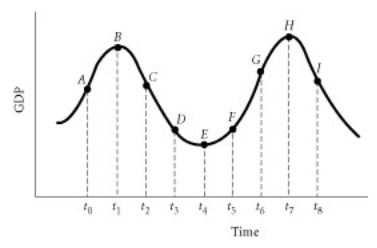 -Using the graph above, if policy makers decide on a policy at point t3 but it does not affect the economy until period t6, then how might this be a problem?
 (Essay)
4.8/5 (76)
(76) What is meant by the use of the phrase "financial crisis" and how is it used?
(Essay)
4.8/5 (89)
(89) Explain how a tax cut might actually result in a decline in the budget deficit.
(Essay)
4.8/5 (89)
(89) 
Filters
- Essay(0)
- Multiple Choice(0)
- Short Answer(0)
- True False(0)
- Matching(0)