



 Chat with AI
Exam 15: Financial Crises, Stabilization, and Deficits

Exam 1: The Scope and Method of Economics65 Questions
Exam 2: The Economic Problem: Scarcity and Choice107 Questions
Exam 3: Demand, Supply, and Market Equilibrium86 Questions
Exam 4: Demand and Supply Applications37 Questions
Exam 5: Introduction to Macroeconomics64 Questions
Exam 6: Measuring National Output and National Income84 Questions
Exam 7: Unemployment, Inflation, and Long-Run Growth81 Questions
Exam 8: Aggregate Expenditure and Equilibrium Output58 Questions
Exam 9: The Government and Fiscal Policy71 Questions
Exam 10: The Money Supply and the Federal Reserve System96 Questions
Exam 11: Money Demand and the Equilibrium Interest Rate96 Questions
Exam 12: The Determination of Aggregate Output, the Price Level, and the Interest Rate100 Questions
Exam 13: Policy Effects and Costs Shocks in the Asad Model89 Questions
Exam 14: The Labor Market in the Macroeconomy111 Questions
Exam 15: Financial Crises, Stabilization, and Deficits102 Questions
Exam 16: Household and Firm Behavior in the Macroeconomy: a Further Look92 Questions
Exam 17: Long-Run Growth59 Questions
Exam 18: Alternative Views in Macroeconomics88 Questions
Exam 19: International Trade, Comparative Advantage, and Protectionism63 Questions
Exam 20: Open-Economy Macroeconomics: the Balance of Payments and Exchange Rates105 Questions
Exam 21: Economic Growth in Developing and Transitional Economies48 Questions
Select questions type


How is the Fed likely to respond during periods of recessionary decline? Make sure to include in your answer the change in the money supply and interest rates.
(Essay)
4.8/5  (88)
(88) 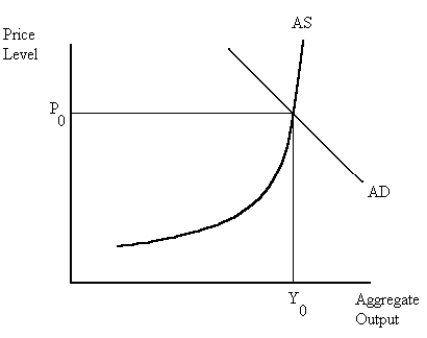 -According to the above graph what kind of action is the Fed likely to take and why? You may assume at Po is highly inflationary and that Yo represents full-employment output. Draw in the new aggregate demand curve to support your answer.
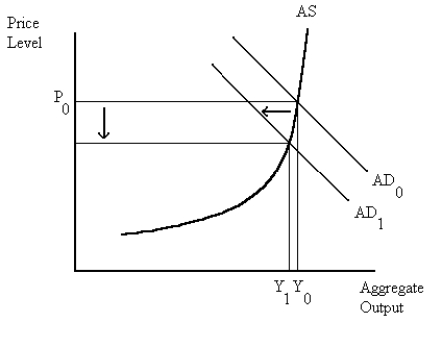
-According to the above graph what kind of action is the Fed likely to take and why? You may assume at Po is highly inflationary and that Yo represents full-employment output. Draw in the new aggregate demand curve to support your answer.
(Essay)
4.8/5 (82)
(82) Suppose that for every $10 billion decrease in GDP, tax revenue would fall by $1 billion. With a budget deficit of $200 billion and a multiplier of 4 what will be the new budget deficit if Congress cuts government spending by $100 billion.
(Essay)
5.0/5 (83)
(83) Explain the Federal Reserve's policy that is often called to "lean against the wind."
(Essay)
4.8/5 (88)
(88) Related to the Economics in Practice on p. 293 [605]: If the estate in the Chekhov play Uncle Vanya is earning 2 percent, the interest rate on suitable securities is 5 percent, and the securities are a better risk than the estate, should the state require a lower or higher price? What should the equivalent return on the estate be equal to?
(Essay)
4.9/5 (81)
(81) What is the economic impact of automatic stabilizers during contractionary periods?
(Essay)
4.8/5 (83)
(83) Use the Economics in Practice titled "Financial Reform Bill" to answer the following question. What were the primary provisions of the Financial Reform Bill as described in the article as it applied to consumers and borrowers?
(Essay)
4.7/5 (81)
(81) How might an increase in stock prices lead to increases in investment?
(Essay)
5.0/5 (81)
(81) Using Scenario 1, if the government is currently facing a deficit of $75 billion why might it have to cut spending by more than that amount to balance the budget?
(Essay)
4.8/5 (88)
(88) Use the Economics in Practice titled "Bernanke's Bubble Laboratory: Princeton Protégés of Fed Chief Study the Economics of Manias" to answer the following question. According to the article what is the explanation for why bubbles emerge?
(Essay)
4.9/5 (92)
(92) Assume that tax revenue is represented by the following function: T = - 200 + .25Y, where the first term represents transfer payments and the second term represents gross tax revenue. Assume furthermore that government spending is $400 billion and the economy is in equilibrium at $2000 billion. Why would a cut in government spending by $100 billion not cause the budget deficit to disappear? If the income multiplier were two, what will the value of the budget deficit be after the cut in spending?
(Essay)
4.8/5 (81)
(81) What might have happened had the U.S. financial system not been "bailed out" by the federal government?
(Essay)
4.8/5 (83)
(83) The unemployment rate in some European countries has recently been significantly higher than the unemployment rate in the United States. Explain what factors might cause the European unemployment rate to be higher.
(Essay)
4.9/5 (74)
(74) 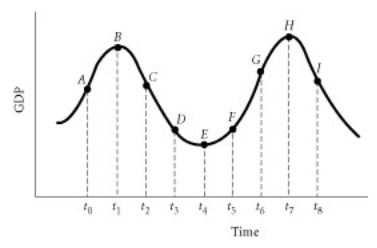 -Using the graph above, if the economy is actually at Point C but policy makers think that it is still at Point B, what kind of lag problem is this? Why might this happen?
 (Essay)
4.7/5 (85)
(85) 
Filters
- Essay(0)
- Multiple Choice(0)
- Short Answer(0)
- True False(0)
- Matching(0)