



 Chat with AI
Exam 9: The Government and Fiscal Policy

Exam 1: The Scope and Method of Economics65 Questions
Exam 2: The Economic Problem: Scarcity and Choice107 Questions
Exam 3: Demand, Supply, and Market Equilibrium86 Questions
Exam 4: Demand and Supply Applications37 Questions
Exam 5: Introduction to Macroeconomics64 Questions
Exam 6: Measuring National Output and National Income84 Questions
Exam 7: Unemployment, Inflation, and Long-Run Growth81 Questions
Exam 8: Aggregate Expenditure and Equilibrium Output58 Questions
Exam 9: The Government and Fiscal Policy71 Questions
Exam 10: The Money Supply and the Federal Reserve System96 Questions
Exam 11: Money Demand and the Equilibrium Interest Rate96 Questions
Exam 12: The Determination of Aggregate Output, the Price Level, and the Interest Rate100 Questions
Exam 13: Policy Effects and Costs Shocks in the Asad Model89 Questions
Exam 14: The Labor Market in the Macroeconomy111 Questions
Exam 15: Financial Crises, Stabilization, and Deficits102 Questions
Exam 16: Household and Firm Behavior in the Macroeconomy: a Further Look92 Questions
Exam 17: Long-Run Growth59 Questions
Exam 18: Alternative Views in Macroeconomics88 Questions
Exam 19: International Trade, Comparative Advantage, and Protectionism63 Questions
Exam 20: Open-Economy Macroeconomics: the Balance of Payments and Exchange Rates105 Questions
Exam 21: Economic Growth in Developing and Transitional Economies48 Questions
Select questions type


How do the values of the tax multiplier and the government spending multiplier change as the MPC increases? Explain why the multipliers change. If the MPC were 0, what would the government spending and tax multipliers equal? If the MPC were 1, what would the government spending and tax multipliers equal?
(Essay)
4.9/5  (100)
(100) What would be the effect of a cut in taxes of $100 billion on the economy if the marginal propensity to consume were .9? Explain why this policy is much different from simply having the government initiate a $100 billion spending program. Support your answer with specific calculations.
(Essay)
4.7/5 (77)
(77) If the government wants to reduce unemployment what are some ways it should change spending and taxes?
(Essay)
4.7/5 (75)
(75) Why do you suppose that state governments cannot rely on automatic stabilizers but the federal government can?
(Essay)
4.8/5 (78)
(78) Assume that the government spending multiplier is equal to 4. Calculate the tax multiplier from this information.
(Essay)
4.7/5 (62)
(62) The the primary purpose of the shock absorber in an automobile is to control spring and suspension movement. This is accomplished by turning the kinetic energy of suspension movement into thermal energy to be dissipated through the hydraulic fluid. How is this similar to the automatic stabilizers of the economy. Why does neither of these necessarily imply a "smooth ride"?
(Essay)
4.7/5 (70)
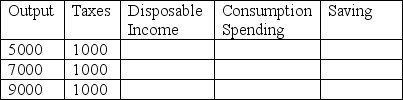
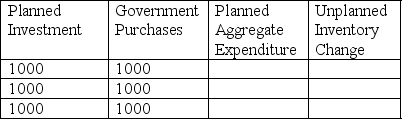
(70) Assume that the consumption function for the above economy is C = 1000 + .75Yd fill in the empty cells. (All Figures are in Billions of Dollars)
(Essay)
4.8/5 (82)
(82) Explain what would be the impact of a decrease in lump-sum taxes on the slope of the consumption function.
(Essay)
4.9/5 (80)
(80) Write out the modified algebraic representation of the consumption function when taxes are included.
(Essay)
4.8/5 (82)
(82) 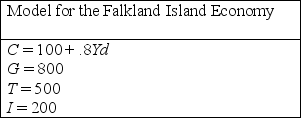 -If the aggregate consumption function is C = 100 +.9Yd what is the level of consumption if income is $3000 and net taxes are $100. Show all work.
 (Short Answer)
4.8/5 (75)
(75) Why might a balanced budget requirement be potentially destabilizing for the economy?
(Essay)
5.0/5 (66)
(66) Assume that the economy is in equilibrium at $9 trillion and the government increases spending by $100 billion. What would happen to unplanned inventories and why?
(Essay)
4.8/5 (82)
(82) Given that Yd C + S, prove that Y C + S + T. Explain the importance of this relationship.
(Essay)
5.0/5 (79)
(79) Assume that an economy is operating at full employment and furthermore there is a government budget surplus. What might be the macroeconomic impact if Congress decides to take the budget surplus and return it to taxpayers as a rebate?
(Essay)
4.7/5 (64)
(64)
-If the aggregate consumption function is C = 100 +.8Yd what is the level of consumption if income is $2000 and net taxes are $200. Show all work.
-If the aggregate consumption function is C = 100 +.8Yd what is the level of consumption if income is $2000 and net taxes are $200. Show all work. (Short Answer)
4.9/5 (86)
(86) Assume an economy is represented by the following:
 (a) Calculate the equilibrium level of output.
(b) Based on your analysis in Part (a), calculate the levels of consumption and saving that occur when the economy is in equilibrium.
(c) Now suppose planned investment rises by 100. Calculate the new equilibrium level of income. Given your answer, what is the size of the multiplier?
(d) What is the size of the tax multiplier for this economy?
(a) Calculate the equilibrium level of output.
(b) Based on your analysis in Part (a), calculate the levels of consumption and saving that occur when the economy is in equilibrium.
(c) Now suppose planned investment rises by 100. Calculate the new equilibrium level of income. Given your answer, what is the size of the multiplier?
(d) What is the size of the tax multiplier for this economy? (Essay)
4.8/5 (92)
(92) Write out the formula for the tax multiplier and explain why a higher MPC would generate a more negative tax multiplier.
(Essay)
4.9/5 (74)
(74) 
Filters
- Essay(0)
- Multiple Choice(0)
- Short Answer(0)
- True False(0)
- Matching(0)