



 Chat with AI
Exam 8: Molecular Biology and Transcription and Rna Processing

Exam 1: The Molecular Basis of Heredity, Variation, and Evolution53 Questions
Exam 2: Transmission Genetics55 Questions
Exam 3: Cell Division and Chromosome Heredity69 Questions
Exam 4: Gene Interaction56 Questions
Exam 5: Genetic Linkage and Mapping in Eukaryotes61 Questions
Exam 6: Genetic Analysis and Mapping in Bacteria and Bacteriophages51 Questions
Exam 7: Dna Structure and Replication57 Questions
Exam 8: Molecular Biology and Transcription and Rna Processing55 Questions
Exam 9: The Molecular Biology of Translation55 Questions
Exam 10: The Integration of Genetic Approaches: Understanding Sickle Cell Disease48 Questions
Exam 11: Chromosome Structure50 Questions
Exam 12: Gene Mutation, Dna Repair, and Homologous Recombination52 Questions
Exam 13: Chromosome Aberrations and Transposition54 Questions
Exam 14: Regulation of Gene Expression in Bacteria and Bacteriophages54 Questions
Exam 15: Regulation of Gene Expression in Eukaryotes56 Questions
Exam 16: Forward Genetics and Recombinant Dna Technology44 Questions
Exam 17: Applications of Recombinant Dna Technology and Reverse Genetics48 Questions
Exam 18: Genomics: Genetics From a Whole-Genome Perspective54 Questions
Exam 19: Cytoplasmic Inheritance and the Evolution of Organelle Genomes52 Questions
Exam 20: Developmental Genetics57 Questions
Exam 21: Genetic Analysis of Quantitative Traits47 Questions
Exam 22: Population Genetics and Evolution47 Questions
Select questions type


Transcription of inverted repeats produces an mRNA with complementary segments that fold to form what type of secondary structure?
(Short Answer)
4.9/5  (69)
(69) Using the accompanying diagram, which of the following corresponds to the +1 nucleotide? 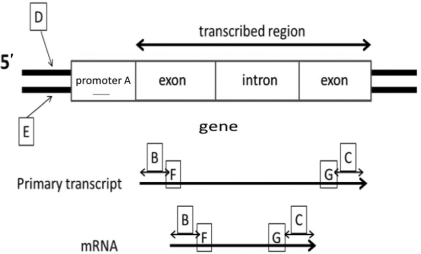
(Multiple Choice)
4.9/5 (77)
(77) What is the consensus sequence for the Pribnow box from these sequences? 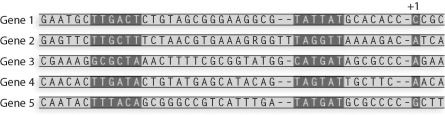
(Multiple Choice)
4.8/5 (76)
(76) miRNA is capable of regulating protein production through which process?
(Short Answer)
4.8/5 (89)
(89) How does the antibiotic rifampicin prevent transcription of RNA?
(Multiple Choice)
5.0/5 (72)
(72) You suspect a region of DNA contains a promoter and wish to confirm that a sequence of interest binds proteins. Which experiment would you use?
(Multiple Choice)
4.8/5 (79)
(79) Which three types of RNAs are found in both prokaryotes and eukaryotes?
(Short Answer)
5.0/5 (72)
(72) Which type of research technique was used to track newly synthesized RNA within a eukaryotic cell?
(Multiple Choice)
4.9/5 (72)
(72) A gene has acquired a mutation in which the protein product has an "extra" 50 amino acids at the end. Which region of the gene was likely mutated?
(Multiple Choice)
5.0/5 (75)
(75) Describe how band shift assays and DNA footprint protection assays can be used to identify promoter regions in DNA.
(Essay)
4.9/5 (83)
(83) You want to design a drug that prevents transcription of mRNAs but does not affect transcription of other RNAs. What enzyme would you target?
(Multiple Choice)
5.0/5 (67)
(67) Describe the mechanism(s)used by bacteria and eukaryotes for transcription termination.
(Essay)
4.9/5 (67)
(67) Which region(s)of a gene are not found within the mRNA transcript?
(Multiple Choice)
4.9/5 (83)
(83) Which of the following statement(s)accurately describe(s)tRNA?
(Multiple Choice)
4.7/5 (82)
(82) Prokaryotes have a -10 and -35 consensus sequence in their promoter. What are the three eukaryotic promoter sequence elements (or "boxes")?
(Short Answer)
4.9/5 (77)
(77) What is the term for catalytically active RNAs that can activate processes such as self-splicing?
(Short Answer)
5.0/5 (78)
(78) What are the two chemical structures found in RNA but not DNA?
(Short Answer)
4.8/5 (71)
(71) Nucleoli contain many tandem repeat copies of which genes, transcribed by RNA polymerase I?
(Multiple Choice)
4.8/5 (76)
(76) 
Filters
- Essay(0)
- Multiple Choice(0)
- Short Answer(0)
- True False(0)
- Matching(0)