



 Chat with AI
Exam 4: Activity-Based Costing and Analysis

Exam 1: Managerial Accounting Concepts and Principles251 Questions
Exam 2: Job Order Costing and Analysis216 Questions
Exam 3: Process Costing and Analysis231 Questions
Exam 4: Activity-Based Costing and Analysis223 Questions
Exam 5: Cost Behavior and Cost-Volume-Profit Analysis248 Questions
Exam 6: Variable Costing and Analysis202 Questions
Exam 7: Master Budgets and Performance Planning215 Questions
Exam 8: Flexible Budgets and Standard Costs221 Questions
Exam 9: Performance Measurement and Responsibility Accounting210 Questions
Exam 10: Relevant Costing for Managerial Decisions145 Questions
Exam 11: Capital Budgeting and Investment Analysis157 Questions
Exam 12: Reporting Cash Flows240 Questions
Exam 13: Analysis of Financial Statements235 Questions
Exam 14: Time Value of Money83 Questions
Exam 15: Lean Principles and Accounting27 Questions
Exam 16: Accounting for Business Transactions251 Questions
Select questions type


Which of the following statements is true of activity-based costing?
(Multiple Choice)
4.8/5  (72)
(72) A company uses activity-based costing to determine the costs of its three products: A, B and C. The activity rates and activity levels for each of the company's three activity cost pools are shown in the following table:
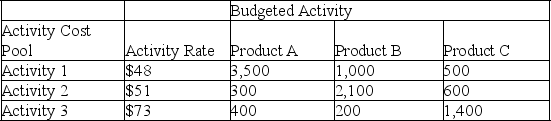 Compute the company's budgeted overhead cost for each of the three products under activity-based costing.
 (Essay)
4.9/5 (81)
(81) ABC is more costly to implement and maintain than more traditional overhead costing systems.
(True/False)
4.8/5 (77)
(77) A method of assigning overhead costs to a product using a single overhead rate is:
(Multiple Choice)
4.8/5 (80)
(80) A company's total expected overhead costs and related overhead data are shown below.
Department A Department B Direct labor hours 75,000 30,000 Machine hours 3,000 6,000 Manufacturing overhead costs ? ? Departmental overhead rate \ 2.40 per DLH \ 36 per MIH a. Compute estimated manufacturing overhead costs for Department A.
b. Compute estimated manufacturing overhead costs for Department B.
(Essay)
4.8/5 (76)
(76) [The following information applies to the questions displayed below.]
Tarnish Industries produces miniature models of farm equipment. These collectibles are in great demand. It takes two operations, molding and finishing, to complete the miniatures. Next year's expected activities are shown in the following table:
 -Tarnish Industries uses departmental overhead rates and is planning on a $2 per machine hour overhead rate for the molding department. Compute the estimated manufacturing overhead cost for the molding department given the information shown in the table.
 (Multiple Choice)
4.9/5 (83)
(83) Compared to the plantwide overhead rate method, the departmental overhead rate method usually results in more accurate overhead allocations.
(True/False)
5.0/5 (71)
(71) Gold Company uses a plantwide overhead rate with machine hours as the allocation base. Use the following information to solve for the amount of machine hours estimated per unit of product RST. 
(Multiple Choice)
4.9/5 (69)
(69) Two big benefits of ABC costing are a) more accurate product cost information and b) more detailed information on costs and the drivers of those costs.
(True/False)
4.9/5 (74)
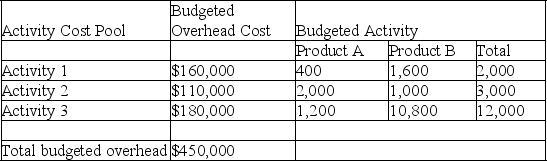
(74) A company has two products: A and B. It uses a plantwide overhead allocation method based on activity 2 and has prepared the following analysis showing budgeted costs and activities. Use this information to compute (a) the company's plantwide overhead rate and (b) the amount of overhead allocated to Product A.
(Essay)
4.8/5 (76)
(76) A company estimates that overhead costs for the next year will be $3,600,000 for indirect labor, $200,000 for factory utilities, and $21,500 for depreciation on factory machinery. The company uses machine hours as its overhead allocation base. If 764,300 machine hours are planned for this next year, what is the company's plantwide overhead rate?
(Essay)
4.8/5 (84)
(84) Aurora Corporation produces outdoor security lighting products. All products go through three processes before completion. Use the expected overhead costs and related data shown below to compute departmental overhead rates based on machine hours in Department A1A; based on direct labor hours in Department B2B; and machine hours in Department C3C. 
(Multiple Choice)
4.8/5 (77)
(77) ABC is significantly less costly to implement and maintain than more traditional overhead costing systems.
(True/False)
5.0/5 (71)
(71) A company identified the following partial list of activities, costs, and activity drivers expected for the next year: 
 How much overhead in total will be assigned to the Product A line using activity-based costing?
 (Multiple Choice)
4.9/5 (80)
(80) Data concerning volume-related measures are readily available in most manufacturing settings.
(True/False)
4.9/5 (76)
(76) The following data relates to Mangini Company's estimated amounts for next year. Estimated: Department 1 Department 2 Manufacturing overhead costs \ 320,000 \ 400,000 Direct labor hours 65,000 75,000 Machine hours 2,000 2,500 What is the company's plantwide overhead rate if machine hours are the allocation base? (Round your answer to two decimal places.)
(Multiple Choice)
4.9/5 (73)
(73) Allocated overhead ________ vary depending upon the allocation method used.
(Short Answer)
4.8/5 (77)
(77) [The following information applies to the questions displayed below.]
Tasty Bakery produces donuts which go through two operations, mixing and baking, before they are ready to be packaged. Next year's expected costs and activities are shown below.
Mixing Baking Direct labor hours 300,000 70,000 Machine hours 1,000,000 800,000 Overhead costs \ 500,000 \ 400,000
-Compute Tasty's departmental overhead rate for the mixing department based on machine hours.
(Multiple Choice)
4.9/5 (75)
(75) 
Filters
- Essay(0)
- Multiple Choice(0)
- Short Answer(0)
- True False(0)
- Matching(0)