



 Chat with AI
Exam 6: Efficiency and Fairness of Markets

Exam 1: Getting Started347 Questions
Exam 2: The Usand Global Economies211 Questions
Exam 3: The Economic Problem282 Questions
Exam 4: Demand and Supply334 Questions
Exam 5: Elasticities of Demand and Supply342 Questions
Exam 6: Efficiency and Fairness of Markets361 Questions
Exam 7: Government Actions in Markets335 Questions
Exam 8: Global Markets in Action281 Questions
Exam 9: Externalities: Pollution, education, and Health Care297 Questions
Exam 10: Production and Cost274 Questions
Exam 11: Perfect Competition285 Questions
Exam 12: Monopoly384 Questions
Exam 13: Monopolistic Competition and Oligopoly313 Questions
Exam 14: Gdp: a Measure of Total Production and Income263 Questions
Exam 15: Jobs and Unemployment293 Questions
Exam 16: The Cpi and the Cost of Living273 Questions
Exam 17: Potential Gdp and Economic Growth330 Questions
Exam 18: Money and the Monetary System370 Questions
Exam 19: Aggregate Supply and Aggregate Demand313 Questions
Exam 20: Fiscal Policy and Monetary Policy222 Questions
Select questions type


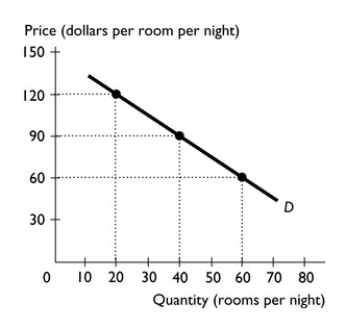 -The figure shows the demand curve for hotel rooms at a local resort.
a.If the hotel charges $120 per night,how many rooms will they rent?
b.If there are only 40 rooms available,how much are customers willing to pay for a room?
c.If 60 rooms are available,how much are customers willing to pay?
d.What do the dollars in your answer to part (c)represent?
-The figure shows the demand curve for hotel rooms at a local resort.
a.If the hotel charges $120 per night,how many rooms will they rent?
b.If there are only 40 rooms available,how much are customers willing to pay for a room?
c.If 60 rooms are available,how much are customers willing to pay?
d.What do the dollars in your answer to part (c)represent? (Essay)
4.9/5  (66)
(66) When the cost of producing a product is paid,at least in part,by someone other than the producer,the cost is referred to as
(Multiple Choice)
4.9/5 (82)
(82) Which of the following is true?
I.Production efficiency occurs only when resources are used to produce the combination of goods that has the greatest value.
Ii.Allocative efficiency occurs when marginal benefit equals marginal cost.
Iii.A demand curve is a marginal cost curve.
(Multiple Choice)
4.8/5 (78)
(78)  -The figure above shows the market for brooms.If 800 brooms are produced,
 (Multiple Choice)
5.0/5 (86)
(86) John has a marginal benefit of $7 for 1 slice of pizza,$5 for a second slice,$3 for a third slice,$1 for a fourth slice,and $0.50 for a fifth slice.The price of pizza is $1.50 per slice.Which of the following statements is correct?
(Multiple Choice)
4.9/5 (62)
(62) An unequal distribution of income is considered fair according to Robert Nozick if
(Multiple Choice)
4.9/5 (74)
(74) Which of the following is a correct description of the supply curve?
I.The supply curve is also the marginal cost curve.
Ii.The supply curve shows the dollars' worth of other goods that we must sacrifice to produce another unit of a good.
Iii.The supply curve shows the additional cost of producing another unit of a good.
(Multiple Choice)
4.8/5 (78)
(78) To determine how much of a good to produce to achieve allocative efficiency,we
(Multiple Choice)
4.9/5 (77)
(77)  -In the above figure,if the quantity is equal to 2,500,000 units,the deadweight loss is equal to
 (Multiple Choice)
4.8/5 (97)
(97) Lattes at Starbucks are allocated to individuals in society through what type of method?
(Multiple Choice)
5.0/5 (90)
(90) A cost not borne by the producer but borne by other people is known as ________ cost.
(Multiple Choice)
4.8/5 (85)
(85) When society must decrease the production of something in order to produce more of another good or service,society has necessarily achieved
(Multiple Choice)
4.8/5 (88)
(88) 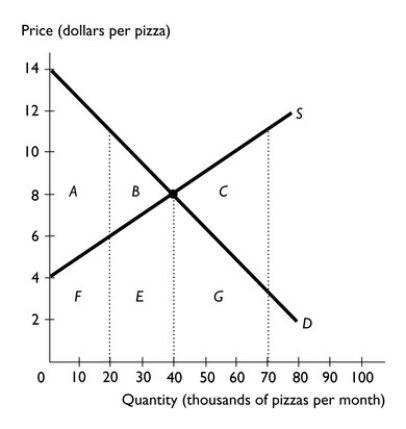 -The figure above shows the supply and demand for pizza.
a.What is the efficient level of output?
b.If 70,000 pizzas are produced,what area represents the deadweight loss?
c.Why does the deadweight loss in part (b)occur?
d.If 20,000 pizzas are produced,what area represents the deadweight loss?
e.Why does the deadweight loss in part (d)occur?
-The figure above shows the supply and demand for pizza.
a.What is the efficient level of output?
b.If 70,000 pizzas are produced,what area represents the deadweight loss?
c.Why does the deadweight loss in part (b)occur?
d.If 20,000 pizzas are produced,what area represents the deadweight loss?
e.Why does the deadweight loss in part (d)occur? (Essay)
4.8/5 (84)
(84) What must be true for a producer to obtain a producer surplus from the sale of a unit of a good?
(Essay)
4.9/5 (76)
(76) 
Filters
- Essay(0)
- Multiple Choice(0)
- Short Answer(0)
- True False(0)
- Matching(0)