



 Chat with AI
Exam 6: Atmosphere-Ocean-Cryosphere Interactions

Exam 1: The Nature of Physical Geography84 Questions
Exam 2: Energy and Matter in the Atmosphere81 Questions
Exam 3: Atmospheric Motion81 Questions
Exam 4: Atmospheric Moisture85 Questions
Exam 5: Weather Systems and Severe Weather83 Questions
Exam 6: Atmosphere-Ocean-Cryosphere Interactions93 Questions
Exam 7: Climates Around the World82 Questions
Exam 8: Water Resources83 Questions
Exam 9: Understanding Landscapes150 Questions
Exam 10: Plate Tectonics and Regional Features137 Questions
Exam 11: Volcanoes,deformation,and Earthquakes218 Questions
Exam 12: Weathering and Mass Wasting81 Questions
Exam 13: Streams and Flooding98 Questions
Exam 14: Glaciers and Glacial Landforms75 Questions
Exam 15: Coasts and Changing Sea Levels80 Questions
Exam 16: Soils90 Questions
Exam 17: Ecosystems and Biogeochemical Cycles90 Questions
Exam 18: Biomes85 Questions
Select questions type


Which of the following is NOT influenced by the Pacific Decadal Oscillation (PDO)?
(Multiple Choice)
4.7/5  (85)
(85) The air above this current is characterized by extremely strong pressure gradients and relative lack of land interruptions that induce extremely strong westerly winds.
(Multiple Choice)
4.9/5 (80)
(80) Which of the following locations is associated with a zone of upwelling for the Antarctic bottom waters (AABW)? 
(Multiple Choice)
4.9/5 (85)
(85) The thermocline would be expected to be closest to the surface off the western coast of south America during
(Multiple Choice)
4.8/5 (84)
(84) A positive phase of the Indian Ocean Dipole (IOD)results in warmer than average surface waters at ________ and cooler than average waters at ________. 
(Multiple Choice)
4.8/5 (89)
(89) Which of the following letters best represents a location where sinking air in a Walker cell is most typical? 
(Multiple Choice)
4.8/5 (76)
(76) During the warm phase of the El Niño,the ITC is drawn south and west of its normal position.This has the effect of
(Multiple Choice)
4.9/5 (87)
(87) In January,the Intertropical Convergence Zone is shifted to
(Multiple Choice)
5.0/5 (73)
(73) This image shows the hypothetical planet in the investigation for the ocean interactions chapter.What type of prevailing winds are most likely between the equator and 30° N? 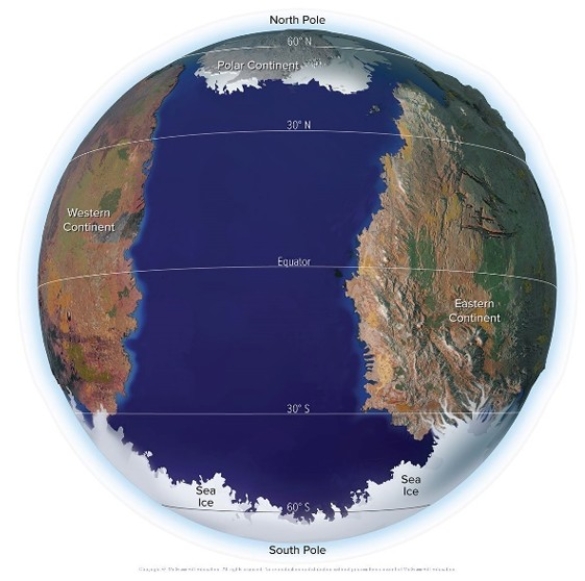
(Multiple Choice)
4.7/5 (69)
(69) Decreasing salinities and lower density,water near the equator is due to
(Multiple Choice)
4.9/5 (92)
(92) The El Niño begins to weaken and eventually terminates when
(Multiple Choice)
4.9/5 (82)
(82) A strong negative index for the North Atlantic Oscillation (NAO)usually means there is ________ of a pressure difference between the Bermuda (subtropical)High and the Icelandic Low pressure.This brings ________ than average temperatures over the northern U.S.and Northwest Europe.
(Multiple Choice)
4.7/5 (81)
(81) Which of the following locations would be characterized by warmer conditions than during an El Niño? 
(Multiple Choice)
4.8/5 (82)
(82) This image shows the hypothetical planet in the investigation for the ocean interactions chapter.Where is the most likely location of a warm pool? 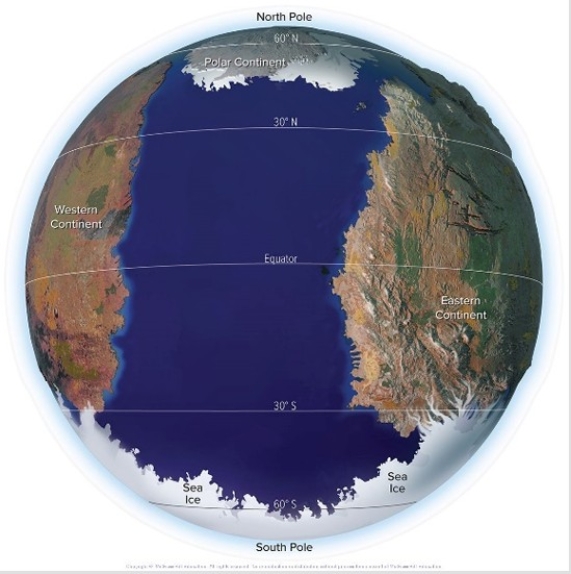
(Multiple Choice)
4.9/5 (79)
(79) Which of the following locations would be characterized by drier and warmer conditions during a La Niña? 
(Multiple Choice)
4.9/5 (71)
(71) El Niño would bring the warm pool and associated convective rainfall to 
(Multiple Choice)
5.0/5 (87)
(87) 
Filters
- Essay(0)
- Multiple Choice(0)
- Short Answer(0)
- True False(0)
- Matching(0)