



 Chat with AI
Exam 10: Plate Tectonics and Regional Features

Exam 1: The Nature of Physical Geography84 Questions
Exam 2: Energy and Matter in the Atmosphere81 Questions
Exam 3: Atmospheric Motion81 Questions
Exam 4: Atmospheric Moisture85 Questions
Exam 5: Weather Systems and Severe Weather83 Questions
Exam 6: Atmosphere-Ocean-Cryosphere Interactions93 Questions
Exam 7: Climates Around the World82 Questions
Exam 8: Water Resources83 Questions
Exam 9: Understanding Landscapes150 Questions
Exam 10: Plate Tectonics and Regional Features137 Questions
Exam 11: Volcanoes,deformation,and Earthquakes218 Questions
Exam 12: Weathering and Mass Wasting81 Questions
Exam 13: Streams and Flooding98 Questions
Exam 14: Glaciers and Glacial Landforms75 Questions
Exam 15: Coasts and Changing Sea Levels80 Questions
Exam 16: Soils90 Questions
Exam 17: Ecosystems and Biogeochemical Cycles90 Questions
Exam 18: Biomes85 Questions
Select questions type


In the diagram below,which layer(s)correspond to the mantle? 

Free
(Multiple Choice)
4.9/5  (75)
(75) Correct Answer: Verified
C
Use your knowledge of plate boundaries to answer whether an earthquake is likely or unlikely to occur at the location of the red circle. 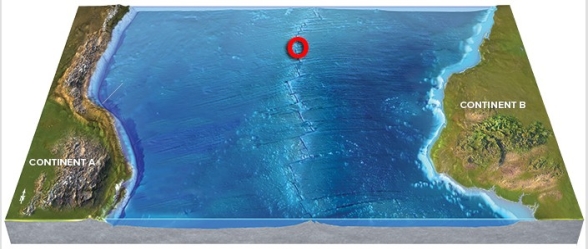
Free
(Multiple Choice)
4.8/5 (75)
(75) Correct Answer:Verified
VerifiedA
Which of the following regions below would you predict to have the thickest continental crust? 
Free
(Multiple Choice)
4.8/5 (76)
(76) Correct Answer:Verified
VerifiedB
Which of the following occurs when mountain belts are eroded?
(Multiple Choice)
4.9/5 (78)
(78) Which location on this figure from the Investigation is most likely to have volcanoes formed above a subduction zone? 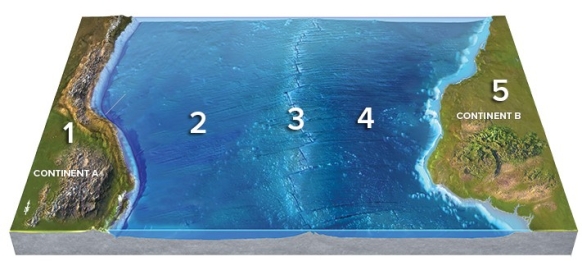
(Multiple Choice)
4.9/5 (86)
(86) On the accompanying figure,what type of feature is located in the area of letter D? 
(Multiple Choice)
4.9/5 (70)
(70) Which feature is interpreted to be in the Yellowstone region (1)? 
(Multiple Choice)
4.8/5 (87)
(87) Which areas on this world map are likely to be near a plate boundary? 
(Multiple Choice)
4.8/5 (88)
(88) The hypothesis of continental drift was not widely accepted because
(Multiple Choice)
4.9/5 (78)
(78) Which location on this figure from the Investigation is located on a passive continental margin? 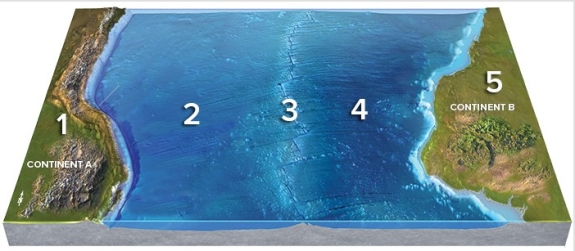
(Multiple Choice)
4.7/5 (78)
(78) The red dots that coincide with volcanically active island chains shown on the map are called 
(Multiple Choice)
4.8/5 (69)
(69) What do the island chains of Hawaii,Tahiti,and Tristan da Cunha have in common?
(Multiple Choice)
4.9/5 (71)
(71) In the diagram below,which layer is able to flow rather than being brittle? 
(Multiple Choice)
4.9/5 (82)
(82) On this map of South America,which features are not on a plate boundary? 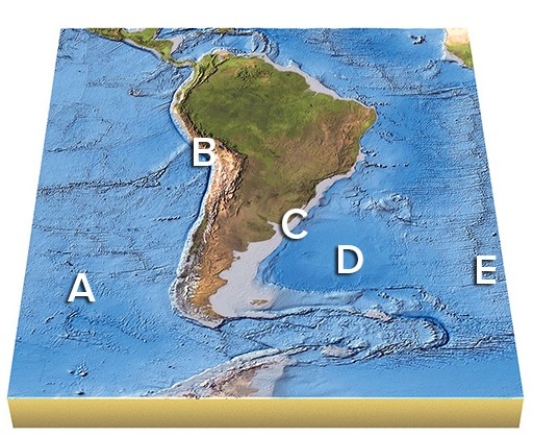
(Multiple Choice)
4.9/5 (84)
(84) A divergent plate boundary is most likely associated with a(n)
(Multiple Choice)
4.8/5 (73)
(73) Use your knowledge of plate boundaries to answer whether an earthquake is likely or unlikely to occur at the location of the red circle. 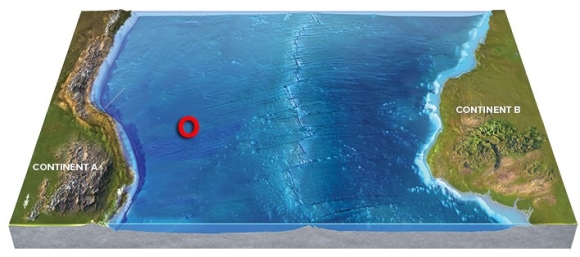
(Multiple Choice)
4.8/5 (85)
(85) Use your knowledge of plate boundaries to answer whether a volcano is likely or unlikely to form at the location of the red triangle. 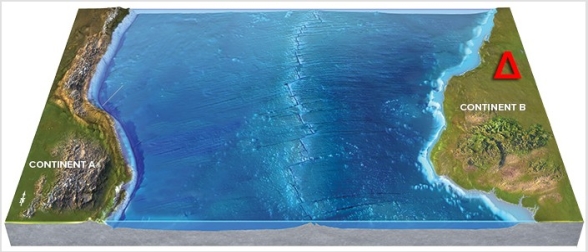
(Multiple Choice)
4.8/5 (85)
(85) 
Filters
- Essay(0)
- Multiple Choice(0)
- Short Answer(0)
- True False(0)
- Matching(0)