



 Chat with AI
Exam 11: College and University Accounting

Exam 1: Introduction to Accounting and Financial Reporting for Governmental and Not-For-Profit Organizations153 Questions
Exam 2: Overview of Financial Reporting for State and Local Governments145 Questions
Exam 3: Modified Accrual Accounting: Including the Role of Fund Balances and Budgetary Authority150 Questions
Exam 4: Accounting for the General and Special Revenue Funds134 Questions
Exam 5: Accounting for Other Governmental Fund Types: Capital Projects, Debt Service, and Permanent149 Questions
Exam 6: Proprietary Funds132 Questions
Exam 7: Fiduciary Funds, Interfund Transactions149 Questions
Exam 8: Government-Wide Statements: Capital Assets; Long-Term Debt160 Questions
Exam 9: Advanced Topics for State and Local Governments99 Questions
Exam 10: Accounting for Private Not-For-Profit Organizations164 Questions
Exam 11: College and University Accounting113 Questions
Exam 12: Accounting for Hospitals and Other Health Care Providers118 Questions
Exam 13: Auditing, Tax-exempt Organizations, and Evaluating Performance 170 Questions
Exam 14: Financial Reporting by the Federal Government92 Questions
Select questions type


Revenue for reimbursement grants may be recognized before expenditures take place, so long as the grant has been awarded.
(True/False)
4.7/5  (94)
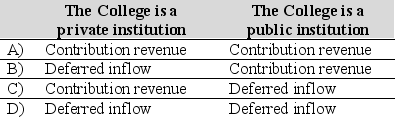
(94) In December 2016, a donor to a college established a trust in which college receives $ 500,000 to be invested. The college receives $ 4,000 of the income per year until the donor dies. At that point, the assets revert to the donor's estate. The college estimates that the present value of the anticipated receipts from the trust amount to $ 120,000. How should this $ 120,000 be recorded in 2016, assuming
(Short Answer)
4.8/5 (81)
(81) Private colleges and universities recognize contribution revenue in the year in which the unconditional pledge is made.
(True/False)
4.8/5 (92)
(92) Public higher education institutions that report as special-purpose entities engaged in business-type activities only are still required to prepare a Management's Discussion and Analysis.
(True/False)
4.8/5 (80)
(80) Private colleges and universities are required to report net assets within the categories of unrestricted, restricted and net investment in capital assets.
(True/False)
4.7/5 (77)
(77) Private colleges and universities are required to prepare a Management's Discussion and Analysis.
(True/False)
4.8/5 (75)
(75) Sam Smith died, leaving a will that provided that $1,000,000 be transferred to a private not-for-profit college. The college is to invest the funds for 10 years and give $40,000 each year to the granddaughter. At the end of the 10 years, the $1,000,000 can be used for any purpose desired by the college. Which of the following is true?
(Multiple Choice)
4.7/5 (63)
(63) Cash paid for interest is classified as an Operating activity in the Statement of Cash Flows for a public university.
(True/False)
4.8/5 (78)
(78) Which of the following is not true regarding the Statement of Revenues, Expenses and Changes in Net Position for a public college?
(Multiple Choice)
5.0/5 (76)
(76) Auxiliary enterprise activities represent revenues and expenses related to units of the college that provide services to students on a user fee basis.
(True/False)
4.8/5 (76)
(76) NACUBO guidelines require both revenues and expenses for split summer sessions to be apportioned to the two fiscal years.
(True/False)
4.9/5 (87)
(87) NACUBO has issued a position paper titled "Accounting and Reporting Scholarship Allowances to Tuition and Other Revenues by Higher Education" to address the issue of scholarship allowances. How are scholarships and allowances treated in the financial statements by colleges and universities?
(Essay)
4.8/5 (91)
(91) Match the Type of Entity with the Equity sections of the Balance Sheet/ Statement of Net Assets/Position Match the Letter and Number
Correct Answer: Verified
Premises:
Responses:
(Matching)
4.8/5 (82)
(82) Generally speaking, accounting standards for private colleges tend to recognize revenue when a split-interest agreement is created while accounting standards of public colleges defer recognition until it is realized.
(True/False)
4.9/5 (77)
(77) Which of the following statements is true regarding accounting and financial reporting for public colleges and universities?
(Multiple Choice)
4.8/5 (69)
(69) Which of the following would not be correct with respect to accounting for colleges and universities under the jurisdiction of the FASB?
(Multiple Choice)
4.8/5 (86)
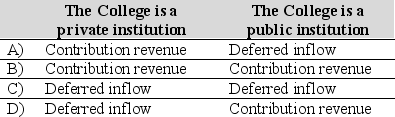
(86) In December 2016 a donor to a college established a trust in which college receives $ 5,000,000 to be invested. The donor's spouse is to receive $ 40,000 of the income per year for ten years. At that point, the assets and income revert to the college. The college estimates that the present value of the anticipated receipts from the trust amount to $ 4,800,000. How should this $ 4,800,000 be recorded in 2016, assuming
(Short Answer)
4.8/5 (58)
(58) Financial statements prepared for public colleges and universities present net position as: unrestricted, restricted, or net investment in capital assets.
(True/False)
4.7/5 (85)
(85) Scholarships tuition discounts) provided to students where no service is required:
(Multiple Choice)
4.9/5 (86)
(86) Public colleges and universities follow __________ guidelines while private colleges and universities follow ________ guidelines
(Multiple Choice)
4.8/5 (83)
(83) 
Filters
- Essay(0)
- Multiple Choice(0)
- Short Answer(0)
- True False(0)
- Matching(0)