



 Chat with AI
Exam 16: Statement of Cash Flows

Exam 1: Accounting in Business245 Questions
Exam 2: Analyzing and Recording Transactions201 Questions
Exam 3: Adjusting Accounts and Preparing Financial Statements227 Questions
Exam 4: Completing the Accounting Cycle177 Questions
Exam 5: Accounting for Merchandising Operations189 Questions
Exam 6: Inventories and Cost of Sales194 Questions
Exam 7: Accounting Information Systems166 Questions
Exam 8: Cash and Internal Controls195 Questions
Exam 9: Accounting for Receivables162 Questions
Exam 10: Long-Term Assets208 Questions
Exam 11: Current Liabilities and Payroll Accounting178 Questions
Exam 12: Accounting for Partnerships141 Questions
Exam 13: Accounting for Corporations210 Questions
Exam 14: Long-Term Liabilities158 Questions
Exam 15: Investments and International Operations156 Questions
Exam 16: Statement of Cash Flows173 Questions
Exam 17: Analysis of Financial Statements182 Questions
Exam 18: Managerial Accounting Concepts and Principles199 Questions
Exam 19: Job Order Cost Accounting165 Questions
Exam 20: Process Cost Accounting172 Questions
Exam 21: Cost Allocation and Performance Measurement173 Questions
Exam 22: Cost-Volume-Profit Analysis190 Questions
Exam 23: Master Budgets and Planning166 Questions
Exam 24: Flexible Budgets and Standard Costs178 Questions
Exam 25: Capital Budgeting and Managerial Decisions153 Questions
Select questions type


For each of the following separate cases, use the information provided to calculate the missing cash inflow or cash outflow using the direct method.
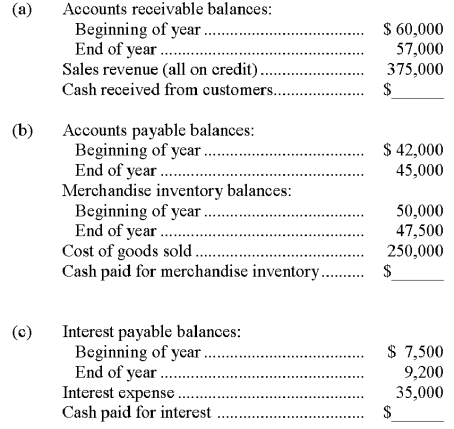
(Essay)
4.9/5  (91)
(91) Trenton reports tax-exempt income of $230,000 for the year ended December 31, Year 2. It also reports $87,700 depreciation expense and a $5,000 gain on the sale of equipment. Its comparative balance sheet reveals a $35,500 decrease in accounts receivable, a $15,750 increase in accounts payable, and a $12,500 decrease in wages payable. Calculate the new cash provided (used) in operating activities using the indirect method.
(Multiple Choice)
4.8/5 (79)
(79) Sebring Company reports depreciation expense of $40,000 for Year 2. Also, equipment costing $140,000 was sold for its carrying amount in Year 2. The following selected information is available for Sebring Company from its comparative balance sheets. Compute the cash received from the sale of the equipment.
(Multiple Choice)
4.9/5 (78)
(78) Since it is recommended by the IASB, the direct method of preparing the statement of cash flows is most frequently used.
(True/False)
4.9/5 (88)
(88) The cash flow on total assets ratio is computed by dividing _____________ by __________.
(Essay)
4.9/5 (82)
(82) The accounting principle that requires important noncash financing and investing activities be reported on the statement of cash flows or in a footnote is the:
(Multiple Choice)
4.8/5 (77)
(77) _____________ activities include the cash effects of transactions and events that determine net income.
(Essay)
4.9/5 (90)
(90) A corporation reported average total assets in Year 1 of $397,350 and $440,800 in Year 2. Its net operating cash flow for Year 1 was $35,667 and $35,790 for Year 2. Calculate the cash flow on total assets ratio for both years. Comment on the results.
(Essay)
4.9/5 (72)
(72) A company reported net income of $318,000, operating cash flows of $218,000, total cash flows of $184,000, and average total assets of $898,000. Calculate its cash flow on total assets ratio.
(Essay)
4.9/5 (78)
(78) Most managers stress the importance of understanding and predicting cash flows for business decisions.
(True/False)
4.9/5 (70)
(70) A cash coverage ratio of less than 1 indicates cash inadequacy to meet asset growth.
(True/False)
4.9/5 (78)
(78) 
Filters
- Essay(0)
- Multiple Choice(0)
- Short Answer(0)
- True False(0)
- Matching(0)