



 Chat with AI
Exam 23: Master Budgets and Planning

Exam 1: Accounting in Business245 Questions
Exam 2: Analyzing and Recording Transactions201 Questions
Exam 3: Adjusting Accounts and Preparing Financial Statements227 Questions
Exam 4: Completing the Accounting Cycle177 Questions
Exam 5: Accounting for Merchandising Operations189 Questions
Exam 6: Inventories and Cost of Sales194 Questions
Exam 7: Accounting Information Systems166 Questions
Exam 8: Cash and Internal Controls195 Questions
Exam 9: Accounting for Receivables162 Questions
Exam 10: Long-Term Assets208 Questions
Exam 11: Current Liabilities and Payroll Accounting178 Questions
Exam 12: Accounting for Partnerships141 Questions
Exam 13: Accounting for Corporations210 Questions
Exam 14: Long-Term Liabilities158 Questions
Exam 15: Investments and International Operations156 Questions
Exam 16: Statement of Cash Flows173 Questions
Exam 17: Analysis of Financial Statements182 Questions
Exam 18: Managerial Accounting Concepts and Principles199 Questions
Exam 19: Job Order Cost Accounting165 Questions
Exam 20: Process Cost Accounting172 Questions
Exam 21: Cost Allocation and Performance Measurement173 Questions
Exam 22: Cost-Volume-Profit Analysis190 Questions
Exam 23: Master Budgets and Planning166 Questions
Exam 24: Flexible Budgets and Standard Costs178 Questions
Exam 25: Capital Budgeting and Managerial Decisions153 Questions
Select questions type


Consulting the persons affected by a budget when it is prepared can provide an effective means of motivation and cooperation.
(True/False)
4.8/5  (84)
(84) Kent Company's May sales budget calls for sales of $900,000. The store expects to begin May with $50,000 of inventory and to end the month with $55,000 of inventory. Gross margin is typically 45% of sales. Compute the budgeted cost of merchandise purchases for May.
(Multiple Choice)
4.9/5 (86)
(86) A master budget refers to a company's sales budget that includes all of its segments or departments.
(True/False)
4.8/5 (82)
(82) Match the definitions 1 through 9 with the correct term or phrase a through i.
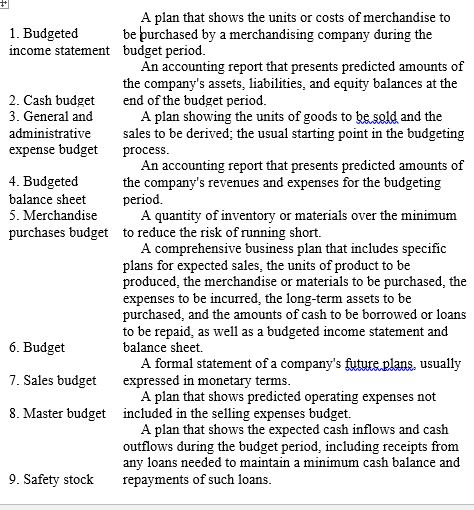
(Short Answer)
4.8/5 (71)
(71) Slim Corp. requires a minimum $8,000 cash balance. If necessary, loans are taken to meet this requirement at a cost of 1% interest per month (paid monthly). Loans are repaid at month's end from any excess cash. The cash balance on July 1 is $8,400. Cash receipts other than for loans received for July, August, and September are forecasted as $24,000, $32,000, and $40,000, respectively. Payments other than for loan or interest payments for the same period are planned at $28,000, $30,000, and $32,000, respectively at July 1, there are no outstanding loans.
Required: Prepare a cash budget for July, August, and September.
(Essay)
4.9/5 (92)
(92) A sporting goods store purchased $7,000 of ski boots in October. The store had $3,000 of ski boots in inventory at the beginning of October, and expects to have $2,000 of ski boots in inventory at the end of October to cover part of anticipated November sales. What is the budgeted cost of goods sold for October?
(Multiple Choice)
4.9/5 (93)
(93) There are three major subgroups of the master budget. These are _______________________, __________________, and ______________________.
(Essay)
4.8/5 (85)
(85) To determine the production budget for an accounting period, consideration is given to all of the following except:
(Multiple Choice)
4.7/5 (82)
(82) The selling expenses budget is normally prepared before the sales budget because selling expenses affect the amount of sales.
(True/False)
4.7/5 (79)
(79) Which of the following budgets is part of the manufacturing budget?
(Multiple Choice)
4.7/5 (83)
(83) The process of evaluating performance can be improved by using budgets.
(True/False)
4.8/5 (73)
(73) Cambridge, Inc., is preparing its master budget for the quarter ended June 30. It sells a single product for $40 each. Sales are 60% cash and 40% on credit. All credit sales are collected in the month following the sale. At March 31, the balance in accounts receivable is $12,000, which represents the uncollected balance on March sales. Budgeted sales for the next four months follow:
The product cost is $20 per unit, and desired ending inventory is 60% of the following month's sales in units. Inventory at March 31 is 480 units. Purchases are paid 50% in the month of purchase and 50% in the following month. At March 31, the balance in accounts payable is $11,000, which represents the unpaid purchases from March. Operating expenses are paid in the month incurred and consist of:
Commissions (10% of sales)
Shipping (3% of sales)
Office salaries ($3,000 per month)
Rent ($5,000 per month)
Depreciation is $2,000 per month. Income taxes are 40%, and will be paid on July 1. There are no taxes payable at March 31. A minimum cash balance of $12,000 is required, and the beginning cash balance is $12,000. Loans are obtained at the end of any month when a cash shortage occurs. Interest is 1% per month based on the beginning of the month loan balance and is paid at each month end. If an excess balance of cash exists, loans are repaid at the end of the month. At March 31, the loan balance is $2,000. Prepare a master budget (round all dollar amounts to the nearest whole dollar) for each of the months of April, May, and June that includes the:
Sales budget
Table of cash receipts
Merchandise purchases budget
Table of cash disbursements for purchases of merchandise
Table of cash disbursements for selling and administrative expenses
Cash budget, including information on the loan balance
Budgeted income statement

(Essay)
5.0/5 (87)
(87) Kent Company anticipates total sales for April, May, and June of $800,000, $900,000, and $950,000 respectively. Cash sales are normally 25% of total sales. Of the credit sales, 30% are collected in the same month as the sale, 65% are collected during the first month after the sale, and the remaining 5% are not collected. Compute the amount of cash received from total sales for June.
(Multiple Choice)
4.7/5 (73)
(73) The sales budget for Carmel shows that 20,000 units of Product A and 22,000 units of Product B are going to be sold for prices of $10 and $12, respectively. The desired ending inventory of Product A is 20% higher than its beginning inventory of 2,000 units. The beginning inventory of Product B is 2,500 units. The desired ending inventory of B is 3,000 units. Total budgeted sales of both products for the year would be:
(Multiple Choice)
4.8/5 (87)
(87) When preparing the cash budget, all the following should be considered except:
(Multiple Choice)
4.8/5 (93)
(93) Describe at least five benefits of budgeting.
Benefits of budgeting are:
(Essay)
4.9/5 (86)
(86) 
Filters
- Essay(0)
- Multiple Choice(0)
- Short Answer(0)
- True False(0)
- Matching(0)