



 Chat with AI
Exam 20: Aggregate Demand and Aggregate Supply

Exam 1: Ten Principles of Economics438 Questions
Exam 2: Thinking Like an Economist620 Questions
Exam 3: Interdependence and the Gains From Trade527 Questions
Exam 4: The Market Forces of Supply and Demand700 Questions
Exam 5: Elasticity and Its Application598 Questions
Exam 6: Supply, Demand, and Government Policies648 Questions
Exam 7: Consumers, Producers, and the Efficiency of Markets547 Questions
Exam 8: Application: the Costs of Taxation514 Questions
Exam 9: Application: International Trade496 Questions
Exam 10: Measuring a Nations Income522 Questions
Exam 11: Measuring the Cost of Living545 Questions
Exam 12: Production and Growth507 Questions
Exam 13: Saving, Investment, and the Financial System567 Questions
Exam 14: The Basic Tools of Finance513 Questions
Exam 15: Unemployment699 Questions
Exam 16: The Monetary System517 Questions
Exam 17: Money Growth and Inflation487 Questions
Exam 18: Open-Economy Macroeconomics: Basic Concepts522 Questions
Exam 19: A Macroeconomic Theory of the Open Economy484 Questions
Exam 20: Aggregate Demand and Aggregate Supply563 Questions
Exam 21: The Influence of Monetary and Fiscal Policy on Aggregate Demand511 Questions
Exam 22: The Short-Run Trade-Off Between Inflation and Unemployment516 Questions
Exam 23: Six Debates Over Macroeconomic Policy372 Questions
Select questions type


Suppose a shift in aggregate demand creates an economic contraction. If policymakers can respond with sufficient speed and precision, they can offset the initial shift by shifting
(Multiple Choice)
4.8/5  (74)
(74) Figure 33-5. 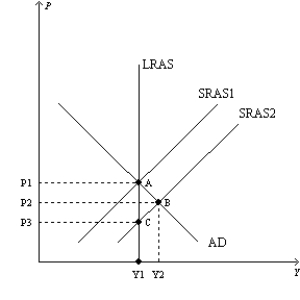 -Refer to Figure 33-5. The shift of the short-run aggregate-supply curve from SRAS1 to SRAS2
 (Multiple Choice)
4.8/5 (85)
(85) Which of the following alone can explain the change in the price level and output during World War II?
(Multiple Choice)
4.9/5 (78)
(78) The sticky-price theory of the short-run aggregate supply curve says that if the price level rises by 5% and people were expecting it to rise by 2%, then firms have
(Multiple Choice)
4.9/5 (69)
(69) Since the end of World War II, the U.S. has almost always had rising prices and an upward trend in real GDP. To explain this
(Multiple Choice)
4.7/5 (84)
(84) Keynes explained that recessions and depressions occur because of
(Multiple Choice)
4.9/5 (84)
(84) Which of the following shifts aggregate demand to the right?
(Multiple Choice)
4.8/5 (89)
(89) Refer to Political Instability Abroad. What would the change in the exchange rate make happen to U.S. net exports and U.S. aggregate demand?
(Multiple Choice)
4.8/5 (86)
(86) In 1936, John Maynard Keynes published a book, The General Theory, which attempted to explain
(Multiple Choice)
4.9/5 (77)
(77) Which of the following is a lesson concerning shifts in aggregate demand?
(Multiple Choice)
4.9/5 (78)
(78) If output is above its natural rate, then according to sticky-wage theory
(Multiple Choice)
4.7/5 (80)
(80) Suppose the economy is in long-run equilibrium. If there is a sharp decline in government purchases combined with a significant increase in immigration of skilled workers, then in the short run,
(Multiple Choice)
4.9/5 (86)
(86) An increase in the money supply causes output to rise in the long run.
(True/False)
4.8/5 (72)
(72) Other things the same, the aggregate quantity of output supplied will decrease if the price level
(Multiple Choice)
5.0/5 (75)
(75) If wages are sticky, then a greater than expected increase in the price level
(Multiple Choice)
4.8/5 (86)
(86) Which of the following would cause investment spending to decrease and aggregate demand to shift left?
(Multiple Choice)
5.0/5 (78)
(78) 
Filters
- Essay(0)
- Multiple Choice(0)
- Short Answer(0)
- True False(0)
- Matching(0)