



 Chat with AI
Exam 9: Application: International Trade

Exam 1: Ten Principles of Economics438 Questions
Exam 2: Thinking Like an Economist620 Questions
Exam 3: Interdependence and the Gains From Trade527 Questions
Exam 4: The Market Forces of Supply and Demand700 Questions
Exam 5: Elasticity and Its Application598 Questions
Exam 6: Supply, Demand, and Government Policies648 Questions
Exam 7: Consumers, Producers, and the Efficiency of Markets547 Questions
Exam 8: Application: the Costs of Taxation514 Questions
Exam 9: Application: International Trade496 Questions
Exam 10: Measuring a Nations Income522 Questions
Exam 11: Measuring the Cost of Living545 Questions
Exam 12: Production and Growth507 Questions
Exam 13: Saving, Investment, and the Financial System567 Questions
Exam 14: The Basic Tools of Finance513 Questions
Exam 15: Unemployment699 Questions
Exam 16: The Monetary System517 Questions
Exam 17: Money Growth and Inflation487 Questions
Exam 18: Open-Economy Macroeconomics: Basic Concepts522 Questions
Exam 19: A Macroeconomic Theory of the Open Economy484 Questions
Exam 20: Aggregate Demand and Aggregate Supply563 Questions
Exam 21: The Influence of Monetary and Fiscal Policy on Aggregate Demand511 Questions
Exam 22: The Short-Run Trade-Off Between Inflation and Unemployment516 Questions
Exam 23: Six Debates Over Macroeconomic Policy372 Questions
Select questions type


According to the principle of comparative advantage, all countries can benefit from trading with one another because trade allows each country to specialize in doing what it does best.
(True/False)
4.8/5  (96)
(96) A country has a comparative advantage in a product if the world price is than that country's domestic price without trade.
(Essay)
4.8/5 (81)
(81) Figure 9-6
The figure illustrates the market for roses in a country.  -Refer to Figure 9-6. The amount of deadweight loss caused by the tariff equals
 (Multiple Choice)
4.9/5 (77)
(77) When a nation first begins to trade with other countries and the nation becomes an importer of corn,
(Multiple Choice)
4.9/5 (80)
(80) "Trade raises the economic wellbeing of a nation in the sense that the gains of the winners exceed the losses of the losers." This statement is correct for a nation that exports manufactured goods, but it is not correct for a nation that imports manufactured goods.
(True/False)
4.9/5 (76)
(76) Figure 9-27
The following diagram shows the domestic demand and supply curves in a market. Assume that the world price in this market is $20 per unit.  -Refer to Figure 9-27. Suppose the country imposes a $5 per unit tariff. If the country allows trade with a tariff, how much is the deadweight loss caused by the tariff?
 (Essay)
4.9/5 (91)
(91) When, in our analysis of the gains and losses from international trade, we assume that a particular country is small, we are
(Multiple Choice)
4.8/5 (86)
(86) Scenario 9-2
• For a small country called Boxland, the equation of the domestic demand curve for cardboard is
 where

 represents the domestic quantity of cardboard demanded, in tons, and represents the price of a ton of cardboard.
• For Boxland, the equation of the domestic supply curve for cardboard is
 where

 represents the domestic quantity of cardboard supplied, in tons, and again represents the price of a ton of cardboard.
-Refer to Scenario 9-2. Suppose the world price of cardboard is $60. Then, relative to the no-trade situation, international trade in cardboard produces which of the following results for Boxland?
where
represents the domestic quantity of cardboard demanded, in tons, and represents the price of a ton of cardboard.
• For Boxland, the equation of the domestic supply curve for cardboard is
where
represents the domestic quantity of cardboard supplied, in tons, and again represents the price of a ton of cardboard.
-Refer to Scenario 9-2. Suppose the world price of cardboard is $60. Then, relative to the no-trade situation, international trade in cardboard produces which of the following results for Boxland? (Multiple Choice)
4.8/5 (92)
(92) Figure 9-17  -Refer to Figure 9-17. When the country moves from free trade to trade and a tariff, consumer surplus
 (Multiple Choice)
4.9/5 (78)
(78) Figure 9-29
The following diagram shows the domestic demand and domestic supply curves in a market. Assume that the world price in this market is $1 per unit.  -Refer to Figure 9-29. Suppose the country imposes a $1 per unit tariff. If the country allows trade with a tariff, how much is the deadweight loss caused by the tariff?
 (Essay)
4.7/5 (79)
(79) Denmark is an importer of computer chips and adds a $5 per chip tariff to the world price of $12 per chip. Suppose Denmark removes the tariff. Which of the following outcomes is not possible?
(Multiple Choice)
4.9/5 (83)
(83) Figure 9-2
The figure illustrates the market for calculators in a country.  -Refer to Figure 9-2. If this country chooses to trade, the price of calculators in this country will be
 (Multiple Choice)
4.9/5 (89)
(89) Figure 9-1
The figure illustrates the market for coffee in Guatemala. 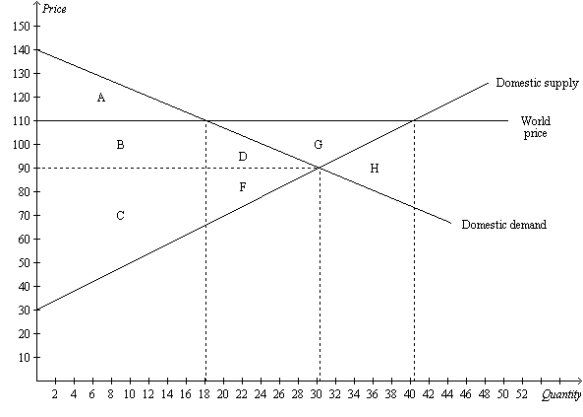 -Refer to Figure 9-1. Relative to the no-trade situation, trade with the rest of the world results in
 (Multiple Choice)
4.8/5 (79)
(79) Import quotas and tariffs produce similar results. Which of the following is not one of those results?
(Multiple Choice)
4.9/5 (61)
(61) When a nation first begins to trade with other countries and the nation becomes an exporter of soybeans,
(Multiple Choice)
4.7/5 (85)
(85) Assume, for Vietnam, that the domestic price of textiles without international trade is higher than the world price of textiles. This suggests that, in the production of textiles,
(Multiple Choice)
4.8/5 (82)
(82) When a certain nation abandoned a policy of prohibiting international trade in automobiles in favor of a free-tree policy, the result was that the country began to import automobiles. The change in policy improved the well-being of that nation in the sense that
(Multiple Choice)
4.8/5 (80)
(80) Figure 9-21
The following diagram shows the domestic demand and domestic supply for a market. In addition, assume that the world price in this market is $40 per unit.  -Refer to Figure 9-21. Producer surplus with free trade is
 (Multiple Choice)
4.9/5 (64)
(64) Figure 9-16. The figure below illustrates a tariff. On the graph, Q represents quantity and P represents price.  -Refer to Figure 9-16. The tariff
 (Multiple Choice)
4.9/5 (82)
(82) 
Filters
- Essay(0)
- Multiple Choice(0)
- Short Answer(0)
- True False(0)
- Matching(0)