



 Chat with AI
Exam 9: Reporting and Interpreting Liabilities

Exam 1: Financial Statements and Business Decisions130 Questions
Exam 2: Investing and Financing Decisions and the Accounting System139 Questions
Exam 3: Operating Decisions and the Accounting System128 Questions
Exam 4: Adjustments, Financial Statements, and the Quality of Earnings138 Questions
Exam 5: Communicating and Interpreting Accounting Information119 Questions
Exam 6: Reporting and Interpreting Sales Revenue, Receivables, and Cash130 Questions
Exam 7: Reporting and Interpreting Cost of Goods Sold and Inventory137 Questions
Exam 8: Reporting and Interpreting Property, Plant, and Equipment; Intangibles; and Natural Resources131 Questions
Exam 9: Reporting and Interpreting Liabilities129 Questions
Exam 10: Reporting and Interpreting Bond Securities128 Questions
Exam 11: Reporting and Interpreting Stockholders Equity133 Questions
Exam 12: Statement of Cash Flows121 Questions
Exam 13: Analyzing Financial Statements125 Questions
Exam 14: PPA: Reporting and Interpreting Investments in Other Corporations115 Questions
Select questions type


When a liability is initially recorded, it is recorded at the future amount of all payments.
(True/False)
4.8/5  (74)
(74) Long-term liabilities are reported on the balance sheet at an amount equal to the future cash flows.
(True/False)
4.7/5 (78)
(78) Moore Company has the following partial list of account balances at year-end December 31, 2016: 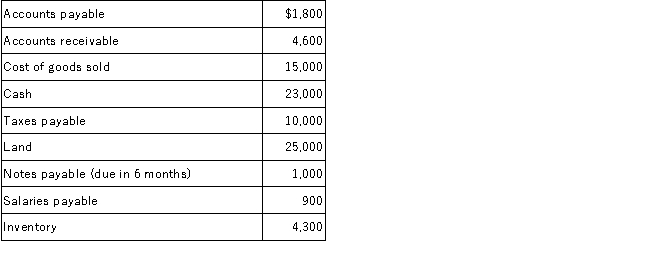 Additional information: The accounts payable balance at the end of the prior year was $3,000.
Required:
(All answers are for December 31, 2016.)
A.Determine the following items:
1.Current assets
2.Current liabilities
3.Working capital
4.Accounts payable turnover ratio
5.Average age of accounts payable
B.Assume that cash is used at December 31, 2016, to pay the entire balance of accounts payable.Determine the revised amounts from part (A) above for the following items:
1.Current assets
2.Current liabilities
3.Working capital
4.Accounts payable turnover ratio
5.Average age of accounts payable
C.Comment on the effect of paying accounts payable at year-end with regard to working capital and accounts payable management.
Additional information: The accounts payable balance at the end of the prior year was $3,000.
Required:
(All answers are for December 31, 2016.)
A.Determine the following items:
1.Current assets
2.Current liabilities
3.Working capital
4.Accounts payable turnover ratio
5.Average age of accounts payable
B.Assume that cash is used at December 31, 2016, to pay the entire balance of accounts payable.Determine the revised amounts from part (A) above for the following items:
1.Current assets
2.Current liabilities
3.Working capital
4.Accounts payable turnover ratio
5.Average age of accounts payable
C.Comment on the effect of paying accounts payable at year-end with regard to working capital and accounts payable management. (Essay)
4.8/5 (76)
(76) SRJ Corporation entered into the following transactions: • The accrual of interest expense on a six-month note payable.
• Collected cash for services to be provided within the next six months.
• The reclassification of short-term debt to long-term debt.
Which of the transactions for SRJ Corporation resulted in a decrease in working capital?
(Multiple Choice)
4.8/5 (92)
(92) An employee has an obligation to pay his payroll taxes to the employer.
(True/False)
4.9/5 (89)
(89) A current liability is created when a customer pays cash for services to be provided in the future.
(True/False)
4.9/5 (72)
(72) A loan supported by an agreement to transfer ownership of assets if the loan is not repaid is called a:
(Multiple Choice)
4.9/5 (100)
(100) Rudy Corporation is looking to purchase a building costing $500,000 by paying $100,000 cash on the purchase date, and agreeing to make annual payments for the next ten years. The first payment is due one year after the purchase date. Rudy's incremental borrowing rate is 10%. Each of the annual payments is closest to:
(Multiple Choice)
4.8/5 (80)
(80) A company's income statement reported net income of $80,000 during 2016. The income tax return excluded a revenue item of $10,000 (reported on the income statement) because under the tax laws the $10,000 would not be reported for tax purposes until 2017.
Required:
Prepare the journal entry to record the 2016 income tax expense assuming a 40% tax rate.
(Essay)
4.8/5 (79)
(79) Smith Corporation entered into the following transactions: • Purchased inventory on account.
• Collected an account receivable.
• Purchased equipment using cash.
Which of the transactions for Smith Corporation resulted in an increase in working capital?
(Multiple Choice)
4.9/5 (81)
(81) Libby Company purchased equipment by paying $5,000 cash on the purchase date and agreeing to pay $5,000 every six months during the next four years. The first payment is due six months after the purchase date. Libby's incremental borrowing rate is 8%. The liability reported on the balance sheet as of the purchase date, after the initial $5,000 payment was made, is closest to:
(Multiple Choice)
4.8/5 (75)
(75) Mission Corp. borrowed $50,000 cash on April 1, 2016, and signed a one-year 12%, interest-bearing note payable. The interest and principal are both due on March 31, 2017. What is the amount to be paid to the bank on March 31, 2017 for interest and principal?
(Multiple Choice)
4.9/5 (82)
(82) For the present value of a single amount, the compounding period may only be once a year.
(True/False)
4.9/5 (65)
(65) With regard to reporting contingent liabilities on a balance sheet, financial statements prepared under International Financial Reporting Standards (IFRS) will:
(Multiple Choice)
4.9/5 (89)
(89) Rae Company purchased a new vehicle by paying $10,000 cash on the purchase date and agreeing to pay $3,000 every three months during the next five years. The first payment is due three months after the purchase date. Rae's incremental borrowing rate is 12%. The vehicle reported on the balance sheet as of the purchase date is closest to:
(Multiple Choice)
4.7/5 (68)
(68) Smith Corporation entered into the following transactions: • Purchased inventory on account.
• Collected an account receivable.
• Purchased equipment using cash.
Which of the following statements about Smith's transactions is correct?
(Multiple Choice)
5.0/5 (86)
(86) Landseeker's Restaurants reported cost of goods sold of $322 million and accounts payable of $84 million for 2017. In 2016, cost of goods sold was $258 million and accounts payable was $72 million. Landseeker's accounts payable turnover ratio in 2017 is closest to:
(Multiple Choice)
4.8/5 (88)
(88) When a company has debt coming due and wants to refinance and classify the debt as a long-term liability rather than paying for it currently with cash:
(Multiple Choice)
4.9/5 (75)
(75) 
Filters
- Essay(0)
- Multiple Choice(0)
- Short Answer(0)
- True False(0)
- Matching(0)