



 Chat with AI
Exam 5: Accounting for Merchandising Operations

Exam 1: Accounting in Business240 Questions
Exam 2: Analyzing and Recording Transactions197 Questions
Exam 3: Adjusting Accounts and Preparing Financial Statements224 Questions
Exam 4: Completing the Accounting Cycle176 Questions
Exam 5: Accounting for Merchandising Operations198 Questions
Exam 6: Inventories and Cost of Sales198 Questions
Exam 7: Accounting Information Systems176 Questions
Exam 8: Cash and Internal Controls196 Questions
Exam 9: Accounting for Receivables191 Questions
Exam 10: Plant Assets, Natural Resources, and Intangibles223 Questions
Exam 11: Current Liabilities and Payroll Accounting193 Questions
Exam 12: Accounting for Partnerships139 Questions
Exam 13: Accounting for Corporations246 Questions
Exam 14: Long-Term Liabilities198 Questions
Exam 15: Investments and International Operations192 Questions
Exam 16: Reporting the Statement of Cash Flows187 Questions
Exam 17: Analysis of Financial Statements187 Questions
Exam 18: Managerial Accounting Concepts and Principles197 Questions
Exam 19: Job Order Cost Accounting164 Questions
Exam 20: Process Cost Accounting174 Questions
Exam 21: Cost Allocation and Performance Measurement170 Questions
Exam 22: Cost-Volume-Profit Analysis186 Questions
Exam 23: Master Budgets and Planning162 Questions
Exam 24: Flexible Budgets and Standard Costs174 Questions
Exam 25: Capital Budgeting and Managerial Decisions150 Questions
Exam 26: Time Value of Money60 Questions
Select questions type


On October 1, Courtland Company sold merchandise in the amount of $5,800 to Carter Company, with credit terms of 2/10, n/30. The cost of the items sold is $4,000. Courtland uses the periodic inventory system. On October 4, Carter returns some of the merchandise. The selling price of the merchandise is $500 and the cost of the merchandise returned is $350. Carter pays the invoice on October 8, and takes the appropriate discount. The journal entry that Courtland makes on October 8 is: 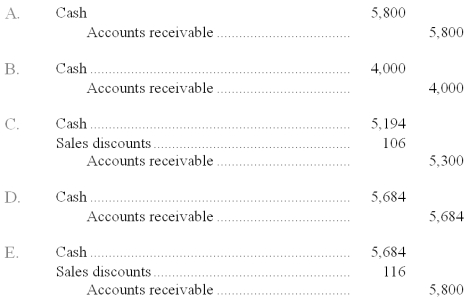
(Multiple Choice)
4.7/5  (78)
(78) Expenses of promoting sales by displaying and advertising merchandise, making sales, and delivering goods to customers are:
(Multiple Choice)
4.8/5 (88)
(88) When a company has no reportable nonoperating activities, its income from operations is simply labeled net income.
(True/False)
4.9/5 (79)
(79) Operating expenses are classified into two categories: selling expenses and cost of goods sold.
(True/False)
4.9/5 (83)
(83) Brig Company had $800,000 in sales, sales discounts of $12,000, sales returns and allowances of $18,000, cost of goods sold of $380,000, and $275,000 in operating expenses. Net income equals:
(Multiple Choice)
4.9/5 (78)
(78) Brig Company had $800,000 in sales, sales discounts of $12,000, sales returns and allowances of $18,000, cost of goods sold of $380,000, and $275,000 in operating expenses. Gross profit equals:
(Multiple Choice)
4.9/5 (80)
(80) A company uses the perpetual inventory system and recorded the following entry  This entry reflects a:
 (Multiple Choice)
4.7/5 (81)
(81) Under the perpetual inventory system, the cost of merchandise purchased is recorded in the Merchandise Inventory account.
(True/False)
4.8/5 (73)
(73) A wholesaler is an intermediary that buys products from manufacturers or other wholesalers and sells them to consumers.
(True/False)
4.8/5 (75)
(75) A journal entry with a debit to cash of $980, a debit to Sales Discounts of $20, and a credit to Accounts Receivable of $1,000 means that a customer has taken a 10% cash discount for early payment.
$20/$1,000 = 2% discount
(True/False)
4.9/5 (78)
(78) Maia's Bike Shop uses the perpetual inventory system and had the following transactions during the month of May: 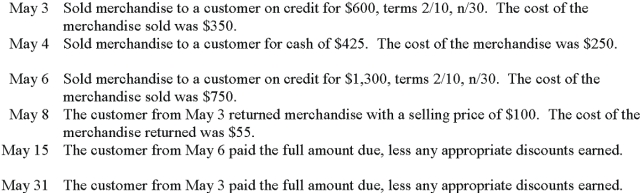 Prepare the required journal entries that Maia's Bike Shop must make to record these transactions.
 (Not Answered)
This question doesn't have any answer yet
Shock Company purchased merchandise from Mee Company with an invoice price of $300,000 and credit terms of 2/10, n/30. The merchandise had cost Mee Company $200,000. Shock Company paid within the discount period. Assume that both buyer and seller use a perpetual inventory system.
1. Prepare entries that the buyer should record for (a) the purchase and (b) the cash payment.
2. Prepare entries that the seller should record for (a) the sale and (b) the cash collection.
3. Assume that the buyer borrowed enough cash to pay the balance on the last day of the discount period at an annual interest rate of 9% and paid it back on the last day of the credit period. Compute how much the buyer saved by following this strategy. (Assume a 365-day year and round dollar amounts to the nearest cent.)
(Not Answered)
This question doesn't have any answer yet
A retailer is an intermediary that buys products from manufacturers and sells them to wholesalers.
(True/False)
4.7/5 (78)
(78) The following information is available for Trico and its two main competitors in the industry (Duco and Unico): 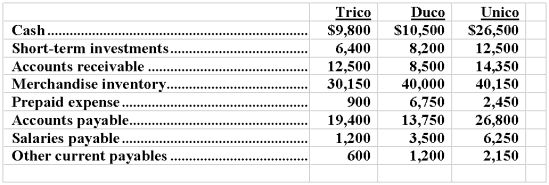 The industry standard for the current ratio is 1.8 and the industry standard for the acid-test ratio is 1.
Required:
1. Calculate the current ratio and acid-test ratio for each firm.
2. Rank the firms in decreasing order of liquidity.
3. Comment on Trico's relative liquidity position.
The industry standard for the current ratio is 1.8 and the industry standard for the acid-test ratio is 1.
Required:
1. Calculate the current ratio and acid-test ratio for each firm.
2. Rank the firms in decreasing order of liquidity.
3. Comment on Trico's relative liquidity position. (Not Answered)
This question doesn't have any answer yet
___________ expenses are those expenses that support a company's overall operations and include expenses related to accounting, human resource management, and financial management.
(Short Answer)
4.7/5 (78)
(78) A perpetual inventory system is able to directly measure and monitor inventory shrinkage and there is no need for a physical count of inventory.
(True/False)
4.9/5 (77)
(77) If a company sells merchandise with credit terms 2/10 n/60, the credit period is 10 days and the discount period is 60 days.
(True/False)
4.9/5 (68)
(68) 
Filters
- Essay(0)
- Multiple Choice(0)
- Short Answer(0)
- True False(0)
- Matching(0)