



 Chat with AI
Exam 5: Accounting for Merchandising Operations

Exam 1: Accounting in Business240 Questions
Exam 2: Analyzing and Recording Transactions197 Questions
Exam 3: Adjusting Accounts and Preparing Financial Statements224 Questions
Exam 4: Completing the Accounting Cycle176 Questions
Exam 5: Accounting for Merchandising Operations198 Questions
Exam 6: Inventories and Cost of Sales198 Questions
Exam 7: Accounting Information Systems176 Questions
Exam 8: Cash and Internal Controls196 Questions
Exam 9: Accounting for Receivables191 Questions
Exam 10: Plant Assets, Natural Resources, and Intangibles223 Questions
Exam 11: Current Liabilities and Payroll Accounting193 Questions
Exam 12: Accounting for Partnerships139 Questions
Exam 13: Accounting for Corporations246 Questions
Exam 14: Long-Term Liabilities198 Questions
Exam 15: Investments and International Operations192 Questions
Exam 16: Reporting the Statement of Cash Flows187 Questions
Exam 17: Analysis of Financial Statements187 Questions
Exam 18: Managerial Accounting Concepts and Principles197 Questions
Exam 19: Job Order Cost Accounting164 Questions
Exam 20: Process Cost Accounting174 Questions
Exam 21: Cost Allocation and Performance Measurement170 Questions
Exam 22: Cost-Volume-Profit Analysis186 Questions
Exam 23: Master Budgets and Planning162 Questions
Exam 24: Flexible Budgets and Standard Costs174 Questions
Exam 25: Capital Budgeting and Managerial Decisions150 Questions
Exam 26: Time Value of Money60 Questions
Select questions type


When preparing an unadjusted trial balance using a periodic inventory system, the amount shown for Merchandise Inventory is:
(Multiple Choice)
4.9/5  (84)
(84) Sales of $350,000 and net sales of $323,000 could reflect sales discounts of $27,000.
$350,000 - $323,000 = $27,000
(True/False)
4.9/5 (65)
(65) A merchandising company's operating cycle begins with the sale of merchandise and ends with the collection of cash from the sale.
(True/False)
4.8/5 (86)
(86) Describe the difference between wholesalers and retailers.
(Not Answered)
This question doesn't have any answer yet
When a company has no reportable nonoperating activities, its income from operations is reported as ___________________.
(Short Answer)
4.8/5 (82)
(82) Purchase returns refer to merchandise a buyer acquires but then returns to the seller.
(True/False)
4.8/5 (87)
(87) Liquidity problems are likely to exist when a company's acid-test ratio:
(Multiple Choice)
4.7/5 (89)
(89) A company has net sales and cost of goods sold of $825,000 and $547,000, respectively. Its net income is $98,500. The company's gross margin and operating expenses are ________ and ___________, respectively.
(Multiple Choice)
4.9/5 (77)
(77) The amounts and timing of payment from a buyer to a seller are the ___________________.
(Short Answer)
4.8/5 (75)
(75) On October 1, Courtland Company sold merchandise in the amount of $5,800 to Carter Company, with credit terms of 2/10, n/30. The cost of the items sold is $4,000. Courtland uses the periodic inventory system. On October 4, Carter returns some of the merchandise. The selling price of the merchandise is $500 and the cost of the merchandise returned is $350. The entry or entries that Courtland must make on October 4 is: 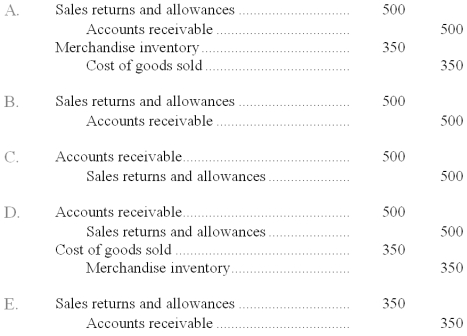
(Multiple Choice)
4.8/5 (78)
(78) Beginning inventory plus the net cost of purchases is the ____________________.
(Short Answer)
4.7/5 (93)
(93) The acid-test ratio differs from the current ratio in that:
(Multiple Choice)
5.0/5 (80)
(80) A company's current ratio is 1.2 and its quick ratio is 0.25. This company is probably an excellent credit risk because the ratios reveal no indication of liquidity problems.
(True/False)
4.8/5 (89)
(89) A company had sales of $375,000 and its gross profit was $157,500. Its cost of goods sold equals:
(Multiple Choice)
4.9/5 (68)
(68) The following statements regarding gross profit are true except:
(Multiple Choice)
4.9/5 (89)
(89) A ___________ inventory system updates the accounting record for inventory only at the end of a period.
(Short Answer)
4.8/5 (88)
(88) FOB shipping point (or FOB factory) implies that ownership of goods transfers to the buyer at the buyer's place of business.
(True/False)
4.7/5 (72)
(72) A company purchased $1,800 of merchandise on December 5. On December 7, it returned $200 worth of merchandise. On December 8, it paid the balance in full, taking a 2% discount. The amount of the cash paid on December 8 equals:
(Multiple Choice)
5.0/5 (72)
(72) 
Filters
- Essay(0)
- Multiple Choice(0)
- Short Answer(0)
- True False(0)
- Matching(0)