



 Chat with AI
Exam 9: Accounting for Receivables

Exam 1: Accounting in Business240 Questions
Exam 2: Analyzing and Recording Transactions197 Questions
Exam 3: Adjusting Accounts and Preparing Financial Statements224 Questions
Exam 4: Completing the Accounting Cycle176 Questions
Exam 5: Accounting for Merchandising Operations198 Questions
Exam 6: Inventories and Cost of Sales198 Questions
Exam 7: Accounting Information Systems176 Questions
Exam 8: Cash and Internal Controls196 Questions
Exam 9: Accounting for Receivables191 Questions
Exam 10: Plant Assets, Natural Resources, and Intangibles223 Questions
Exam 11: Current Liabilities and Payroll Accounting193 Questions
Exam 12: Accounting for Partnerships139 Questions
Exam 13: Accounting for Corporations246 Questions
Exam 14: Long-Term Liabilities198 Questions
Exam 15: Investments and International Operations192 Questions
Exam 16: Reporting the Statement of Cash Flows187 Questions
Exam 17: Analysis of Financial Statements187 Questions
Exam 18: Managerial Accounting Concepts and Principles197 Questions
Exam 19: Job Order Cost Accounting164 Questions
Exam 20: Process Cost Accounting174 Questions
Exam 21: Cost Allocation and Performance Measurement170 Questions
Exam 22: Cost-Volume-Profit Analysis186 Questions
Exam 23: Master Budgets and Planning162 Questions
Exam 24: Flexible Budgets and Standard Costs174 Questions
Exam 25: Capital Budgeting and Managerial Decisions150 Questions
Exam 26: Time Value of Money60 Questions
Select questions type


The direct write-off method of accounting for bad debts records the loss from an uncollectible account receivable when it is determined to be uncollectible.
(True/False)
4.8/5  (83)
(83) Teller purchased merchandise from TechCom on October 17 of the current year and TechCom accepted Teller's $4,800, 90-day, 10% note. What entry should TechCom make on January 15 of the next year when the note is paid?
(Multiple Choice)
4.9/5 (73)
(73) The formula for computing interest on a note is principal of the note times the annual interest rate times time expressed in fraction of year.
(True/False)
4.8/5 (79)
(79) The Connecting Company uses the percent of sales method of accounting for uncollectible accounts receivable. During the current year, the following transactions occurred: 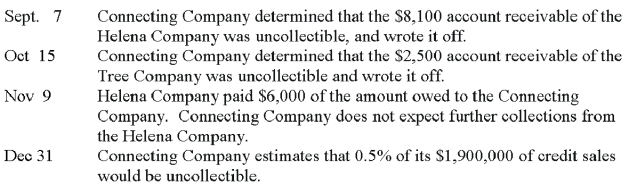 1. Prepare the general journal entries to record these transactions.
2. If the balance of the allowance for uncollectible accounts was $8,000 on January 1 of the current year, determine the balance of the allowance for uncollectible accounts at December 31 of the current year. Assume that the transactions above are the only transactions affecting the allowance for uncollectible accounts during the year.
1. Prepare the general journal entries to record these transactions.
2. If the balance of the allowance for uncollectible accounts was $8,000 on January 1 of the current year, determine the balance of the allowance for uncollectible accounts at December 31 of the current year. Assume that the transactions above are the only transactions affecting the allowance for uncollectible accounts during the year. (Not Answered)
This question doesn't have any answer yet
Tecom had net sales of $315,000 and average accounts receivable of $75,600. Its competitor, ZCom, had net sales of $299,000 and average accounts receivables of $81,350. Calculate the accounts receivable turnover for both companies. Which company is doing a better job of managing its accounts receivables?
(Not Answered)
This question doesn't have any answer yet
The materiality constraint permits the use of the direct write-off method of accounting for uncollectible accounts when bad debts are very large in relation to a company's other financial statement items such as sales and net income.
(True/False)
4.9/5 (79)
(79) A dishonored note receivable is usually reclassified as an account receivable.
(True/False)
4.8/5 (80)
(80) If a 90-day note receivable is dated June 12, what is the maturity date of the note?
(Not Answered)
This question doesn't have any answer yet
When a company holds a large number of notes receivable it sometimes sets up a controlling account and a subsidiary ledger for notes.
(True/False)
4.9/5 (82)
(82) A company had the following items and amounts in its unadjusted trial balance as of December 31 of the current year:
(Essay)
4.9/5 (84)
(84) The advantage of the allowance method of accounting for bad debts is that it identifies the specific customers who will not pay their bills.
(True/False)
4.7/5 (61)
(61) When using the allowance method of accounting for uncollectible accounts, the entry to write off Harold's uncollectible account is a debit to Allowance for Doubtful Accounts and a credit to Accounts Receivable - Harold.
(True/False)
4.7/5 (76)
(76) Darby uses the allowance method to account for uncollectible accounts. Its year-end unadjusted trial balance shows Accounts Receivable of $104,500, allowance for doubtful accounts of $665 (credit) and sales of $925,000. If uncollectible accounts are estimated to be .5% of sales, what is the amount of the bad debts expense adjusting entry?
(Multiple Choice)
4.8/5 (98)
(98) A promissory note received from a customer in exchange for an account receivable:
(Multiple Choice)
4.8/5 (83)
(83) Companies follow both the matching principle and the materiality constraint when applying the direct write-off method.
(True/False)
4.8/5 (98)
(98) Explain the basic difference between estimating the amount of uncollectible accounts using the percent of sales method and the accounts receivable method.
(Essay)
4.9/5 (85)
(85) Receivables can be used to obtain cash by either selling them or using them as security for a loan.
(True/False)
4.7/5 (83)
(83) On August 9, Pierce Company receives a $8,500, 90-day, 8% note from customer Eric Simms as payment on his account. Compute the maturity date for the note.
(Multiple Choice)
4.7/5 (85)
(85) TechCom's customer, RDA, paid off an $8,300 balance on its account receivable. TechCom should record the transaction as a debit to Accounts Receivable-RDA and a credit to Cash.
(True/False)
4.9/5 (93)
(93) 
Filters
- Essay(0)
- Multiple Choice(0)
- Short Answer(0)
- True False(0)
- Matching(0)