



 Chat with AI
Exam 9: Accounting for Receivables

Exam 1: Accounting in Business240 Questions
Exam 2: Analyzing and Recording Transactions197 Questions
Exam 3: Adjusting Accounts and Preparing Financial Statements224 Questions
Exam 4: Completing the Accounting Cycle176 Questions
Exam 5: Accounting for Merchandising Operations198 Questions
Exam 6: Inventories and Cost of Sales198 Questions
Exam 7: Accounting Information Systems176 Questions
Exam 8: Cash and Internal Controls196 Questions
Exam 9: Accounting for Receivables191 Questions
Exam 10: Plant Assets, Natural Resources, and Intangibles223 Questions
Exam 11: Current Liabilities and Payroll Accounting193 Questions
Exam 12: Accounting for Partnerships139 Questions
Exam 13: Accounting for Corporations246 Questions
Exam 14: Long-Term Liabilities198 Questions
Exam 15: Investments and International Operations192 Questions
Exam 16: Reporting the Statement of Cash Flows187 Questions
Exam 17: Analysis of Financial Statements187 Questions
Exam 18: Managerial Accounting Concepts and Principles197 Questions
Exam 19: Job Order Cost Accounting164 Questions
Exam 20: Process Cost Accounting174 Questions
Exam 21: Cost Allocation and Performance Measurement170 Questions
Exam 22: Cost-Volume-Profit Analysis186 Questions
Exam 23: Master Budgets and Planning162 Questions
Exam 24: Flexible Budgets and Standard Costs174 Questions
Exam 25: Capital Budgeting and Managerial Decisions150 Questions
Exam 26: Time Value of Money60 Questions
Select questions type


____________________ is the charge for using (not paying) money until a later date.
(Short Answer)
4.8/5  (86)
(86) The percent of sales method for estimating bad debts assumes that a given percent of a company's credit sales for the period are uncollectible.
(True/False)
4.8/5 (82)
(82) Under the allowance method of accounting for uncollectible accounts receivable, no attempt is made to estimate bad debts expense.
(True/False)
4.9/5 (77)
(77) A company received a $1,000, 90-day, 10% note receivable. The journal entry to record receipt of the note includes a debit to Notes Receivable.
(True/False)
4.8/5 (95)
(95) On April 30, Steinbeck Co. has $448,800 of accounts receivable. 1. Prepare journal entries to record the following selected May transactions. The company uses the perpetual inventory system. 2. Also prepare any footnotes to the May 31 financial statements that result from these transactions. 3. Calculate the balance in the Accounts Receivable account as of May 10.
(Essay)
4.9/5 (72)
(72) When the maker of a note is unable or refuses to pay at maturity, the note is said to be _________________.
(Short Answer)
4.9/5 (82)
(82) The matching principle requires use of the direct write-off method of accounting for bad debts.
(True/False)
4.8/5 (77)
(77) What areas related to accounts receivable management did Brother Bernard McCoy employ in his new venture LaserMonks?
(Essay)
4.9/5 (72)
(72) A maker who dishonors a note is one who does not pay it at maturity.
(True/False)
4.9/5 (73)
(73) Each December 31, Davis Company ages its accounts receivable to determine the amount of its adjustment for bad debts. At the end of the current year, management estimated that $16,900 of the accounts receivable balances would be uncollectible. The Allowance for Doubtful Accounts account had a debit balance of $3,200 before any year-end adjustment for bad debts. Prepare the adjusting journal entry that Davis Company should make on December 31, of the current year, to estimate bad debts expense.
(Not Answered)
This question doesn't have any answer yet
Loma Company estimates uncollectible accounts using the allowance method at December 31. It prepared the following aging of receivables analysis.  a. Estimate the balance of the Allowance for Doubtful Accounts using the aging of accounts receivable method.
b. Prepare the adjusting entry to record Bad Debts Expense using the estimate from part a. Assume the unadjusted balance in the Allowance for Doubtful Accounts is a $550 credit.
c. Prepare the adjusting entry to record Bad Debts Expense using the estimate from part a. Assume the unadjusted balance in the Allowance for Doubtful Accounts is a $300 debit.
a. Estimate the balance of the Allowance for Doubtful Accounts using the aging of accounts receivable method.
b. Prepare the adjusting entry to record Bad Debts Expense using the estimate from part a. Assume the unadjusted balance in the Allowance for Doubtful Accounts is a $550 credit.
c. Prepare the adjusting entry to record Bad Debts Expense using the estimate from part a. Assume the unadjusted balance in the Allowance for Doubtful Accounts is a $300 debit. (Not Answered)
This question doesn't have any answer yet
A high accounts receivable turnover in comparison with competitors suggests that the firm should tighten its credit policy.
(True/False)
4.8/5 (98)
(98) A company uses the percent of sales method to determine its bad debts expense. At the end of the current year, the company's unadjusted trial balance reported the following selected amounts:  All sales are made on credit. Based on past experience, the company estimates 0.6% of credit sales to be uncollectible. What amount should be debited to Bad Debts Expense when the year-end adjusting entry is prepared?
 (Multiple Choice)
5.0/5 (90)
(90) The accounts receivable turnover is calculated by dividing _________________ by ___________________.
(Short Answer)
4.9/5 (81)
(81) All of the following statements regarding valuation of receivables under U.S. GAAP and IFRS are True except:
(Multiple Choice)
4.9/5 (85)
(85) Timmons Company had a January 1, balance in its Allowance for Doubtful Accounts of $7,000 for the current year. The following transactions and events affected the Allowance for Doubtful Accounts during the current year:  What amount should appear in the allowance for doubtful accounts in the December 31, balance sheet for the current year?
 (Not Answered)
This question doesn't have any answer yet
A company has net sales of $900,000 and average accounts receivable of $300,000. What is its accounts receivable turnover for the period?
(Multiple Choice)
4.9/5 (73)
(73) A company uses the aging of accounts receivable method to estimate its bad debts expense. On December 31 of the current year an aging analysis of accounts receivable revealed the following: 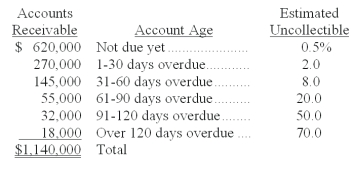 Required:
a. Calculate the amount of the Allowance for Doubtful Accounts that should be reported on the current year-end balance sheet.
b. Calculate the amount of the Bad Debts Expense that should be reported on the current year's income statement, assuming that the balance of the Allowance for Doubtful Accounts on January 1 of the current year was $44,000 and that accounts receivable written off during the current year totaled $49,200.
c. Prepare the adjusting entry to record bad debts expense on December 31 of the current year.
d. Show how Accounts Receivable will appear on the current year-end balance sheet as of December 31.
Required:
a. Calculate the amount of the Allowance for Doubtful Accounts that should be reported on the current year-end balance sheet.
b. Calculate the amount of the Bad Debts Expense that should be reported on the current year's income statement, assuming that the balance of the Allowance for Doubtful Accounts on January 1 of the current year was $44,000 and that accounts receivable written off during the current year totaled $49,200.
c. Prepare the adjusting entry to record bad debts expense on December 31 of the current year.
d. Show how Accounts Receivable will appear on the current year-end balance sheet as of December 31. (Not Answered)
This question doesn't have any answer yet
On August 9, Pierce Company receives a $8,500, 90-day, 8% note from customer Eric Simms as payment on his account. What entry should be made on August 9 to record receipt of the note?
(Multiple Choice)
4.9/5 (80)
(80) All of the following are True regarding credit card expense except:
(Multiple Choice)
4.9/5 (99)
(99) 
Filters
- Essay(0)
- Multiple Choice(0)
- Short Answer(0)
- True False(0)
- Matching(0)