



 Chat with AI
Exam 10: Plant Assets, Natural Resources, and Intangibles

Exam 1: Accounting in Business240 Questions
Exam 2: Analyzing and Recording Transactions197 Questions
Exam 3: Adjusting Accounts and Preparing Financial Statements224 Questions
Exam 4: Completing the Accounting Cycle176 Questions
Exam 5: Accounting for Merchandising Operations198 Questions
Exam 6: Inventories and Cost of Sales198 Questions
Exam 7: Accounting Information Systems176 Questions
Exam 8: Cash and Internal Controls196 Questions
Exam 9: Accounting for Receivables191 Questions
Exam 10: Plant Assets, Natural Resources, and Intangibles223 Questions
Exam 11: Current Liabilities and Payroll Accounting193 Questions
Exam 12: Accounting for Partnerships139 Questions
Exam 13: Accounting for Corporations246 Questions
Exam 14: Long-Term Liabilities198 Questions
Exam 15: Investments and International Operations192 Questions
Exam 16: Reporting the Statement of Cash Flows187 Questions
Exam 17: Analysis of Financial Statements187 Questions
Exam 18: Managerial Accounting Concepts and Principles197 Questions
Exam 19: Job Order Cost Accounting164 Questions
Exam 20: Process Cost Accounting174 Questions
Exam 21: Cost Allocation and Performance Measurement170 Questions
Exam 22: Cost-Volume-Profit Analysis186 Questions
Exam 23: Master Budgets and Planning162 Questions
Exam 24: Flexible Budgets and Standard Costs174 Questions
Exam 25: Capital Budgeting and Managerial Decisions150 Questions
Exam 26: Time Value of Money60 Questions
Select questions type


Decision makers and other users of financial statements are especially interested in evaluating a company's ability to use its assets in generating sales.
(True/False)
4.7/5  (88)
(88) A depreciation method that produces larger depreciation expense during the early years of an asset's life and smaller expense in the later years is a(an):
(Multiple Choice)
4.7/5 (72)
(72) When a company constructs a building, the cost of the building includes materials and labor, design fees, building permits, and insurance during construction.
(True/False)
4.9/5 (83)
(83) Intangible assets are nonphysical assets used in operations that confer on their owners long-term rights, privileges, or competitive advantages.
(True/False)
4.9/5 (79)
(79) A company purchased a cash register on January 1 for $5,400. This register has a useful life of 10 years and a salvage value of $400. What would be the depreciation expense for the second year of its useful life using the double-declining-balance method?
(Multiple Choice)
4.9/5 (82)
(82) A method that charges the same amount of expense to each period of the asset's useful life is called:
(Multiple Choice)
4.9/5 (69)
(69) A company paid $150,000, plus a 6% commission and $4,000 in closing costs for a property. The property included land appraised at $87,500, land improvements appraised at $35,000, and a building appraised at $52,500. What should be the allocation of this property's costs in the company's accounting records?
(Multiple Choice)
4.8/5 (99)
(99) Ordinary repairs are expenditures that keep assets in normal, good operating condition.
(True/False)
4.9/5 (85)
(85) Heidel Co. paid $750,000 cash to buy the plant assets of Rogers Co. that went out of business. An independent appraiser assigned the following values to the assets acquired: 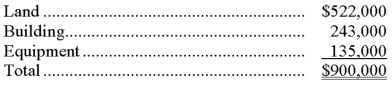 Prepare Heidel's journal entry to record the acquisition of these assets.
 (Not Answered)
This question doesn't have any answer yet
A company purchased a delivery van for $23,000 with a salvage value of $3,000 on September 1, Year 1. It has an estimated useful life of 5 years. Using the straight-line method, how much depreciation expense should the company recognize on December 31, Year 1?
(Multiple Choice)
4.9/5 (77)
(77) A company purchased a mineral deposit for $800,000. It expects this property to produce 1,200,000 tons of ore and to have a salvage value of $50,000. In the current year, the company mined and sold 90,000 tons of ore. Its depletion expense for the current period equals:
(Multiple Choice)
4.8/5 (85)
(85) A company traded an old forklift for a new forklift, receiving a $10,500 trade-in allowance and paying the remaining $37,200 in cash. The old forklift had cost $39,000, and straight-line accumulated depreciation of $27,200 had been recorded as of the exchange date under the assumption it would last five years and have a $5,000 salvage value.
1. What was the book value of the old forklift on the date of the exchange?
2. What amount of gain or loss (indicate which) should be recognized in recording the exchange, assuming the transaction has commercial substance?
3. What amount should be recorded as the cost of the new forklift?
(Essay)
4.8/5 (76)
(76) A company purchased office equipment for $4,300 by trading in old equipment with a cost of $2,000 and that had accumulated depreciation of $1,900 as of the exchange date. The company received a $75 trade-in allowance for the old equipment with the balance of $4,225 paid in cash. Prepare the journal entry to record the exchange, assuming the transaction had commercial substance.
(Not Answered)
This question doesn't have any answer yet
A company purchased land on which to construct a new building for a cost of $250,000. Additional costs incurred were:  What total dollar amount should be charged to Land and what amount should be charged to the new Building?
 (Not Answered)
This question doesn't have any answer yet
Big River Rafting pays $310,000 plus $15,000 in closing costs to buy out a competitor. The real estate consists of land appraised at $105,000, a building appraised at $210,000, and equipment appraised at $35,000. Compute the cost that should be allocated to the land.
(Multiple Choice)
4.7/5 (89)
(89) Cambria owns equipment that cost $93,500 with accumulated depreciation of $64,000. Cambria asks $35,000 for the equipment but sells the equipment for $33,000. Compute the amount of gain or loss on the sale. The journal entry to record the disposal of the asset would involve all of the following except:
(Multiple Choice)
4.8/5 (79)
(79) A method that allocates an equal portion of the total depreciable cost for a plant asset to each unit produced is called:
(Multiple Choice)
4.8/5 (81)
(81) ____________________ refers to a plant asset that is no longer useful in producing goods or services with a competitive advantage because of new inventions and improvements.
(Short Answer)
4.9/5 (91)
(91) 
Filters
- Essay(0)
- Multiple Choice(0)
- Short Answer(0)
- True False(0)
- Matching(0)