



 Chat with AI
Exam 10: Plant Assets, Natural Resources, and Intangibles

Exam 1: Accounting in Business240 Questions
Exam 2: Analyzing and Recording Transactions197 Questions
Exam 3: Adjusting Accounts and Preparing Financial Statements224 Questions
Exam 4: Completing the Accounting Cycle176 Questions
Exam 5: Accounting for Merchandising Operations198 Questions
Exam 6: Inventories and Cost of Sales198 Questions
Exam 7: Accounting Information Systems176 Questions
Exam 8: Cash and Internal Controls196 Questions
Exam 9: Accounting for Receivables191 Questions
Exam 10: Plant Assets, Natural Resources, and Intangibles223 Questions
Exam 11: Current Liabilities and Payroll Accounting193 Questions
Exam 12: Accounting for Partnerships139 Questions
Exam 13: Accounting for Corporations246 Questions
Exam 14: Long-Term Liabilities198 Questions
Exam 15: Investments and International Operations192 Questions
Exam 16: Reporting the Statement of Cash Flows187 Questions
Exam 17: Analysis of Financial Statements187 Questions
Exam 18: Managerial Accounting Concepts and Principles197 Questions
Exam 19: Job Order Cost Accounting164 Questions
Exam 20: Process Cost Accounting174 Questions
Exam 21: Cost Allocation and Performance Measurement170 Questions
Exam 22: Cost-Volume-Profit Analysis186 Questions
Exam 23: Master Budgets and Planning162 Questions
Exam 24: Flexible Budgets and Standard Costs174 Questions
Exam 25: Capital Budgeting and Managerial Decisions150 Questions
Exam 26: Time Value of Money60 Questions
Select questions type


A machine was purchased for $37,000 and depreciated for five years on a straight-line basis under the assumption it would have a ten-year life and a $1,000 salvage value. At the beginning of the machine's sixth year it was recognized the machine had three years of remaining life instead of five and that at the end of the remaining three years its salvage value would be $1,600. What amount of depreciation should be recorded in each of the machine's remaining three years?
(Short Answer)
4.8/5  (64)
(64) _____________________ is an estimate of an asset's value at the end of its benefit period.
(Essay)
4.7/5 (82)
(82) Amortization is the process of allocating the cost of natural resources to periods when they are consumed.
(True/False)
4.7/5 (83)
(83) The going concern assumption supports the reporting of plant assets at book value rather than market value.
(True/False)
4.8/5 (81)
(81) Carmel Company acquires a mineral deposit at a cost of $5,900,000. It incurs additional costs of $600,000 to access the deposit, which is estimated to contain 2,000,000 tons and is expected to take 5 years to extract. Compute the depletion expense for the first year assuming 418,000 tons were mined.
(Multiple Choice)
5.0/5 (73)
(73) The cost of an intangible asset is systematically allocated to depreciation expense over its estimated useful life.
(True/False)
4.8/5 (80)
(80) Salta Company installs a manufacturing machine in its factory at the beginning of the year at a cost of $87,000. The machine's useful life is estimated to be 5 years, or 400,000 units of product, with a $7,000 salvage value. During its second year, the machine produces 84,500 units of product. Determine the machines' second year depreciation under the units-of-production method.
(Multiple Choice)
4.9/5 (90)
(90) _______________________ are expenditures that extend an asset's useful life beyond its original estimate.
(Short Answer)
4.8/5 (78)
(78) Salvage value is an estimate of an asset's value at the end of its benefit period.
(True/False)
4.8/5 (85)
(85) Monte Ray leases office space for $7,000 per month. On January 3, Monte Ray incurs $75,000 to improve his leased office space. These improvements are expected to yield benefits for 8 years. Ray has 6 years remaining on his lease. What journal entry would be needed to record the expense for the first year related to the improvements?
(Multiple Choice)
4.9/5 (76)
(76) _____________ are the federal income tax rules for depreciating assets.
(Essay)
4.9/5 (73)
(73) Depreciation expense is calculated using estimates of an asset's salvage value and useful life.
(True/False)
4.9/5 (80)
(80) Accounting for the exchange of assets depends on whether the transaction has commercial substance; commercial substance implies that it alters the company's future cash flows.
(True/False)
4.9/5 (91)
(91) A company purchased a machine on January 1 of the current year for $750,000. Calculate the annual depreciation expense for each year of the machine's life (estimated at 5 years or 20,000 hours, with a salvage value of $75,000). During the machine's 5-year life its hourly usage was: 3,000; 4,000; 5,000; 5,000; and 3,000 hours. 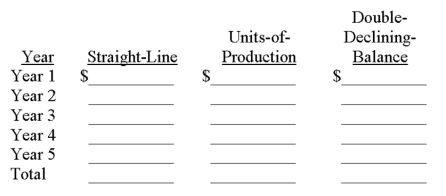
(Not Answered)
This question doesn't have any answer yet
A leasehold refers to the rights the lessor grants to the lessee under the terms of the lease.
(True/False)
4.8/5 (77)
(77) 
Filters
- Essay(0)
- Multiple Choice(0)
- Short Answer(0)
- True False(0)
- Matching(0)