



 Chat with AI
Exam 23: The Economics of Resources

Exam 1: Urban Services107 Questions
Exam 2: Business Efficiency104 Questions
Exam 3: Planning and Scheduling108 Questions
Exam 4: Linear Programming111 Questions
Exam 5: Exploring Data: Distributions115 Questions
Exam 6: Exploring Data: Relationships104 Questions
Exam 7: Data for Decisions99 Questions
Exam 8: Probability: the Mathematics of Chance108 Questions
Exam 9: Social Choice: the Impossible Dream103 Questions
Exam 10: The Manipulability of Voting Systems106 Questions
Exam 11: Weighted Voting Systems111 Questions
Exam 12: Electing the President93 Questions
Exam 13: Fair Division121 Questions
Exam 14: Apportionment112 Questions
Exam 15: Game Theory: the Mathematics of Competition113 Questions
Exam 16: Identification Numbers110 Questions
Exam 17: Information Science94 Questions
Exam 18: Growth and Form111 Questions
Exam 19: Symmetry and Patterns115 Questions
Exam 20: Tilings112 Questions
Exam 21: Savings Models113 Questions
Exam 22: Borrowing Models113 Questions
Exam 23: The Economics of Resources119 Questions
Select questions type


The population of the United States in 1700 was about 600,000,000. In 2000, the population was about 6,000,000,000. What was the average growth rate over that period?
(Multiple Choice)
4.8/5  (74)
(74) Suppose the world demand for chromium is about 1,845,000 tons per year. The known global reserves are 775,000,000 tons. The demand for chromium is increasing at a rate of 2.6%. What is the exponential reserve for chromium?
(Multiple Choice)
4.9/5 (71)
(71) Use the following reproduction curve for a population to answer the Questions Units are in thousands. 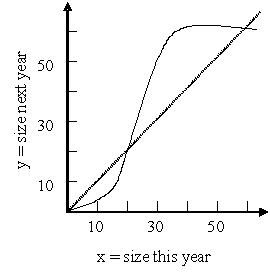 -The maximum sustainable yield is approximately:
 (Multiple Choice)
4.8/5 (89)
(89) Use the following information to answer the Questions
A radioactive element used in medicine has a physical half-life
(the time in which half of any quantity of the element decays) and a biological half-life (the time in which half of an amount of this element in the body is excreted). The effective half-life is calculated from
-The physical half-life of iron-59 is 45 days and its biological half-life is 600 days. Find the effective half-life of iron-59.
(Multiple Choice)
4.9/5 (84)
(84) The population of the state of California in 1980 was about 23,237,000. In 2001, the population was about 34,501,000. What was the average growth rate over that period?
(Multiple Choice)
4.8/5 (79)
(79) The population of a small town was 3000 at the beginning of 2007. Assuming an average growth rate of 0.8% per year, what will the population be at the beginning of 2015?
(Multiple Choice)
4.9/5 (76)
(76) Refer to the iterated function system based on the function = the sum of the squares of the digits of n text to solve the questions:
-If the first term of the sequence is 211, what is the fourth term?
(Multiple Choice)
4.9/5 (69)
(69) The population of Ontario in 1997 was about 11,249,500. In 2001, the population was about 11,874,400. What was the average growth rate over that period?
(Multiple Choice)
4.9/5 (83)
(83) The population of a small town was 4200 at the beginning of 2002. Assuming an average growth rate of 0.2% per year, what will the population be at the beginning of 2020?
(Short Answer)
4.9/5 (78)
(78) A population grows according to a logistic population model, with population parameter = 1.8 and starting population fraction x = 0.34 for the first year. The value of x after the third year is:
(Multiple Choice)
5.0/5 (78)
(78) Suppose the world demand for silver is about 343,750,000 troy ounces per year and the static reserve is 16. What are the known global reserves for silver?
(Multiple Choice)
4.9/5 (72)
(72) For a logistic model, what kind of shape will you get if you graph the quantity against ?
(Short Answer)
4.8/5 (81)
(81) A small change in initial conditions of a system can make an enormous difference later on. This is called:
(Multiple Choice)
4.9/5 (80)
(80) A population grows according to a logistic growth model, with population parameter = 2.4 and starting population fraction x = 0.35 for the first year. The value of x after the second year is:
(Multiple Choice)
4.7/5 (64)
(64) Suppose the world demand for cobalt is about 16,360,000 pounds per year. The known global reserves are 1,800,000,000 pounds. What is the static reserve for cobalt?
(Multiple Choice)
4.8/5 (76)
(76) The population of Laos in 1996 was about 5,200,000. In 2001, the population was about 5,952,520. What was the average growth rate over that period?
(Multiple Choice)
4.9/5 (79)
(79) The population of Mexico in 1900 was about 18,000,000. In 2000, the population was about 100,000,000. What was the average growth rate over that period?
(Multiple Choice)
4.9/5 (89)
(89) If is much larger than for a particular element, then is approximately equal to:
(Multiple Choice)
4.9/5 (75)
(75) What is the world demand for iron, if the known global reserves are 100,000,000,000 tons and the static reserve is 238?
(Multiple Choice)
4.8/5 (84)
(84) Suppose the world demand for chromium is about 1,845,000 tons per year and the static reserve is 420. What are the known global reserves for chromium?
(Multiple Choice)
4.8/5 (77)
(77) 
Filters
- Essay(0)
- Multiple Choice(0)
- Short Answer(0)
- True False(0)
- Matching(0)