



 Chat with AI
Exam 23: The Economics of Resources

Exam 1: Urban Services107 Questions
Exam 2: Business Efficiency104 Questions
Exam 3: Planning and Scheduling108 Questions
Exam 4: Linear Programming111 Questions
Exam 5: Exploring Data: Distributions115 Questions
Exam 6: Exploring Data: Relationships104 Questions
Exam 7: Data for Decisions99 Questions
Exam 8: Probability: the Mathematics of Chance108 Questions
Exam 9: Social Choice: the Impossible Dream103 Questions
Exam 10: The Manipulability of Voting Systems106 Questions
Exam 11: Weighted Voting Systems111 Questions
Exam 12: Electing the President93 Questions
Exam 13: Fair Division121 Questions
Exam 14: Apportionment112 Questions
Exam 15: Game Theory: the Mathematics of Competition113 Questions
Exam 16: Identification Numbers110 Questions
Exam 17: Information Science94 Questions
Exam 18: Growth and Form111 Questions
Exam 19: Symmetry and Patterns115 Questions
Exam 20: Tilings112 Questions
Exam 21: Savings Models113 Questions
Exam 22: Borrowing Models113 Questions
Exam 23: The Economics of Resources119 Questions
Select questions type


Suppose the world demand for copper is about 8,600,000 tons per year and the static reserve is about 36. However, the demand for copper is increasing at a rate of 4.6%. What is the exponential reserve for copper?
(Multiple Choice)
4.8/5  (68)
(68) Suppose the world demand for silver is about 343,750,000 troy ounces per year and the static reserve is 16. However, the demand for silver is increasing at a rate of 2.7%. What is the exponential reserve for silver?
(Multiple Choice)
5.0/5 (84)
(84) The population of the United States in 2000 was about 281,422,000. In 2001, the population was about 284,797,000. What was the average growth rate over that period?
(Multiple Choice)
4.8/5 (85)
(85) Suppose the world demand for gold is about 32,000,000 troy ounces per year. The known global reserves are 100,000,000,000 troy ounces. What is the static reserve for gold?
(Short Answer)
4.8/5 (81)
(81) A population grows according to a logistic growth model, with population parameter
= 1.4 and x = 0.05 for the first year. Find the value of x after the third year.
(Short Answer)
4.8/5 (81)
(81) Use the following reproductive curve for a population to answer the Questions. Units are in thousands. 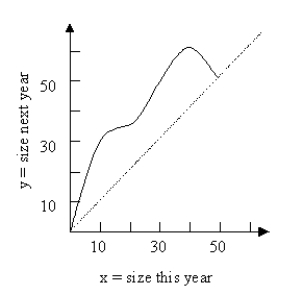 -Estimate the equilibrium population size.
 (Short Answer)
4.9/5 (83)
(83) A population grows according to a logistic population model, with population parameter = 3.7 and starting population fraction x = 0.8 for the first year. The value of x after the second year is:
(Multiple Choice)
4.7/5 (77)
(77) Suppose the world demand for iron is about 420,000,000 tons per year. The known global reserves are 100,000,000,000 tons. The demand for iron is increasing at a rate of 1.8%. What is the exponential reserve for iron?
(Multiple Choice)
4.8/5 (70)
(70) Use the following reproduction curve for a population to answer the Questions Units are in thousands. 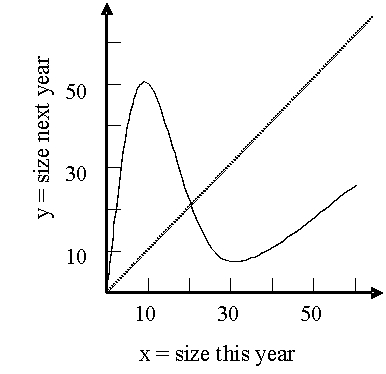 -The sustainable yield corresponding to a population of size 10,000 remaining after the harvest is approximately:
 (Multiple Choice)
4.7/5 (86)
(86) The population of the world in 1800 was about 900,000,000. The average growth rate from 1800 to 1900 was 0.51%. What was the approximate population in 1900?
(Multiple Choice)
4.9/5 (85)
(85) Use the following information to answer the Questions
A radioactive element used in medicine has a physical half-life
(the time in which half of any quantity of the element decays) and a biological half-life (the time in which half of an amount of this element in the body is excreted). The effective half-life is calculated from
-The physical half-life of sulfur-35 is 87.4 days and its biological half-life is 90 days. Find the effective half-life of sulfur-35.
(Multiple Choice)
4.9/5 (73)
(73) A colony of penguins had 534 members at the beginning of 1998. At the beginning of 2015, the colony had grown to 821 members. What was the average growth rate over that period?
(Short Answer)
4.9/5 (82)
(82) A population grows according to a logistic population model, with population parameter = 1.3 and starting population fraction x = 0.7 for the first year. The value of x after the second year is:
(Multiple Choice)
4.8/5 (68)
(68) Use the following reproductive curve for a population to answer the Questions. Units are in thousands.
-Estimate the sustainable yield corresponding to a population of size 40,000 remaining after the harvest.
-Estimate the sustainable yield corresponding to a population of size 40,000 remaining after the harvest. (Short Answer)
4.8/5 (73)
(73) The half-life of radon-222 is 3.82 days. How long will it take for a quantity of radon-222 to decay to one millionth of the original amount?
(Short Answer)
4.8/5 (74)
(74) Use the following reproductive curve for a population to answer the Questions . Units are in thousands. 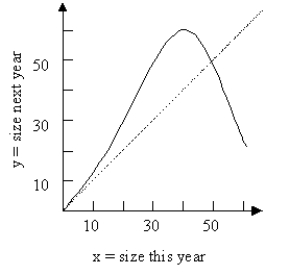 -Estimate the equilibrium population size.
 (Short Answer)
4.9/5 (85)
(85) Iodine-131 has a half-life of eight days. A sample that originally contained 10 grams of iodine-131 now contains 1 gram. How much time elapsed between the two measurements?
(Multiple Choice)
4.8/5 (88)
(88) Suppose that the discrete logistic model for population growth is models as follows: What is the natural rate of increase when the population is small?
(Multiple Choice)
4.8/5 (77)
(77) Use the following reproductive curve for a population to answer the Questions. Units are in thousands.
-Estimate the maximum sustainable yield.
-Estimate the maximum sustainable yield. (Short Answer)
4.8/5 (86)
(86) 
Filters
- Essay(0)
- Multiple Choice(0)
- Short Answer(0)
- True False(0)
- Matching(0)