



 Chat with AI
Exam 10: Meiosis and Sexual Life Cycles

Exam 1: Introduction: Evolution and the Foundations of Biology36 Questions
Exam 2: The Chemical Context of Life135 Questions
Exam 3: Carbon and the Molecular Diversity of Life121 Questions
Exam 4: A Tour of the Cell72 Questions
Exam 5: Membrane Transport and Cell Signaling89 Questions
Exam 6: An Introduction to Metabolism74 Questions
Exam 7: Cellular Respiration and Fermentation90 Questions
Exam 8: Photosynthesis71 Questions
Exam 9: The Cell Cycle63 Questions
Exam 10: Meiosis and Sexual Life Cycles65 Questions
Exam 11: Mendel and the Gene Idea65 Questions
Exam 12: The Chromosomal Basis of Inheritance46 Questions
Exam 13: The Molecular Basis of Inheritance68 Questions
Exam 14: Gene Expression: From Gene to Protein83 Questions
Exam 15: Regulation of Gene Expression53 Questions
Exam 16: Development, Stem Cells, and Cancer34 Questions
Exam 17: Viruses35 Questions
Exam 18: Genomes and Their Evolution31 Questions
Exam 19: Descent With Modification54 Questions
Exam 20: Phylogeny53 Questions
Exam 21: The Evolution of Populations69 Questions
Exam 22: The Origin of Species60 Questions
Exam 23: Broad Patterns of Evolution38 Questions
Exam 24: Early Life and the Diversification of Prokaryotes89 Questions
Exam 25: The Origin and Diversification of Eukaryotes71 Questions
Exam 26: The Colonization of Land by Plants and Fungi153 Questions
Exam 27: The Rise of Animal Diversity107 Questions
Exam 28: Plant Structure and Growth50 Questions
Exam 29: Resource Acquisition, Nutrition, and Transport in Vascular Plants130 Questions
Exam 30: Reproduction and Domestication of Flowering Plants68 Questions
Exam 31: Plant Responses to Internal and External Signals71 Questions
Exam 32: Homeostasis and Endocrine Signaling122 Questions
Exam 33: Animal Nutrition61 Questions
Exam 34: Circulation and Gas Exchange77 Questions
Exam 35: The Immune System84 Questions
Exam 36: Reproduction and Development109 Questions
Exam 37: Neurons, Synapses, and Signaling68 Questions
Exam 38: Nervous and Sensory Systems89 Questions
Exam 39: Motor Mechanisms and Behavior74 Questions
Exam 40: Population Ecology and the Distribution of Organisms92 Questions
Exam 41: Species Interactions55 Questions
Exam 42: Ecosystems and Energy79 Questions
Exam 43: Global Ecology and Conservation Biology70 Questions
Select questions type


A given organism has 46 chromosomes in its karyotype. We can therefore conclude which of the following?
(Multiple Choice)
4.9/5  (71)
(71) The following question refers to the essential steps in meiosis described below.
1. Formation of four new nuclei, each with half the chromosomes present in the parental nucleus
2. Alignment of homologous chromosomes at the metaphase plate
3. Separation of sister chromatids
4. Separation of the homologs; no uncoupling of the centromere
5. Synapsis; chromosomes moving to the middle of the cell in pairs
-When homologous chromosomes cross over, what occurs?
(Multiple Choice)
4.8/5 (77)
(77) You have isolated DNA from three different cell types of an organism, determined the relative DNA content for each type, and plotted the results on the graph shown in Figure 10.3. Refer to the graph to answer the following questions.
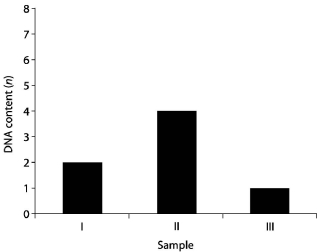 Figure 10.3
-Which sample(s) might represent a zygote?
Figure 10.3
-Which sample(s) might represent a zygote? (Multiple Choice)
4.8/5 (84)
(84) The somatic cells of a privet shrub each contain 46 chromosomes. To be as different as they are from human cells, which have the same number of chromosomes, which of the following must be true?
(Multiple Choice)
4.8/5 (88)
(88) When we see chiasmata under a microscope, that lets us know which of the following has occurred?
(Multiple Choice)
5.0/5 (92)
(92) Use the following information to answer the next questions.
There is a group of invertebrate animals called rotifers, among which a particular group of species reproduces, as far as is known, only asexually. These rotifers, however, have survived a long evolutionary history without evidence of having been overcome by excessive mutations.
-How many different combinations of maternal and paternal chromosomes can be packaged in gametes made by an organism with a diploid number of 8 (2n = 8)?
(Multiple Choice)
4.9/5 (91)
(91) For the following questions, match the key event of meiosis with the stages listed below.
I. Prophase I V. Prophase II
II. Metaphase I VI. Metaphase II
III. Anaphase I VII. Anaphase II
IV. Telophase I VIII. Telophase II
-Homologous chromosomes are aligned at the equator of the spindle.
(Multiple Choice)
4.8/5 (68)
(68) Use the following information to answer the next questions.
There is a group of invertebrate animals called rotifers, among which a particular group of species reproduces, as far as is known, only asexually. These rotifers, however, have survived a long evolutionary history without evidence of having been overcome by excessive mutations.
-If the DNA content of a diploid cell in the G1 phase of the cell cycle is x, then the DNA content of the same cell at metaphase of meiosis I would be
(Multiple Choice)
4.8/5 (79)
(79) At which stage of mitosis are chromosomes usually photographed in the preparation of a karyotype?
(Multiple Choice)
5.0/5 (71)
(71) Use the following information to answer the next questions.
There is a group of invertebrate animals called rotifers, among which a particular group of species reproduces, as far as is known, only asexually. These rotifers, however, have survived a long evolutionary history without evidence of having been overcome by excessive mutations.
-How is natural selection related to sexual reproduction as opposed to asexual reproduction?
(Multiple Choice)
4.7/5 (78)
(78) Which of the following can utilize both mitosis and meiosis in the correct circumstances?
(Multiple Choice)
4.7/5 (80)
(80) The following question refers to the essential steps in meiosis described below.
1. Formation of four new nuclei, each with half the chromosomes present in the parental nucleus
2. Alignment of homologous chromosomes at the metaphase plate
3. Separation of sister chromatids
4. Separation of the homologs; no uncoupling of the centromere
5. Synapsis; chromosomes moving to the middle of the cell in pairs
-Which of the steps take(s) place in both mitosis and meiosis?
(Multiple Choice)
4.8/5 (71)
(71) Whether during mitosis or meiosis, sister chromatids are held together by proteins referred to as cohesins. Such molecules must have which of the following properties?
(Multiple Choice)
4.7/5 (91)
(91) For the following questions, match the key event of meiosis with the stages listed below.
I. Prophase I V. Prophase II
II. Metaphase I VI. Metaphase II
III. Anaphase I VII. Anaphase II
IV. Telophase I VIII. Telophase II
-Centromeres of sister chromatids disjoin and chromatids separate.
(Multiple Choice)
4.7/5 (70)
(70) To visualize and identify meiotic cells at metaphase with a microscope, what would you look for?
(Multiple Choice)
4.9/5 (76)
(76) How do cells at the completion of meiosis compare with cells that have replicated their DNA and are just about to begin meiosis?
(Multiple Choice)
4.9/5 (85)
(85) Which of the following is true of a species that has a chromosome number of 2n = 16?
(Multiple Choice)
5.0/5 (78)
(78) 
Filters
- Essay(0)
- Multiple Choice(0)
- Short Answer(0)
- True False(0)
- Matching(0)