



 Chat with AI
Exam 26: The Colonization of Land by Plants and Fungi

Exam 1: Introduction: Evolution and the Foundations of Biology36 Questions
Exam 2: The Chemical Context of Life135 Questions
Exam 3: Carbon and the Molecular Diversity of Life121 Questions
Exam 4: A Tour of the Cell72 Questions
Exam 5: Membrane Transport and Cell Signaling89 Questions
Exam 6: An Introduction to Metabolism74 Questions
Exam 7: Cellular Respiration and Fermentation90 Questions
Exam 8: Photosynthesis71 Questions
Exam 9: The Cell Cycle63 Questions
Exam 10: Meiosis and Sexual Life Cycles65 Questions
Exam 11: Mendel and the Gene Idea65 Questions
Exam 12: The Chromosomal Basis of Inheritance46 Questions
Exam 13: The Molecular Basis of Inheritance68 Questions
Exam 14: Gene Expression: From Gene to Protein83 Questions
Exam 15: Regulation of Gene Expression53 Questions
Exam 16: Development, Stem Cells, and Cancer34 Questions
Exam 17: Viruses35 Questions
Exam 18: Genomes and Their Evolution31 Questions
Exam 19: Descent With Modification54 Questions
Exam 20: Phylogeny53 Questions
Exam 21: The Evolution of Populations69 Questions
Exam 22: The Origin of Species60 Questions
Exam 23: Broad Patterns of Evolution38 Questions
Exam 24: Early Life and the Diversification of Prokaryotes89 Questions
Exam 25: The Origin and Diversification of Eukaryotes71 Questions
Exam 26: The Colonization of Land by Plants and Fungi153 Questions
Exam 27: The Rise of Animal Diversity107 Questions
Exam 28: Plant Structure and Growth50 Questions
Exam 29: Resource Acquisition, Nutrition, and Transport in Vascular Plants130 Questions
Exam 30: Reproduction and Domestication of Flowering Plants68 Questions
Exam 31: Plant Responses to Internal and External Signals71 Questions
Exam 32: Homeostasis and Endocrine Signaling122 Questions
Exam 33: Animal Nutrition61 Questions
Exam 34: Circulation and Gas Exchange77 Questions
Exam 35: The Immune System84 Questions
Exam 36: Reproduction and Development109 Questions
Exam 37: Neurons, Synapses, and Signaling68 Questions
Exam 38: Nervous and Sensory Systems89 Questions
Exam 39: Motor Mechanisms and Behavior74 Questions
Exam 40: Population Ecology and the Distribution of Organisms92 Questions
Exam 41: Species Interactions55 Questions
Exam 42: Ecosystems and Energy79 Questions
Exam 43: Global Ecology and Conservation Biology70 Questions
Select questions type


Arrange the following structures from largest to smallest, assuming that they belong to two generations of the same angiosperm. 1. ovary
2) ovule
3) egg
4) carpel
5) embryo sac
(Multiple Choice)
4.8/5  (82)
(82) According to our current knowledge of plant evolution, which group of organisms should feature mitosis most similar to that of land plants?
(Multiple Choice)
4.9/5 (81)
(81) A researcher took water in which a Jl population had been thriving, filtered the water to remove all bacterial cells, and then applied the water to the skins of adult amphibians to see if there would subsequently be a reduced infection rate by Bd when frog skins were inoculated with Bd. For which of the following hypotheses is the procedure described a potential test?
(Multiple Choice)
4.8/5 (94)
(94) The same bees that pollinate the flowers of the Brazil nut trees pollinate orchids, which are epiphytes (in other words, plants that grow on other plants); however, orchids cannot grow on Brazil nut trees. These observations explain
(Multiple Choice)
4.8/5 (74)
(74) Which of the following flower parts develops into the pulp of a fleshy fruit?
(Multiple Choice)
4.8/5 (75)
(75) Which of the following are structures of angiosperm gametophytes?
(Multiple Choice)
4.8/5 (69)
(69) Big Bend National Park in Texas is mostly Chihuahuan desert, where rainfall averages about 10 inches per year. Yet, it is not uncommon when hiking in this bone-dry desert to encounter mosses and ferns. One such plant is called "flower of stone." It is not a flowering plant, nor does it produce seeds. Under arid conditions, its leaflike structures curl up. However, when it rains, it unfurls its leaves, which form a bright green rosette on the desert floor. Consequently, it is sometimes called the "resurrection plant." At first glance, it could be a fern, a true moss, or a spike moss.
-Which of the following features is most important in order for true mosses and ferns to survive and reproduce in the desert?
(Multiple Choice)
4.7/5 (72)
(72) What adaptations should one expect of the seed coats of angiosperm species whose seeds are dispersed by frugivorous (fruit-eating) animals, as opposed to angiosperm species whose seeds are dispersed by other means? 1. The exterior of the seed coat should have barbs or hooks.
2) The seed coat should contain secondary compounds that irritate the lining of the animal's mouth.
3) The seed coat should be able to withstand low pH's.
4) The seed coat, upon its complete digestion, should provide vitamins or nutrients to animals.
5) The seed coat should be resistant to the animals' digestive enzymes.
(Multiple Choice)
5.0/5 (80)
(80) Figure 26.2 depicts the outline of a large fairy ring that has appeared overnight in an open meadow, as viewed from above. The fairy ring represents the furthest advance of this mycelium through the soil. Locations A-D are all 0.5 meters below the soil surface. Responses may be used once, more than once, or not at all.
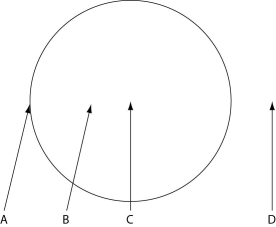 Figure 26.2
-At which location should one find the lowest concentration of fungal enzymes, assuming that the enzymes do not diffuse far from their source, and that no other fungi are present in this habitat?
Figure 26.2
-At which location should one find the lowest concentration of fungal enzymes, assuming that the enzymes do not diffuse far from their source, and that no other fungi are present in this habitat? (Multiple Choice)
4.8/5 (83)
(83) Which description does not apply equally well to both sexual and asexual spores?
(Multiple Choice)
4.9/5 (81)
(81) Which of the following statements correctly describes a portion of the pine life cycle?
(Multiple Choice)
4.8/5 (76)
(76) Which of the following statements is true of the pine life cycle?
(Multiple Choice)
4.9/5 (73)
(73) Which group is noted for the independence of gametophyte and sporophyte generations from each other?
(Multiple Choice)
4.8/5 (81)
(81) When pathogenic fungi are found growing on the roots of grape vines, grape farmers sometimes respond by covering the ground around their vines with plastic sheeting and pumping a gaseous fungicide into the soil. The most important concern of grape farmers who engage in this practice should be that the
(Multiple Choice)
4.9/5 (87)
(87) The next few questions refer to the following description.
The cycads, a mostly tropical phylum of gymnosperms, evolved about 300 million years ago and were dominant forms during the Age of the Dinosaurs. Though their sperm are flagellated, their ovules are pollinated by beetles. These beetles get nutrition (they eat pollen) and shelter from the microsporophylls. Upon visiting megasporophylls, the beetles transfer pollen to the exposed ovules. In cycads, pollen cones and seed cones are borne on different plants. Cycads synthesize neurotoxins, especially in the seeds, that are effective against most animals, including humans.
-Which feature of cycads makes them similar to many angiosperms? 1. They have exposed ovules.
2) They have flagellated sperm.
3) They are pollinated by animals.
(Multiple Choice)
4.9/5 (89)
(89) Plasmogamy can directly result in which of the following? 1. cells with a single haploid nucleus
2) heterokaryotic cells
3) dikaryotic cells
4) cells with two diploid nuclei
(Multiple Choice)
4.9/5 (80)
(80) A botanist discovers a new species of plant in a tropical rain forest. After observing its anatomy and life cycle, he notes the following characteristics: flagellated sperm, xylem with tracheids, separate gametophyte and sporophyte generations with the sporophyte dominant, and no seeds. This plant is probably most closely related to
(Multiple Choice)
4.8/5 (69)
(69) For several decades now, amphibian species worldwide have been in decline. A significant proportion of the decline seems to be due to the spread of the chytrid fungus, Batrachochytrium dendrobatidis (Bd). Chytrid sporangia reside within the epidermal cells of infected animals, animals that consequently show areas of sloughed skin. They can also be lethargic, which is expressed through failure to hide and failure to flee. The infection cycle typically takes four to five days, at the end of which zoospores are released from sporangia into the environment. In some amphibian species, mortality rates approach 100%; other species seem able to survive the infection.
-If Bd cannot grow properly at temperatures above 28°C (82°F), then, assuming the amphibians can survive, in which time or place should the chytrid infection proceed most rapidly? 1. cooler months
2) warmer months
3) lower altitudes
4) higher altitudes
(Multiple Choice)
4.9/5 (78)
(78) The microsporidian, Brachiola gambiae, parasitizes the mosquito, Anopheles gambiae. Adult female mosquitoes must take blood meals in order for their eggs to develop, and it is while they take blood that they transmit malarial parasites to humans. Male mosquitoes drink flower nectar. If humans are to safely and effectively use Brachiola gambiae as a biological control to reduce human deaths from malaria, then how many of the following statements should be true? 1. Brachiola should kill the mosquitoes before the malarial parasite they carry reaches maturity.
2) The microsporidian should not be harmful to other insects.
3) Microsporidians should infect mosquito larvae, rather than mosquito adults.
4) The subsequent decline in anopheline mosquitoes should not significantly disrupt human food resources or other food webs.
5) Brachiola must be harmful to male mosquitoes, but not to female mosquitoes.
(Multiple Choice)
4.8/5 (75)
(75) The Brazil nut tree, Bertholletia excels (n = 17), is native to tropical rain forests of South America. It is a hardwood tree that can grow to over 50 meters tall, is a source of high-quality lumber, and is a favorite nesting site for harpy eagles. As the rainy season ends, tough-walled fruits, each containing 8-25 seeds (Brazil nuts), fall to the forest floor. Brazil nuts are composed primarily of endosperm. About $50 million worth of nuts are harvested each year. Scientists have discovered that the pale yellow flowers of Brazil nut trees cannot fertilize themselves and admit only female orchid bees as pollinators. The agouti (Dasyprocta spp.), a cat-sized rodent, is the only animal with teeth strong enough to crack the hard wall of Brazil nut fruits. It typically eats some of the seeds, buries others, and leaves still others inside the fruit, which moisture can now enter. The uneaten seeds may subsequently germinate.
-Animals that consume Brazil nuts are deriving nutrition mostly from tissue whose nuclei have how many chromosomes?
(Multiple Choice)
4.9/5 (80)
(80) 
Filters
- Essay(0)
- Multiple Choice(0)
- Short Answer(0)
- True False(0)
- Matching(0)