



 Chat with AI
Exam 37: Neurons, Synapses, and Signaling

Exam 1: Introduction: Evolution and the Foundations of Biology36 Questions
Exam 2: The Chemical Context of Life135 Questions
Exam 3: Carbon and the Molecular Diversity of Life121 Questions
Exam 4: A Tour of the Cell72 Questions
Exam 5: Membrane Transport and Cell Signaling89 Questions
Exam 6: An Introduction to Metabolism74 Questions
Exam 7: Cellular Respiration and Fermentation90 Questions
Exam 8: Photosynthesis71 Questions
Exam 9: The Cell Cycle63 Questions
Exam 10: Meiosis and Sexual Life Cycles65 Questions
Exam 11: Mendel and the Gene Idea65 Questions
Exam 12: The Chromosomal Basis of Inheritance46 Questions
Exam 13: The Molecular Basis of Inheritance68 Questions
Exam 14: Gene Expression: From Gene to Protein83 Questions
Exam 15: Regulation of Gene Expression53 Questions
Exam 16: Development, Stem Cells, and Cancer34 Questions
Exam 17: Viruses35 Questions
Exam 18: Genomes and Their Evolution31 Questions
Exam 19: Descent With Modification54 Questions
Exam 20: Phylogeny53 Questions
Exam 21: The Evolution of Populations69 Questions
Exam 22: The Origin of Species60 Questions
Exam 23: Broad Patterns of Evolution38 Questions
Exam 24: Early Life and the Diversification of Prokaryotes89 Questions
Exam 25: The Origin and Diversification of Eukaryotes71 Questions
Exam 26: The Colonization of Land by Plants and Fungi153 Questions
Exam 27: The Rise of Animal Diversity107 Questions
Exam 28: Plant Structure and Growth50 Questions
Exam 29: Resource Acquisition, Nutrition, and Transport in Vascular Plants130 Questions
Exam 30: Reproduction and Domestication of Flowering Plants68 Questions
Exam 31: Plant Responses to Internal and External Signals71 Questions
Exam 32: Homeostasis and Endocrine Signaling122 Questions
Exam 33: Animal Nutrition61 Questions
Exam 34: Circulation and Gas Exchange77 Questions
Exam 35: The Immune System84 Questions
Exam 36: Reproduction and Development109 Questions
Exam 37: Neurons, Synapses, and Signaling68 Questions
Exam 38: Nervous and Sensory Systems89 Questions
Exam 39: Motor Mechanisms and Behavior74 Questions
Exam 40: Population Ecology and the Distribution of Organisms92 Questions
Exam 41: Species Interactions55 Questions
Exam 42: Ecosystems and Energy79 Questions
Exam 43: Global Ecology and Conservation Biology70 Questions
Select questions type


Assume that a single IPSP has a negative magnitude of -0.5 mV at the axon hillock, and that a single EPSP has a positive magnitude of +0.5 mV. For a neuron with an initial membrane potential of -70 mV, the net effect of the simultaneous arrival of six IPSPs and two EPSPs would be to move the membrane potential to
(Multiple Choice)
4.7/5  (79)
(79) A cation that is more abundant as a solute in the cytosol of a neuron than it is in the interstitial fluid outside the neuron is
(Multiple Choice)
4.8/5 (89)
(89) Action potentials are normally carried in only one direction: from the axon hillock toward the axon terminals. If you experimentally depolarize the middle of the axon to threshold, using an electronic probe, then
(Multiple Choice)
4.8/5 (82)
(82) Two fundamental principles that characterize gated ion channels in the neuronal membrane are that the channels
(Multiple Choice)
4.8/5 (94)
(94) Two fundamental concepts about the ion channels of a "resting" neuron are that the channels
(Multiple Choice)
4.9/5 (79)
(79) The "undershoot" phase of after-hyperpolarization is due to
(Multiple Choice)
4.7/5 (89)
(89) An inhibitory postsynaptic potential (IPSP) occurs in a membrane made more permeable to
(Multiple Choice)
4.7/5 (78)
(78) The surface on a neuron that discharges the contents of synaptic vesicles is the
(Multiple Choice)
4.8/5 (77)
(77) An amino acid that operates at inhibitory synapses in the brain is
(Multiple Choice)
4.9/5 (70)
(70) After the depolarization phase of an action potential, the resting potential is restored by
(Multiple Choice)
4.8/5 (87)
(87) When several EPSPs arrive at the axon hillock from different dendritic locations, depolarizing the postsynaptic cell to threshold for an action potential, this is an example of
(Multiple Choice)
4.9/5 (83)
(83) Opening all of the sodium channels, with all other ion channels closed-which is an admittedly artificial setting-on an otherwise typical neuron should move its membrane potential to
(Multiple Choice)
4.9/5 (65)
(65) For the following questions, refer to the graph of an action potential in Figure 37.1.
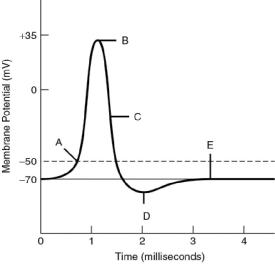 Figure 37.1
-The membrane potential is closest to the equilibrium potential for potassium at label
Figure 37.1
-The membrane potential is closest to the equilibrium potential for potassium at label (Multiple Choice)
4.9/5 (80)
(80) 
Filters
- Essay(0)
- Multiple Choice(0)
- Short Answer(0)
- True False(0)
- Matching(0)