



 Chat with AI
Exam 38: Nervous and Sensory Systems

Exam 1: Introduction: Evolution and the Foundations of Biology36 Questions
Exam 2: The Chemical Context of Life135 Questions
Exam 3: Carbon and the Molecular Diversity of Life121 Questions
Exam 4: A Tour of the Cell72 Questions
Exam 5: Membrane Transport and Cell Signaling89 Questions
Exam 6: An Introduction to Metabolism74 Questions
Exam 7: Cellular Respiration and Fermentation90 Questions
Exam 8: Photosynthesis71 Questions
Exam 9: The Cell Cycle63 Questions
Exam 10: Meiosis and Sexual Life Cycles65 Questions
Exam 11: Mendel and the Gene Idea65 Questions
Exam 12: The Chromosomal Basis of Inheritance46 Questions
Exam 13: The Molecular Basis of Inheritance68 Questions
Exam 14: Gene Expression: From Gene to Protein83 Questions
Exam 15: Regulation of Gene Expression53 Questions
Exam 16: Development, Stem Cells, and Cancer34 Questions
Exam 17: Viruses35 Questions
Exam 18: Genomes and Their Evolution31 Questions
Exam 19: Descent With Modification54 Questions
Exam 20: Phylogeny53 Questions
Exam 21: The Evolution of Populations69 Questions
Exam 22: The Origin of Species60 Questions
Exam 23: Broad Patterns of Evolution38 Questions
Exam 24: Early Life and the Diversification of Prokaryotes89 Questions
Exam 25: The Origin and Diversification of Eukaryotes71 Questions
Exam 26: The Colonization of Land by Plants and Fungi153 Questions
Exam 27: The Rise of Animal Diversity107 Questions
Exam 28: Plant Structure and Growth50 Questions
Exam 29: Resource Acquisition, Nutrition, and Transport in Vascular Plants130 Questions
Exam 30: Reproduction and Domestication of Flowering Plants68 Questions
Exam 31: Plant Responses to Internal and External Signals71 Questions
Exam 32: Homeostasis and Endocrine Signaling122 Questions
Exam 33: Animal Nutrition61 Questions
Exam 34: Circulation and Gas Exchange77 Questions
Exam 35: The Immune System84 Questions
Exam 36: Reproduction and Development109 Questions
Exam 37: Neurons, Synapses, and Signaling68 Questions
Exam 38: Nervous and Sensory Systems89 Questions
Exam 39: Motor Mechanisms and Behavior74 Questions
Exam 40: Population Ecology and the Distribution of Organisms92 Questions
Exam 41: Species Interactions55 Questions
Exam 42: Ecosystems and Energy79 Questions
Exam 43: Global Ecology and Conservation Biology70 Questions
Select questions type


Experiments with genetically altered mice showed that the mice would consume abnormally high amounts of bitter-tasting compounds in water after their
(Multiple Choice)
4.8/5  (90)
(90) Choose the correct sequence of the following events leading to the sensory processing of a stimulus. 1. transmission
2) transduction
3) integration
4) amplification
(Multiple Choice)
4.8/5 (87)
(87) The next questions refer to the diagram of the ear in Figure 38.3.
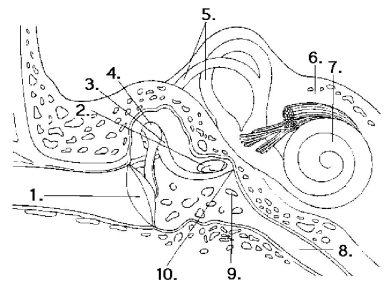 Figure 38.3
-The organ of Corti is contained in the structure numbered
Figure 38.3
-The organ of Corti is contained in the structure numbered (Multiple Choice)
4.7/5 (93)
(93) Refer to the illustration of the limbic system in Figure 38.1 to help answer the next few questions.
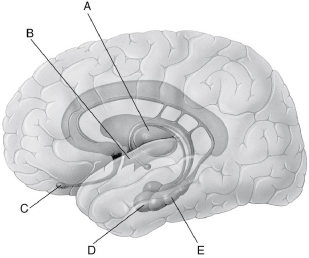 Figure 38.1
-In Figure 38.1, which letter points to the olfactory bulb?
Figure 38.1
-In Figure 38.1, which letter points to the olfactory bulb? (Multiple Choice)
4.9/5 (80)
(80) Cerebrospinal fluid can be described as all of the following except
(Multiple Choice)
4.9/5 (79)
(79) Although some sharks close their eyes just before they bite, their bites are on target. Researchers have noted that sharks often misdirect their bites at metal objects and that they can find batteries buried under sand. This evidence suggests that sharks keep track of their prey during the split second before they bite in the same way that
(Multiple Choice)
4.8/5 (77)
(77) Cephalization, the clustering of neurons and interneurons in the anterior part of the animal, is apparent in
(Multiple Choice)
4.9/5 (68)
(68) Hormones that are secreted by the posterior pituitary gland are made in the
(Multiple Choice)
4.8/5 (79)
(79) Short-term memory information processing usually causes changes in the
(Multiple Choice)
4.9/5 (89)
(89) Imagine you are resting comfortably on a sofa after dinner. This could be described as a state with
(Multiple Choice)
4.8/5 (93)
(93) If the following events are arranged in the order in which they occur for an animal hiding in response to seeing a predator, which is the fourth event in the series?
(Multiple Choice)
4.9/5 (72)
(72) Food and water appetites are under the regulatory influence of the
(Multiple Choice)
4.9/5 (77)
(77) 
Filters
- Essay(0)
- Multiple Choice(0)
- Short Answer(0)
- True False(0)
- Matching(0)