



 Chat with AI
Exam 5: Membrane Transport and Cell Signaling

Exam 1: Introduction: Evolution and the Foundations of Biology36 Questions
Exam 2: The Chemical Context of Life135 Questions
Exam 3: Carbon and the Molecular Diversity of Life121 Questions
Exam 4: A Tour of the Cell72 Questions
Exam 5: Membrane Transport and Cell Signaling89 Questions
Exam 6: An Introduction to Metabolism74 Questions
Exam 7: Cellular Respiration and Fermentation90 Questions
Exam 8: Photosynthesis71 Questions
Exam 9: The Cell Cycle63 Questions
Exam 10: Meiosis and Sexual Life Cycles65 Questions
Exam 11: Mendel and the Gene Idea65 Questions
Exam 12: The Chromosomal Basis of Inheritance46 Questions
Exam 13: The Molecular Basis of Inheritance68 Questions
Exam 14: Gene Expression: From Gene to Protein83 Questions
Exam 15: Regulation of Gene Expression53 Questions
Exam 16: Development, Stem Cells, and Cancer34 Questions
Exam 17: Viruses35 Questions
Exam 18: Genomes and Their Evolution31 Questions
Exam 19: Descent With Modification54 Questions
Exam 20: Phylogeny53 Questions
Exam 21: The Evolution of Populations69 Questions
Exam 22: The Origin of Species60 Questions
Exam 23: Broad Patterns of Evolution38 Questions
Exam 24: Early Life and the Diversification of Prokaryotes89 Questions
Exam 25: The Origin and Diversification of Eukaryotes71 Questions
Exam 26: The Colonization of Land by Plants and Fungi153 Questions
Exam 27: The Rise of Animal Diversity107 Questions
Exam 28: Plant Structure and Growth50 Questions
Exam 29: Resource Acquisition, Nutrition, and Transport in Vascular Plants130 Questions
Exam 30: Reproduction and Domestication of Flowering Plants68 Questions
Exam 31: Plant Responses to Internal and External Signals71 Questions
Exam 32: Homeostasis and Endocrine Signaling122 Questions
Exam 33: Animal Nutrition61 Questions
Exam 34: Circulation and Gas Exchange77 Questions
Exam 35: The Immune System84 Questions
Exam 36: Reproduction and Development109 Questions
Exam 37: Neurons, Synapses, and Signaling68 Questions
Exam 38: Nervous and Sensory Systems89 Questions
Exam 39: Motor Mechanisms and Behavior74 Questions
Exam 40: Population Ecology and the Distribution of Organisms92 Questions
Exam 41: Species Interactions55 Questions
Exam 42: Ecosystems and Energy79 Questions
Exam 43: Global Ecology and Conservation Biology70 Questions
Select questions type


Singer and Nicolson's fluid mosaic model of the membrane proposed that membranes
(Multiple Choice)
4.9/5  (80)
(80) Which of the following would increase the electrochemical gradient across a membrane?
(Multiple Choice)
4.7/5 (72)
(72) Some regions of the plasma membrane, called lipid rafts, have a higher concentration of cholesterol molecules. At high temperatures, these regions
(Multiple Choice)
4.9/5 (88)
(88) 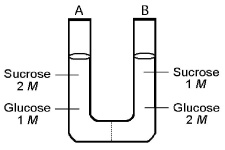 Figure 5.2
The solutions in the two arms of this U-tube are separated by a membrane that is permeable to water and glucose but not to sucrose. Side A is half-filled with a solution of 2 M sucrose and 1 M glucose. Side B is half-filled with 1 M sucrose and 2 M glucose. Initially, the liquid levels on both sides are equal.
-After the system reaches equilibrium, what changes are observed?
Figure 5.2
The solutions in the two arms of this U-tube are separated by a membrane that is permeable to water and glucose but not to sucrose. Side A is half-filled with a solution of 2 M sucrose and 1 M glucose. Side B is half-filled with 1 M sucrose and 2 M glucose. Initially, the liquid levels on both sides are equal.
-After the system reaches equilibrium, what changes are observed? (Multiple Choice)
4.8/5 (85)
(85) GTPase activity is important in the regulation of signal transduction because it
(Multiple Choice)
4.8/5 (90)
(90) Figure 5.2
The solutions in the two arms of this U-tube are separated by a membrane that is permeable to water and glucose but not to sucrose. Side A is half-filled with a solution of 2 M sucrose and 1 M glucose. Side B is half-filled with 1 M sucrose and 2 M glucose. Initially, the liquid levels on both sides are equal.
-Initially, in terms of tonicity, the solution in side A with respect to that in side B is
Figure 5.2
The solutions in the two arms of this U-tube are separated by a membrane that is permeable to water and glucose but not to sucrose. Side A is half-filled with a solution of 2 M sucrose and 1 M glucose. Side B is half-filled with 1 M sucrose and 2 M glucose. Initially, the liquid levels on both sides are equal.
-Initially, in terms of tonicity, the solution in side A with respect to that in side B is (Multiple Choice)
4.8/5 (83)
(83) Which of the following is a characteristic feature of a carrier protein in a plasma membrane?
(Multiple Choice)
4.9/5 (80)
(80) Which of these are not embedded in the hydrophobic portion of the lipid bilayer?
(Multiple Choice)
4.8/5 (83)
(83) Why are lipids and proteins free to move laterally in membranes?
(Multiple Choice)
4.7/5 (87)
(87) Which of the following types of molecules are the major structural components of the cell membrane?
(Multiple Choice)
4.9/5 (85)
(85) 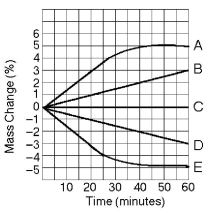 Figure 5.4
Five dialysis bags, constructed from a semipermeable membrane that is impermeable to sucrose, were filled with various concentrations of sucrose and then placed in separate beakers containing an initial concentration of 0.6 M sucrose solution. At 10-minute intervals, the bags were massed (weighed) and the percent change in mass of each bag was graphed.
-Which line in the graph represents the bag that contained a solution isotonic to the 0.6 M solution at the beginning of the experiment?
Figure 5.4
Five dialysis bags, constructed from a semipermeable membrane that is impermeable to sucrose, were filled with various concentrations of sucrose and then placed in separate beakers containing an initial concentration of 0.6 M sucrose solution. At 10-minute intervals, the bags were massed (weighed) and the percent change in mass of each bag was graphed.
-Which line in the graph represents the bag that contained a solution isotonic to the 0.6 M solution at the beginning of the experiment? (Multiple Choice)
4.9/5 (96)
(96) When biological membranes are frozen and then fractured, they tend to break along the middle of the bilayer. The best explanation for this is that
(Multiple Choice)
4.8/5 (90)
(90) Which of the following is a reasonable explanation for why unsaturated fatty acids help keep any membrane more fluid at lower temperatures?
(Multiple Choice)
4.8/5 (77)
(77) Which of the following statements is correct about diffusion?
(Multiple Choice)
4.8/5 (73)
(73) 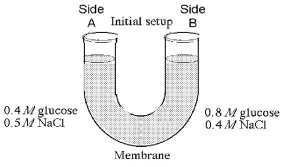 Figure 5.3
The solutions in the arms of a U-tube are separated at the bottom of the tube by a selectively permeable membrane. The membrane is permeable to sodium chloride but not to glucose. Side A is filled with a solution of 0.4 M glucose and 0.5 M sodium chloride (NaCl), and side B is filled with a solution containing 0.8 M glucose and 0.4 M sodium chloride. Initially, the volume in both arms is the same. Refer to the figure to answer the following questions.
-If you examine side A after three days, you should find
Figure 5.3
The solutions in the arms of a U-tube are separated at the bottom of the tube by a selectively permeable membrane. The membrane is permeable to sodium chloride but not to glucose. Side A is filled with a solution of 0.4 M glucose and 0.5 M sodium chloride (NaCl), and side B is filled with a solution containing 0.8 M glucose and 0.4 M sodium chloride. Initially, the volume in both arms is the same. Refer to the figure to answer the following questions.
-If you examine side A after three days, you should find (Multiple Choice)
4.7/5 (84)
(84) Which of the following membrane activities requires energy from ATP hydrolysis?
(Multiple Choice)
4.7/5 (81)
(81) Figure 5.4
Five dialysis bags, constructed from a semipermeable membrane that is impermeable to sucrose, were filled with various concentrations of sucrose and then placed in separate beakers containing an initial concentration of 0.6 M sucrose solution. At 10-minute intervals, the bags were massed (weighed) and the percent change in mass of each bag was graphed.
-Which line or lines in the graph represent(s) bags that contain a solution that is hypertonic at 50 minutes?
Figure 5.4
Five dialysis bags, constructed from a semipermeable membrane that is impermeable to sucrose, were filled with various concentrations of sucrose and then placed in separate beakers containing an initial concentration of 0.6 M sucrose solution. At 10-minute intervals, the bags were massed (weighed) and the percent change in mass of each bag was graphed.
-Which line or lines in the graph represent(s) bags that contain a solution that is hypertonic at 50 minutes? (Multiple Choice)
4.8/5 (86)
(86) The cell membranes of Antarctic ice fish might have which of the following adaptations?
(Multiple Choice)
4.9/5 (71)
(71) What is most likely to happen to an animal's target cells that lack receptors for local regulators?
(Multiple Choice)
4.9/5 (85)
(85) 
Filters
- Essay(0)
- Multiple Choice(0)
- Short Answer(0)
- True False(0)
- Matching(0)