



 Chat with AI
Exam 1: Biology: Exploring Life

Exam 1: Biology: Exploring Life47 Questions
Exam 2: The Chemical Basis of Life73 Questions
Exam 3: The Molecules of Cells89 Questions
Exam 4: A Tour of the Cell93 Questions
Exam 5: The Working Cell81 Questions
Exam 6: How Cells Harvest Chemical Energy82 Questions
Exam 7: Photosynthesis: Using Light to Make Food83 Questions
Exam 8: The Cellular Basis of Reproduction and Inheritance81 Questions
Exam 9: Patterns of Inheritance76 Questions
Exam 10: Molecular Biology of the Gene85 Questions
Exam 11: How Genes Are Controlled84 Questions
Exam 12: DNA Technology and Genomics80 Questions
Exam 13: How Populations Evolve67 Questions
Exam 14: The Origin of Species59 Questions
Exam 15: Tracing Evolutionary History88 Questions
Exam 16: Microbial Life: Prokaryotes and Protists80 Questions
Exam 17: The Evolution of Plant and Fungal Diversity85 Questions
Exam 18: The Evolution of Invertebrate Diversity81 Questions
Exam 19: The Evolution of Vertebrate Diversity77 Questions
Exam 20: Unifying Concepts of Animal Structure and Function68 Questions
Exam 21: Nutrition and Digestion96 Questions
Exam 22: Gas Exchange68 Questions
Exam 23: Circulation81 Questions
Exam 24: The Immune System76 Questions
Exam 25: Control of Body Temperature and Water Balance67 Questions
Exam 26: Hormones and the Endocrine System66 Questions
Exam 27: Reproduction and Embryonic Development88 Questions
Exam 28: Nervous Systems75 Questions
Exam 29: The Senses62 Questions
Exam 30: How Animals Move72 Questions
Exam 31: Plant Structure, Growth, and Reproduction81 Questions
Exam 32: Plant Nutrition and Transport69 Questions
Exam 33: Control Systems in Plants61 Questions
Exam 34: The Biosphere: an Introduction to Earths Diverse Environments61 Questions
Exam 35: Behavioral Adaptations to the Environment54 Questions
Exam 36: Population Ecology57 Questions
Exam 37: Communities and Ecosystems62 Questions
Exam 38: Conservation Biology61 Questions
Select questions type


Researchers have created a robot that has a very thin leg that is moved by cardiac (heart) cells contracting in unison. The robot, made of a polymer similar to that used in making contact lenses, is bathed in heart cells with supporting cells, which then attach to the robot and provide movement as they contract.
-All of the cardiac cells working together can cause the robot leg to move in a way that individual cells could not. This is an example of
(Multiple Choice)
4.9/5  (77)
(77) When a scientist examined museum specimens of a particular moth species, she noticed that the variation in color was distributed as shown in the first graph. She was surprised because her data from current collections indicated the distribution of colors shown in the second graph. Which hypothesis about the cause of this shift in the range of genetic variation is the most likely to be supported by examination of the distribution of colors in a collection assembled at a time between that of the collection of the museum specimens and her current specimens? 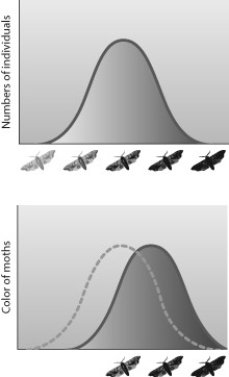
(Multiple Choice)
4.8/5 (79)
(79) Researchers have created a robot that has a very thin leg that is moved by cardiac (heart) cells contracting in unison. The robot, made of a polymer similar to that used in making contact lenses, is bathed in heart cells with supporting cells, which then attach to the robot and provide movement as they contract.
-If the creators of the robot wanted to provide evidence that it is alive, which of the following properties would be best to use as evidence?
(Multiple Choice)
4.9/5 (66)
(66) Scientists interested in knowing the best way to restore an area after a temporary road was built through it completed a study comparing two treatments: (1) restoring the contour of an area so that there was no longer a depression or cut-through where the road was previously and (2) simply abandoning the area to allow vegetation to return on its own. They wanted to know whether either or both of these treatments would return the aboveground vegetation and the belowground soil properties to their original state, as seen in a similar area where there had never been a road.
-In this experiment, the area that had never had a road is useful to the experiment because
(Multiple Choice)
4.7/5 (68)
(68) Which statement best describes the relationship between a tissue and an organ system?
(Multiple Choice)
4.8/5 (74)
(74) Researchers set up a study to determine whether large doses of a nutritional supplement would shorten the length of time it takes to recover from a cold. Three thousand volunteers were split into two groups. For two weeks, members of group A took 3,000 mg of the supplement daily. Group B received 3,000 mg of a placebo (sugar pill). At the end of the two-week period, the researchers inserted live cold viruses directly into the noses of all the volunteers. The volunteers in both group A and group B continued to take their daily pills. All the volunteers got colds, and there was no significant difference in the length of time the colds lasted.
-To have confidence that the results of the experiment were valid, you'd also want to know
(Multiple Choice)
4.9/5 (77)
(77) 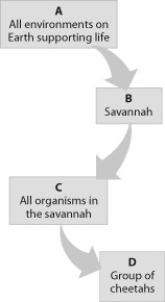
Which sequence is not a correct pathway of energy through an ecosystem?
(Multiple Choice)
4.8/5 (75)
(75) Life is organized in a hierarchical fashion. Which sequence correctly lists that hierarchy from least inclusive to most inclusive?
(Multiple Choice)
4.8/5 (75)
(75)  This graph shows an increase in the number of species of pesticide-resistant insects from 1900 to 2000.
-Based on the graph, during what years did pesticide application likely become prevalent?
This graph shows an increase in the number of species of pesticide-resistant insects from 1900 to 2000.
-Based on the graph, during what years did pesticide application likely become prevalent? (Multiple Choice)
4.8/5 (82)
(82) An antibiotic kills 99.9% of a bacterial population. You would expect the next generation of bacteria to
(Multiple Choice)
4.7/5 (78)
(78) 
Filters
- Essay(0)
- Multiple Choice(0)
- Short Answer(0)
- True False(0)
- Matching(0)