



 Chat with AI
Exam 11: How Genes Are Controlled

Exam 1: Biology: Exploring Life47 Questions
Exam 2: The Chemical Basis of Life73 Questions
Exam 3: The Molecules of Cells89 Questions
Exam 4: A Tour of the Cell93 Questions
Exam 5: The Working Cell81 Questions
Exam 6: How Cells Harvest Chemical Energy82 Questions
Exam 7: Photosynthesis: Using Light to Make Food83 Questions
Exam 8: The Cellular Basis of Reproduction and Inheritance81 Questions
Exam 9: Patterns of Inheritance76 Questions
Exam 10: Molecular Biology of the Gene85 Questions
Exam 11: How Genes Are Controlled84 Questions
Exam 12: DNA Technology and Genomics80 Questions
Exam 13: How Populations Evolve67 Questions
Exam 14: The Origin of Species59 Questions
Exam 15: Tracing Evolutionary History88 Questions
Exam 16: Microbial Life: Prokaryotes and Protists80 Questions
Exam 17: The Evolution of Plant and Fungal Diversity85 Questions
Exam 18: The Evolution of Invertebrate Diversity81 Questions
Exam 19: The Evolution of Vertebrate Diversity77 Questions
Exam 20: Unifying Concepts of Animal Structure and Function68 Questions
Exam 21: Nutrition and Digestion96 Questions
Exam 22: Gas Exchange68 Questions
Exam 23: Circulation81 Questions
Exam 24: The Immune System76 Questions
Exam 25: Control of Body Temperature and Water Balance67 Questions
Exam 26: Hormones and the Endocrine System66 Questions
Exam 27: Reproduction and Embryonic Development88 Questions
Exam 28: Nervous Systems75 Questions
Exam 29: The Senses62 Questions
Exam 30: How Animals Move72 Questions
Exam 31: Plant Structure, Growth, and Reproduction81 Questions
Exam 32: Plant Nutrition and Transport69 Questions
Exam 33: Control Systems in Plants61 Questions
Exam 34: The Biosphere: an Introduction to Earths Diverse Environments61 Questions
Exam 35: Behavioral Adaptations to the Environment54 Questions
Exam 36: Population Ecology57 Questions
Exam 37: Communities and Ecosystems62 Questions
Exam 38: Conservation Biology61 Questions
Select questions type


In multicellular organisms, the coordination of cellular activities relies on
(Multiple Choice)
4.9/5  (82)
(82) While DNA microarrays can be used to determine whether or not a gene is expressed in a cell, quantitative polymerase chain reaction (qPCR) can be used to specifically quantify the extent of gene expression in cells and tissues. To perform qPCR, mRNA is extracted from cells and reverse transcribed to complementary DNA (cDNA). Using fluorescent DNA molecules that recognize specific gene sequences and DNA polymerase, copies of the gene sequence of interest are made. After the copies are made, a fluorescent detector measures the intensity of the fluorescent signal, which is proportional to the number of mRNA transcripts in the cell and corresponds to the level of gene expression in the cell.
-In a muscle cell, the contractile protein myosin is present in larger quantities than the structural protein actin. Which of the following qPCR results would support this observation?
(Multiple Choice)
4.7/5 (78)
(78) Which statement regarding skin cells and muscle cells in your body is true?
(Multiple Choice)
4.7/5 (82)
(82) What is the correct order of structures in a chromosome from smallest to largest?
(Multiple Choice)
4.8/5 (80)
(80) Which of the following statements regarding cancer risk factors is false?
(Multiple Choice)
4.8/5 (83)
(83) There is a mutation in the operator of the trp operon in a cell such that the trp repressor is unable to bind to the operator. If tryptophan is added to the cell, what will happen?
(Multiple Choice)
4.8/5 (80)
(80) Melanoma (skin cancer) can develop after several mutations occur in skin cells. If a woman is diagnosed with melanoma and becomes pregnant, what are the chances that her offspring will inherit melanoma?
(Multiple Choice)
4.8/5 (93)
(93) During an experiment assessing the development of a fly embryo, a scientist artificially turns on a homeotic gene that controls eye development in somatic cells that normally develop into the wings. Which of the following is the most likely outcome of this experiment?
(Multiple Choice)
5.0/5 (69)
(69) Half the trees in an orchard were derived from rootstock "A" and half from rootstock "B," but all the trees had the same scion. If the trees grafted onto rootstock "A" were infected by a parasite that causes blossom rot, the trees grafted onto rootstock "B"
(Multiple Choice)
4.8/5 (71)
(71) A stomach cell is producing pepsin, an enzyme that hydrolyzes proteins. Which of the following events suggests that gene expression of pepsin has been turned off in the cell?
(Multiple Choice)
4.9/5 (83)
(83) 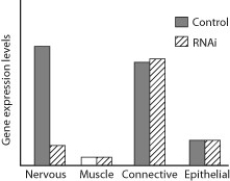 Gene knockdown is a procedure used to reduce gene expression in cells or organisms so that scientists can investigate gene function. While there are several ways to knock down gene expression, RNAi is one of the most commonly used approaches. Suppose that a research team wants to investigate where a new gene X is expressed in the fruit fly, Drosophila melanogaster. Using RNAi, they obtained the results shown below examining the expression of gene X in four types of tissues.
-Which of the following physiological results would you possibly find in the Drosophila that underwent RNAi against gene X?
Gene knockdown is a procedure used to reduce gene expression in cells or organisms so that scientists can investigate gene function. While there are several ways to knock down gene expression, RNAi is one of the most commonly used approaches. Suppose that a research team wants to investigate where a new gene X is expressed in the fruit fly, Drosophila melanogaster. Using RNAi, they obtained the results shown below examining the expression of gene X in four types of tissues.
-Which of the following physiological results would you possibly find in the Drosophila that underwent RNAi against gene X? (Multiple Choice)
4.8/5 (72)
(72) Which structure in this figure shows one complete nucleosome? 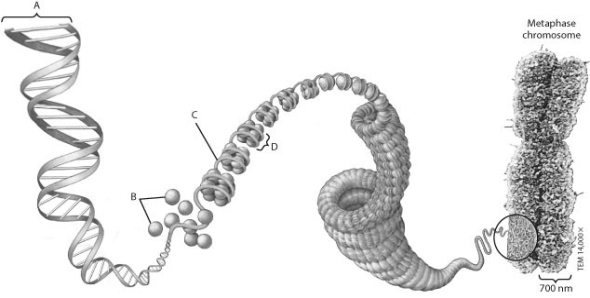
(Multiple Choice)
4.8/5 (88)
(88) 
Filters
- Essay(0)
- Multiple Choice(0)
- Short Answer(0)
- True False(0)
- Matching(0)