



 Chat with AI
Exam 22: Gas Exchange

Exam 1: Biology: Exploring Life47 Questions
Exam 2: The Chemical Basis of Life73 Questions
Exam 3: The Molecules of Cells89 Questions
Exam 4: A Tour of the Cell93 Questions
Exam 5: The Working Cell81 Questions
Exam 6: How Cells Harvest Chemical Energy82 Questions
Exam 7: Photosynthesis: Using Light to Make Food83 Questions
Exam 8: The Cellular Basis of Reproduction and Inheritance81 Questions
Exam 9: Patterns of Inheritance76 Questions
Exam 10: Molecular Biology of the Gene85 Questions
Exam 11: How Genes Are Controlled84 Questions
Exam 12: DNA Technology and Genomics80 Questions
Exam 13: How Populations Evolve67 Questions
Exam 14: The Origin of Species59 Questions
Exam 15: Tracing Evolutionary History88 Questions
Exam 16: Microbial Life: Prokaryotes and Protists80 Questions
Exam 17: The Evolution of Plant and Fungal Diversity85 Questions
Exam 18: The Evolution of Invertebrate Diversity81 Questions
Exam 19: The Evolution of Vertebrate Diversity77 Questions
Exam 20: Unifying Concepts of Animal Structure and Function68 Questions
Exam 21: Nutrition and Digestion96 Questions
Exam 22: Gas Exchange68 Questions
Exam 23: Circulation81 Questions
Exam 24: The Immune System76 Questions
Exam 25: Control of Body Temperature and Water Balance67 Questions
Exam 26: Hormones and the Endocrine System66 Questions
Exam 27: Reproduction and Embryonic Development88 Questions
Exam 28: Nervous Systems75 Questions
Exam 29: The Senses62 Questions
Exam 30: How Animals Move72 Questions
Exam 31: Plant Structure, Growth, and Reproduction81 Questions
Exam 32: Plant Nutrition and Transport69 Questions
Exam 33: Control Systems in Plants61 Questions
Exam 34: The Biosphere: an Introduction to Earths Diverse Environments61 Questions
Exam 35: Behavioral Adaptations to the Environment54 Questions
Exam 36: Population Ecology57 Questions
Exam 37: Communities and Ecosystems62 Questions
Exam 38: Conservation Biology61 Questions
Select questions type


When bar-headed geese fly at very high altitudes (possibly over Mount Everest!), they breathe very thin air where the partial pressure of oxygen is very low compared to that at sea level. Which of the following adaptions would help the geese efficiently exchange gases when flying at high altitudes?
(Multiple Choice)
4.8/5  (87)
(87) Pulmonary fibrosis is a lung disease that is characterized by damage and scarring of lung tissue. This results in the lungs becoming stiff and inelastic. What function is most likely to be impaired in someone with pulmonary fibrosis?
(Multiple Choice)
4.9/5 (79)
(79) Physicians routinely give their patients pulmonary function tests in order to measure characteristics of lung function. The most common of these tests, spirometry, measures both the volume and the speed of air entering and exiting the lungs. In this test, a person first breathes normally while breathing into a spirometer, a machine that measures air volume and air speed. Then the person takes the deepest breath possible and exhales as hard as possible for 6 seconds into the spirometer. The resulting data are plotted on a graph of volume (y axis) versus time (x axis). Spirometry is useful not only for assessing lung function in healthy patients but also for characterizing patients with lung conditions such as pulmonary fibrosis, asthma, or emphysema.
A sample graph for a healthy adult male is shown below. Normal breathing occurs between points A and B, a maximal inhalation occurs at point C, and a maximal exhalation occurs at point D. Normal breathing resumes between points E and F.
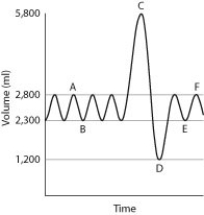 -For this data set, what is the vital capacity?
 (Multiple Choice)
4.8/5 (83)
(83) When bar-headed geese fly at very high altitudes (possibly over Mount Everest!), they breathe very thin air where the partial pressure of oxygen is very low compared to that at sea level. They are able to do this because they have a modified version of the hemoglobin protein. To which of the following is their hemoglobin protein most likely similar in terms of its ability to bind oxygen?
(Multiple Choice)
5.0/5 (81)
(81) Which respiratory structure likely has the largest surface area for gas exchange to occur?
(Multiple Choice)
4.8/5 (95)
(95) Which of the following contributes to gas exchange in the human fetus?
(Multiple Choice)
5.0/5 (76)
(76) Many amphibians (including many frogs, toads, and salamanders) spend the early part of their lives in water but live on land as adults. The adults of many species return to water to breed and lay their eggs. Frogs have small lungs and supplement their oxygen intake by breathing through the skin. Although large frogs have more total surface area than smaller frogs, the larger frogs have a lower surface area/volume ratio (less skin surface relative to their total body volume). To keep their respiratory surfaces moist, frogs are generally found in wet or very moist locations.
In an experiment designed to investigate oxygen consumption in relation to body size, frogs from five different species were weighed and placed in a respirometer (a machine that measures oxygen consumption) for 1 hour. The table shows the results of the experiment.
Species Average Weight (grams) Oxygen Consumption in One Hour (cc) A 7 0.35 B 11 0.55 C 15 0.75 D 21 1.05 E 37 1.85
-From the data in the table, it is reasonable to conclude that
(Multiple Choice)
4.7/5 (83)
(83) The flow rate of a gas through a tube is proportional to the diameter of the tube. Through which structure in the human respiratory system does air flow the fastest?
(Multiple Choice)
4.8/5 (80)
(80) The organization of blood and water flow in a fish's gills increases the fish's ability to
(Multiple Choice)
4.8/5 (74)
(74) Which option correctly lists the direction carbon dioxide travels as it leaves the body of a human?
(Multiple Choice)
5.0/5 (75)
(75) The reason animals need a continuous supply of oxygen is to
(Multiple Choice)
4.8/5 (91)
(91) Which of the following statements about fish gills is true?
(Multiple Choice)
4.8/5 (81)
(81) 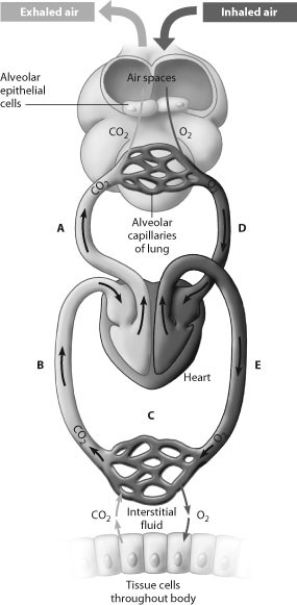 -At which point(s) in the figure is blood oxygen-rich?
What is the name of the muscle that helps move air in and out of the lungs?
(Multiple Choice)
4.9/5 (64)
(64) 
Filters
- Essay(0)
- Multiple Choice(0)
- Short Answer(0)
- True False(0)
- Matching(0)