



 Chat with AI
Exam 23: Circulation

Exam 1: Biology: Exploring Life47 Questions
Exam 2: The Chemical Basis of Life73 Questions
Exam 3: The Molecules of Cells89 Questions
Exam 4: A Tour of the Cell93 Questions
Exam 5: The Working Cell81 Questions
Exam 6: How Cells Harvest Chemical Energy82 Questions
Exam 7: Photosynthesis: Using Light to Make Food83 Questions
Exam 8: The Cellular Basis of Reproduction and Inheritance81 Questions
Exam 9: Patterns of Inheritance76 Questions
Exam 10: Molecular Biology of the Gene85 Questions
Exam 11: How Genes Are Controlled84 Questions
Exam 12: DNA Technology and Genomics80 Questions
Exam 13: How Populations Evolve67 Questions
Exam 14: The Origin of Species59 Questions
Exam 15: Tracing Evolutionary History88 Questions
Exam 16: Microbial Life: Prokaryotes and Protists80 Questions
Exam 17: The Evolution of Plant and Fungal Diversity85 Questions
Exam 18: The Evolution of Invertebrate Diversity81 Questions
Exam 19: The Evolution of Vertebrate Diversity77 Questions
Exam 20: Unifying Concepts of Animal Structure and Function68 Questions
Exam 21: Nutrition and Digestion96 Questions
Exam 22: Gas Exchange68 Questions
Exam 23: Circulation81 Questions
Exam 24: The Immune System76 Questions
Exam 25: Control of Body Temperature and Water Balance67 Questions
Exam 26: Hormones and the Endocrine System66 Questions
Exam 27: Reproduction and Embryonic Development88 Questions
Exam 28: Nervous Systems75 Questions
Exam 29: The Senses62 Questions
Exam 30: How Animals Move72 Questions
Exam 31: Plant Structure, Growth, and Reproduction81 Questions
Exam 32: Plant Nutrition and Transport69 Questions
Exam 33: Control Systems in Plants61 Questions
Exam 34: The Biosphere: an Introduction to Earths Diverse Environments61 Questions
Exam 35: Behavioral Adaptations to the Environment54 Questions
Exam 36: Population Ecology57 Questions
Exam 37: Communities and Ecosystems62 Questions
Exam 38: Conservation Biology61 Questions
Select questions type


Arteries are distinguished from veins based on all of the following features except the
(Multiple Choice)
4.8/5  (73)
(73) In which of the following human blood vessels is the blood pressure lowest?
(Multiple Choice)
4.7/5 (91)
(91) Electrocardiographs (ECGs or EKGs) provide data about the electrical activity of the heart. By placing a series of "leads" on a person's chest, the electrical activity of the heart can be recorded and analyzed in order to detect irregular heartbeats (arrhythmias) and other conditions. The figure below shows a normal EKG tracing for one cardiac cycle.
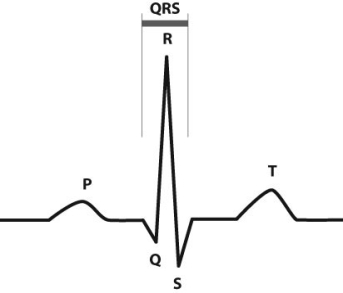 The P region represents electrical activity spreading through the atria. The QRS region represents electrical activity spreading through the ventricles. The T region represents electrical activity in the ventricles returning to rest.
-Suppose a person's AV node in their heart suddenly stopped sending signals to the rest of the heart. How would this person's EKG differ from normal?
The P region represents electrical activity spreading through the atria. The QRS region represents electrical activity spreading through the ventricles. The T region represents electrical activity in the ventricles returning to rest.
-Suppose a person's AV node in their heart suddenly stopped sending signals to the rest of the heart. How would this person's EKG differ from normal? (Multiple Choice)
4.8/5 (75)
(75) Electrocardiographs (ECGs or EKGs) provide data about the electrical activity of the heart. By placing a series of "leads" on a person's chest, the electrical activity of the heart can be recorded and analyzed in order to detect irregular heartbeats (arrhythmias) and other conditions. The figure below shows a normal EKG tracing for one cardiac cycle.
The P region represents electrical activity spreading through the atria. The QRS region represents electrical activity spreading through the ventricles. The T region represents electrical activity in the ventricles returning to rest.
-Suppose a person has a heart rate of 60 beats/min and that the start of the P region until the end of the T region represents one cardiac cycle. If the x axis in the EKG is time, approximately how much time passes between the start of the P region and the end of the T region?
The P region represents electrical activity spreading through the atria. The QRS region represents electrical activity spreading through the ventricles. The T region represents electrical activity in the ventricles returning to rest.
-Suppose a person has a heart rate of 60 beats/min and that the start of the P region until the end of the T region represents one cardiac cycle. If the x axis in the EKG is time, approximately how much time passes between the start of the P region and the end of the T region? (Multiple Choice)
4.9/5 (72)
(72) Using a stethoscope, you listen to a beating heart and hear "lub-dup, lub-dup." These sounds are created by
(Multiple Choice)
4.8/5 (70)
(70) Which of the following animals has a three-chambered heart?
(Multiple Choice)
4.8/5 (81)
(81) One way that substances move between blood and interstitial fluid is by
(Multiple Choice)
4.9/5 (79)
(79) In mammals, blood returning from the head will pass through the ________ just before entering the right atrium.
(Multiple Choice)
4.9/5 (84)
(84) During exercise, your heart rate can increase dramatically in order to meet the metabolic demands of your tissues. If your heart rate increased to 144 beats per minute, approximately how long would diastole last in a single cardiac cycle?
(Multiple Choice)
4.7/5 (77)
(77) 
Which of the following is characteristic of the circulatory system of arthropods?
(Multiple Choice)
4.8/5 (84)
(84) A red blood cell is in an artery in the right leg. How many capillary beds will it pass through before it returns to the left atrium of the heart?
(Multiple Choice)
4.7/5 (71)
(71) Which of the following statements about blood clotting is true?
(Multiple Choice)
4.9/5 (70)
(70) What type of blood vessel is solely responsible for exchange between the blood and the interstitial fluid?
(Multiple Choice)
5.0/5 (81)
(81) Plasma proteins are involved in all of the following activities except
(Multiple Choice)
4.8/5 (90)
(90) During ventricular systole, the semilunar valves ________ and the AV valves ________.
(Multiple Choice)
4.8/5 (85)
(85) 
Filters
- Essay(0)
- Multiple Choice(0)
- Short Answer(0)
- True False(0)
- Matching(0)