



 Chat with AI
Exam 26: Hormones and the Endocrine System

Exam 1: Biology: Exploring Life47 Questions
Exam 2: The Chemical Basis of Life73 Questions
Exam 3: The Molecules of Cells89 Questions
Exam 4: A Tour of the Cell93 Questions
Exam 5: The Working Cell81 Questions
Exam 6: How Cells Harvest Chemical Energy82 Questions
Exam 7: Photosynthesis: Using Light to Make Food83 Questions
Exam 8: The Cellular Basis of Reproduction and Inheritance81 Questions
Exam 9: Patterns of Inheritance76 Questions
Exam 10: Molecular Biology of the Gene85 Questions
Exam 11: How Genes Are Controlled84 Questions
Exam 12: DNA Technology and Genomics80 Questions
Exam 13: How Populations Evolve67 Questions
Exam 14: The Origin of Species59 Questions
Exam 15: Tracing Evolutionary History88 Questions
Exam 16: Microbial Life: Prokaryotes and Protists80 Questions
Exam 17: The Evolution of Plant and Fungal Diversity85 Questions
Exam 18: The Evolution of Invertebrate Diversity81 Questions
Exam 19: The Evolution of Vertebrate Diversity77 Questions
Exam 20: Unifying Concepts of Animal Structure and Function68 Questions
Exam 21: Nutrition and Digestion96 Questions
Exam 22: Gas Exchange68 Questions
Exam 23: Circulation81 Questions
Exam 24: The Immune System76 Questions
Exam 25: Control of Body Temperature and Water Balance67 Questions
Exam 26: Hormones and the Endocrine System66 Questions
Exam 27: Reproduction and Embryonic Development88 Questions
Exam 28: Nervous Systems75 Questions
Exam 29: The Senses62 Questions
Exam 30: How Animals Move72 Questions
Exam 31: Plant Structure, Growth, and Reproduction81 Questions
Exam 32: Plant Nutrition and Transport69 Questions
Exam 33: Control Systems in Plants61 Questions
Exam 34: The Biosphere: an Introduction to Earths Diverse Environments61 Questions
Exam 35: Behavioral Adaptations to the Environment54 Questions
Exam 36: Population Ecology57 Questions
Exam 37: Communities and Ecosystems62 Questions
Exam 38: Conservation Biology61 Questions
Select questions type


Scientific investigation of the exact effects of environmental steroids on humans is extremely difficult since there are multiple sources of hormones in the environment. A valid study would require a control group that has not been exposed to the chemicals being studied. Since everyone has had some exposure to environmental hormones, no control group is available to use as a reference.
Another way to assess the environmental hazard due to steroid hormones is to analyze the amount of residual hormones present following commercial water treatment by water treatment plants.
-Which situation would make researchers suspect that there was an excess of steroid hormones in the environment?
(Multiple Choice)
4.9/5  (74)
(74) Which gland secretes hormones that enable the body to respond to stress?
(Multiple Choice)
4.8/5 (73)
(73) Which may be a consequence of low secretion of parathyroid hormone?
(Multiple Choice)
5.0/5 (78)
(78) Which molecule in this figure portraying water-soluble hormone action is the receptor protein? 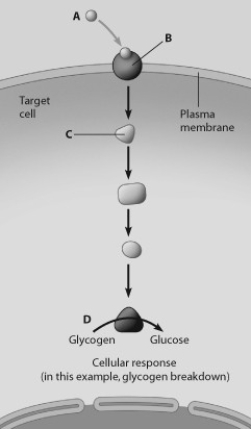
(Multiple Choice)
4.9/5 (79)
(79) An excess of T3 and T4 in the blood is hyperthyroidism, which in its most common form is called
(Multiple Choice)
4.8/5 (79)
(79) Results of the experiment yield the data shown in the following graph. What is one overall conclusion that you can draw from these results? 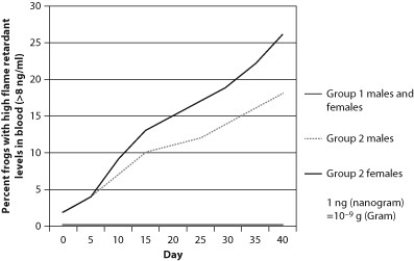 The figure shows the percentage of male and female frogs with flame retardants in their blood in two groups: Group 1 was not exposed to flame retardants, and group 2 was exposed to low doses.
 (Multiple Choice)
4.9/5 (69)
(69) Which hormone stimulates and maintains metabolic processes?
(Multiple Choice)
4.9/5 (80)
(80) Feeling tired after a long day of work, you walk across a parking lot at night to get to your car. As you approach the car you see a shadow extending behind the back of the car. You immediately feel a rush of energy, your heart starts pounding, and you feel wide awake and alert. You are experiencing
(Multiple Choice)
4.9/5 (76)
(76) Anabolic steroid abuse, the self-administration of hormones such as testosterone for body building or other nonmedical uses, is an increasing concern in society. A study of the effects of added testosterone on behavior yielded the data shown below. They are from the responses to testosterone treatment based on a scale of manic (excited or irritable) behavior for six adult males. Black bars indicate testosterone administration time and white bars indicate placebo administration time. The asterisk for the first subject indicates discontinuation of testosterone treatment after week 5 because of rapidly escalating manic symptoms.
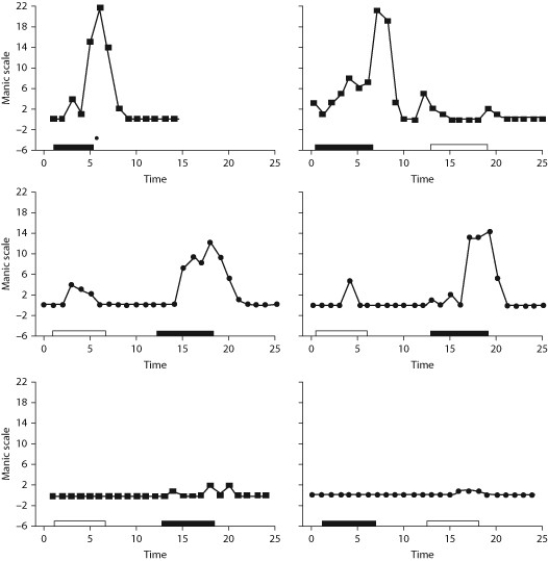 Source: Pople, H. G., Kouri, E. M., & Hudson, J. I. (2000). Effects of supraphysiologic doses of testosterone on mood and aggression in normal men: a randomized controlled trial. Archives of general psychiatry, 57(2): 133-140.
-Abnormal levels of testosterone might also be expected to cause
Source: Pople, H. G., Kouri, E. M., & Hudson, J. I. (2000). Effects of supraphysiologic doses of testosterone on mood and aggression in normal men: a randomized controlled trial. Archives of general psychiatry, 57(2): 133-140.
-Abnormal levels of testosterone might also be expected to cause (Multiple Choice)
4.9/5 (73)
(73) Which is an endocrine gland that raises blood calcium levels?
(Multiple Choice)
4.9/5 (89)
(89) Which option correctly pairs an endocrine gland or hormone with an aspect of metabolism that it regulates?
(Multiple Choice)
4.8/5 (81)
(81) Which hormone causes glucose release and, consequently, a rise in the concentration of sugar in the blood?
(Multiple Choice)
4.9/5 (61)
(61) A mutation in the gene for hormone A causes it to be unable to bind to its receptor protein. What do you predict will likely happen?
(Multiple Choice)
5.0/5 (82)
(82) Which gland requires the element iodine to produce its hormones?
(Multiple Choice)
4.8/5 (85)
(85) 
Filters
- Essay(0)
- Multiple Choice(0)
- Short Answer(0)
- True False(0)
- Matching(0)