



 Chat with AI
Exam 36: Population Ecology

Exam 1: Biology: Exploring Life47 Questions
Exam 2: The Chemical Basis of Life73 Questions
Exam 3: The Molecules of Cells89 Questions
Exam 4: A Tour of the Cell93 Questions
Exam 5: The Working Cell81 Questions
Exam 6: How Cells Harvest Chemical Energy82 Questions
Exam 7: Photosynthesis: Using Light to Make Food83 Questions
Exam 8: The Cellular Basis of Reproduction and Inheritance81 Questions
Exam 9: Patterns of Inheritance76 Questions
Exam 10: Molecular Biology of the Gene85 Questions
Exam 11: How Genes Are Controlled84 Questions
Exam 12: DNA Technology and Genomics80 Questions
Exam 13: How Populations Evolve67 Questions
Exam 14: The Origin of Species59 Questions
Exam 15: Tracing Evolutionary History88 Questions
Exam 16: Microbial Life: Prokaryotes and Protists80 Questions
Exam 17: The Evolution of Plant and Fungal Diversity85 Questions
Exam 18: The Evolution of Invertebrate Diversity81 Questions
Exam 19: The Evolution of Vertebrate Diversity77 Questions
Exam 20: Unifying Concepts of Animal Structure and Function68 Questions
Exam 21: Nutrition and Digestion96 Questions
Exam 22: Gas Exchange68 Questions
Exam 23: Circulation81 Questions
Exam 24: The Immune System76 Questions
Exam 25: Control of Body Temperature and Water Balance67 Questions
Exam 26: Hormones and the Endocrine System66 Questions
Exam 27: Reproduction and Embryonic Development88 Questions
Exam 28: Nervous Systems75 Questions
Exam 29: The Senses62 Questions
Exam 30: How Animals Move72 Questions
Exam 31: Plant Structure, Growth, and Reproduction81 Questions
Exam 32: Plant Nutrition and Transport69 Questions
Exam 33: Control Systems in Plants61 Questions
Exam 34: The Biosphere: an Introduction to Earths Diverse Environments61 Questions
Exam 35: Behavioral Adaptations to the Environment54 Questions
Exam 36: Population Ecology57 Questions
Exam 37: Communities and Ecosystems62 Questions
Exam 38: Conservation Biology61 Questions
Select questions type


An ecologist hypothesizes that predation by a particular owl species is the major factor controlling the population of a particular rabbit species. If this is the case, which of the following population effects could be expected in this rabbit-owl pair?
(Multiple Choice)
4.9/5  (86)
(86) Consider a stable frog population living at carrying capacity in a pond. If an average female produces 6,000 eggs during her lifetime and an average of 300 tadpoles hatch from these eggs, how many of these tadpoles will, on average, survive to reproduce?
(Multiple Choice)
4.8/5 (88)
(88) If a population has a birth rate of 40 individuals per 1,000 per year and a death rate of 30 individuals per 1,000 per year, how will the population change each year? (Assume that the population is below carrying capacity and that there is no immigration or emigration.)
(Multiple Choice)
4.9/5 (74)
(74) Thanks to a new conservation program, a population with only 200 individuals at the beginning of the year is growing exponentially. The population has a per capita birth rate of 0.5 per year and a death rate of 0.2 per year. What is the growth rate during the year? What will the population be at the end of the year?
(Multiple Choice)
4.9/5 (76)
(76) In terms of population dynamics, "boom-and-bust" cycling is a situation in which
(Multiple Choice)
4.9/5 (83)
(83) Examine the age structure of Germany in the following figure. Which conclusion is not supported by the age structure? 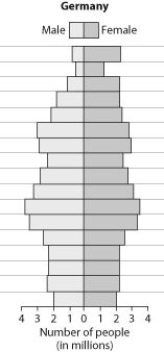
(Multiple Choice)
4.7/5 (84)
(84) The density of Douglas firs in an old-growth forest is estimated by counting the Douglas firs in four sample plots of 1 hectare each. The number of fir trees in the plots is 10, 12, 7, and 11, respectively. What is the estimated density of firs in the forest?
(Multiple Choice)
4.8/5 (73)
(73) An ecologist hypothesizes that predation by a particular owl species is the major factor controlling the population of a particular rabbit species. The first step in testing this hypothesis would be to determine
(Multiple Choice)
4.8/5 (78)
(78) Which example is most clearly a case of density-dependent population regulation?
(Multiple Choice)
4.7/5 (102)
(102) If a population of 5,000 zebras is growing logistically and has a carrying capacity of 10,000, what would the per capita rate of increase be if the population grew by 50 zebras in 1 year?
(Multiple Choice)
4.7/5 (79)
(79) A test tube is inoculated with 1 × 10³ cells of a bacterial strain that has a generation time of 30 minutes. The carrying capacity of the test tube for this strain is 6 × 10⁹ cells. What will the bacterial population be after 90 minutes of culturing?
(Multiple Choice)
5.0/5 (84)
(84) 
Filters
- Essay(0)
- Multiple Choice(0)
- Short Answer(0)
- True False(0)
- Matching(0)