



 Chat with AI
Exam 38: Conservation Biology

Exam 1: Biology: Exploring Life47 Questions
Exam 2: The Chemical Basis of Life73 Questions
Exam 3: The Molecules of Cells89 Questions
Exam 4: A Tour of the Cell93 Questions
Exam 5: The Working Cell81 Questions
Exam 6: How Cells Harvest Chemical Energy82 Questions
Exam 7: Photosynthesis: Using Light to Make Food83 Questions
Exam 8: The Cellular Basis of Reproduction and Inheritance81 Questions
Exam 9: Patterns of Inheritance76 Questions
Exam 10: Molecular Biology of the Gene85 Questions
Exam 11: How Genes Are Controlled84 Questions
Exam 12: DNA Technology and Genomics80 Questions
Exam 13: How Populations Evolve67 Questions
Exam 14: The Origin of Species59 Questions
Exam 15: Tracing Evolutionary History88 Questions
Exam 16: Microbial Life: Prokaryotes and Protists80 Questions
Exam 17: The Evolution of Plant and Fungal Diversity85 Questions
Exam 18: The Evolution of Invertebrate Diversity81 Questions
Exam 19: The Evolution of Vertebrate Diversity77 Questions
Exam 20: Unifying Concepts of Animal Structure and Function68 Questions
Exam 21: Nutrition and Digestion96 Questions
Exam 22: Gas Exchange68 Questions
Exam 23: Circulation81 Questions
Exam 24: The Immune System76 Questions
Exam 25: Control of Body Temperature and Water Balance67 Questions
Exam 26: Hormones and the Endocrine System66 Questions
Exam 27: Reproduction and Embryonic Development88 Questions
Exam 28: Nervous Systems75 Questions
Exam 29: The Senses62 Questions
Exam 30: How Animals Move72 Questions
Exam 31: Plant Structure, Growth, and Reproduction81 Questions
Exam 32: Plant Nutrition and Transport69 Questions
Exam 33: Control Systems in Plants61 Questions
Exam 34: The Biosphere: an Introduction to Earths Diverse Environments61 Questions
Exam 35: Behavioral Adaptations to the Environment54 Questions
Exam 36: Population Ecology57 Questions
Exam 37: Communities and Ecosystems62 Questions
Exam 38: Conservation Biology61 Questions
Select questions type


The average global temperature has risen ________ over the past 100 years.
(Multiple Choice)
4.8/5  (75)
(75) You arrive back in the United States after a visit to a foreign country located on another continent. The customs agent stops the person in front of you and confiscates the fruit basket this person is bringing home. Being the knowledgeable person you are, you calmly explain to your enraged fellow traveler that the reason for the detainment is that the fruit basket may be
(Multiple Choice)
4.8/5 (89)
(89) Which phenomenon is a likely consequence of thinning of the ozone layer?
(Multiple Choice)
4.7/5 (70)
(70) Introduced species are a problem all over the world, and there are many examples in the United States. Several years ago, a fisherman caught a northern snakehead fish in a pond in Crofton, Maryland (a suburb of Washington, DC). It was suspected that the fish in the Crofton pond were purchased locally and then intentionally released. Snakeheads are top predators, and 90% of the northern snakeheads' diet consists of other fishes. The northern snakehead can breathe out of water and travel short distances (about 100 feet) across land. They also breed rapidly. Females can lay more than 100,000 eggs per year. Juveniles have also been identified in the Potomac River and other rivers in Pennsylvania.
-When snakeheads enter aquatic ecosystems, biodiversity in these ecosystems would most likely
(Multiple Choice)
4.9/5 (85)
(85) Carbon dioxide (CO2) in the atmosphere is absorbed by ________ and converted into biomass.
(Multiple Choice)
4.8/5 (86)
(86) The accompanying figure depicts natural fluctuation of ozone levels in Switzerland between 1925 and 1976. Dobson units are a way to measure the total amount of atmospheric ozone above a point on the Earth's surface. What can you conclude from this figure? 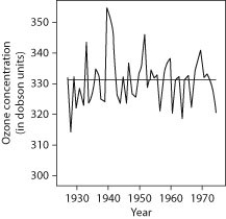
(Multiple Choice)
4.9/5 (94)
(94) The introduction of wolves into Yellowstone National Park in 1991 resulted in
(Multiple Choice)
5.0/5 (88)
(88) The three greatest current threats to biodiversity, in order starting with the greatest, are
(Multiple Choice)
4.9/5 (84)
(84) According to this figure, which organisms have the highest concentration of PCBs, and why? 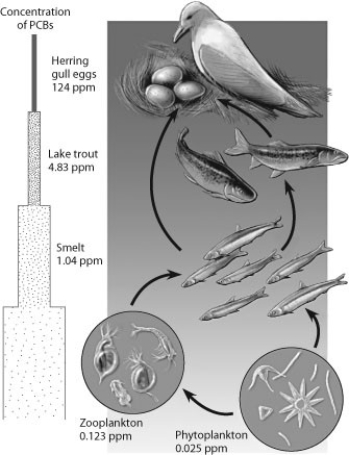
(Multiple Choice)
4.8/5 (92)
(92) Rising concentrations of carbon dioxide (CO2) in the atmosphere result in the oceans
(Multiple Choice)
4.9/5 (79)
(79) Suppose a species of wild boar (a type of pig) is actively hunted when it is at a young age because at that stage of its development the meat of the boar is particularly tender. What is a likely outcome if this species is overharvested?
(Multiple Choice)
4.7/5 (72)
(72) Species found in only one place on Earth are called ________ species.
(Multiple Choice)
4.7/5 (68)
(68) 
Filters
- Essay(0)
- Multiple Choice(0)
- Short Answer(0)
- True False(0)
- Matching(0)