



 Chat with AI
Exam 9: Patterns of Inheritance

Exam 1: Biology: Exploring Life47 Questions
Exam 2: The Chemical Basis of Life73 Questions
Exam 3: The Molecules of Cells89 Questions
Exam 4: A Tour of the Cell93 Questions
Exam 5: The Working Cell81 Questions
Exam 6: How Cells Harvest Chemical Energy82 Questions
Exam 7: Photosynthesis: Using Light to Make Food83 Questions
Exam 8: The Cellular Basis of Reproduction and Inheritance81 Questions
Exam 9: Patterns of Inheritance76 Questions
Exam 10: Molecular Biology of the Gene85 Questions
Exam 11: How Genes Are Controlled84 Questions
Exam 12: DNA Technology and Genomics80 Questions
Exam 13: How Populations Evolve67 Questions
Exam 14: The Origin of Species59 Questions
Exam 15: Tracing Evolutionary History88 Questions
Exam 16: Microbial Life: Prokaryotes and Protists80 Questions
Exam 17: The Evolution of Plant and Fungal Diversity85 Questions
Exam 18: The Evolution of Invertebrate Diversity81 Questions
Exam 19: The Evolution of Vertebrate Diversity77 Questions
Exam 20: Unifying Concepts of Animal Structure and Function68 Questions
Exam 21: Nutrition and Digestion96 Questions
Exam 22: Gas Exchange68 Questions
Exam 23: Circulation81 Questions
Exam 24: The Immune System76 Questions
Exam 25: Control of Body Temperature and Water Balance67 Questions
Exam 26: Hormones and the Endocrine System66 Questions
Exam 27: Reproduction and Embryonic Development88 Questions
Exam 28: Nervous Systems75 Questions
Exam 29: The Senses62 Questions
Exam 30: How Animals Move72 Questions
Exam 31: Plant Structure, Growth, and Reproduction81 Questions
Exam 32: Plant Nutrition and Transport69 Questions
Exam 33: Control Systems in Plants61 Questions
Exam 34: The Biosphere: an Introduction to Earths Diverse Environments61 Questions
Exam 35: Behavioral Adaptations to the Environment54 Questions
Exam 36: Population Ecology57 Questions
Exam 37: Communities and Ecosystems62 Questions
Exam 38: Conservation Biology61 Questions
Select questions type


Justin has type A blood and his wife Brittany has type B blood. Justin's parents both have type AB blood, and Brittany's parents also both have type AB blood. What are the chances that Justin and Brittany's son Theodore has type A blood?
(Multiple Choice)
4.8/5  (83)
(83) Cats normally have a total of 18 toes, 5 on each front paw and 4 on each back paw. But some cats express the dominant phenotype for polydactyly, which results in the development of extra toes on one or more paws. Jake, a Canadian tabby cat, has 28 toes and is recognized by the Guinness Book of World Records as the cat with the most toes.
Suppose that Jake mates with a female cat, Lucy, who has 18 total toes. Over several years, they have multiple litters and a total of 16 kittens (10 males and 6 females). The total number of toes on each kitten ranges from 21 to 25.
-One of Jake and Lucy's kittens mates with another cat that has 18 total toes. What is the probability that one of their offspring would have 18 total toes?
(Multiple Choice)
4.8/5 (83)
(83) Below are two statements. Which (if any) applies to the law of segregation? Which (if any) applies to the law of independent assortment? I: Phenotypes for long tails and big eyes are inherited separately in lab mice.
II: A baby mouse inherits a maternal red-eye allele and a paternal black-eye allele.
(Multiple Choice)
4.9/5 (81)
(81) If independent assortment did not occur, which of the following would be true?
(Multiple Choice)
4.7/5 (75)
(75) Which of the following statements regarding genotypes and phenotypes is false?
(Multiple Choice)
5.0/5 (86)
(86) What is the most likely explanation for the occurrence of an X-linked genetic disorder in the boy at the bottom of the pedigree shown? 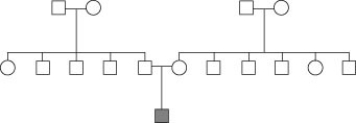
(Multiple Choice)
4.8/5 (75)
(75) In some cats, black coat color (B) is dominant over brown (b) and a striped fur pattern (S) is dominant over a marbled fur pattern (s). You rescued a black striped cat from an animal shelter but could not determine its exact genotype. To do so, you mated the cat with a brown marbled cat. The mating produced 3 brown marbled, 2 brown striped, 2 black marbled, and 3 black striped. Immediately, you concluded the genotype of your rescued cat was
(Multiple Choice)
4.8/5 (85)
(85) According to this figure, heterozygotes for this form of hypercholesterolemia suffer from the disease because they 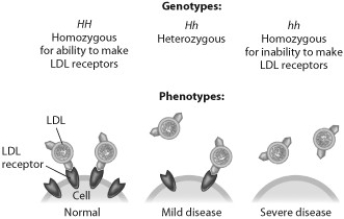
(Multiple Choice)
4.7/5 (76)
(76) Which of the following terms refers to a situation where a single phenotypic character is determined by the additive effects of two or more genes?
(Multiple Choice)
4.8/5 (83)
(83) If A is dominant to a and B is dominant to b, what is the expected phenotypic ratio of the cross AaBb × AaBb?
(Multiple Choice)
4.9/5 (65)
(65) Cats normally have a total of 18 toes, 5 on each front paw and 4 on each back paw. But some cats express the dominant phenotype for polydactyly, which results in the development of extra toes on one or more paws. Jake, a Canadian tabby cat, has 28 toes and is recognized by the Guinness Book of World Records as the cat with the most toes.
Suppose that Jake mates with a female cat, Lucy, who has 18 total toes. Over several years, they have multiple litters and a total of 16 kittens (10 males and 6 females). The total number of toes on each kitten ranges from 21 to 25.
-If we use the letter P to represent the polydactyly gene, what is Jake's genotype?
(Multiple Choice)
4.8/5 (73)
(73) You prepare a human karyotype. Upon analysis, you find 22 pairs of chromosomes that are each of approximately equal length and also a single pair that has one chromosome longer than the other. What can you conclude from this information?
(Multiple Choice)
4.9/5 (84)
(84) You are looking at an unknown cell under a microscope that has 22 chromosomes plus 2 X chromosomes. Which of the following is the most likely identity of this cell?
(Multiple Choice)
4.8/5 (80)
(80) The phenotypic ratio resulting from a dihybrid cross of two heterozygote individuals showing independent assortment is expected to be
(Multiple Choice)
4.8/5 (90)
(90) 
Filters
- Essay(0)
- Multiple Choice(0)
- Short Answer(0)
- True False(0)
- Matching(0)