



 Chat with AI
Exam 10: The Humoral Immune Response

Exam 1: Basic Concepts in Immunology44 Questions
Exam 2: Innate Immunity: the First Lines of Defense32 Questions
Exam 3: The Induced Responses of Innate Immunity39 Questions
Exam 4: Antigen Recognition by B-Cell and T-Cell Receptors28 Questions
Exam 5: The Generation of Lymphocyte Antigen Receptors33 Questions
Exam 6: Antigen Presentation to T Lymphocytes30 Questions
Exam 7: Lymphocyte Receptor Signaling42 Questions
Exam 8: Development and Survival of Lymphocytes37 Questions
Exam 9: T-Cell-Mediated Immunity37 Questions
Exam 10: The Humoral Immune Response30 Questions
Exam 11: Integrated Dynamics of Innate and Adaptive Immunity28 Questions
Exam 12: The Mucosal Immune System27 Questions
Exam 13: Failures of Host Defense Mechanisms43 Questions
Exam 14: Allergy and Allergic Diseases26 Questions
Exam 15: Autoimmunity and Transplantation31 Questions
Exam 16: Manipulation of the Immune Response34 Questions
Select questions type


Infants born with the immunodeficiency disease X-linked agammaglobulinemia (XLA) have a block in B cell development, and fail to produce mature B cells. As a result, these infants lack the ability to produce antibodies. After birth, babies with XLA first begin to show symptoms of recurrent and persistent extracellular bacterial infections due to common environmental pathogens when they are 4-6 months of age. The reason these infants are healthy for the first 4-6 months after birth is because:Newborn infants have high circulating levels of maternal IgG at birth.
(Multiple Choice)
4.9/5  (83)
(83) A mouse is immunized with the tetanus toxoid protein (inactivated toxin) in adjuvant. One week later, the entire population of splenic B cells are isolated from the mouse and mixed with tetanus toxoid-specific CD4 TFH cells plus the purified tetanus toxoid protein. Four days later, the total number of B cells in the culture and the number of tetanus toxoid-specific B cells are determined and compared to the starting population on the day of isolation. The results are shown in Figure Q1). 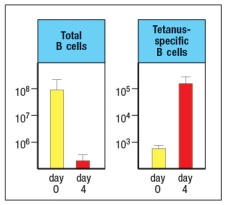 B cells preferentially survive and proliferate because:
 (Multiple Choice)
4.9/5 (64)
(64) In germinal centers, proliferating B cells undergo a process called somatic hypermutation, in which mutations are introduced into the V regions of the antibody heavy and light chain genes. When this process is complete after several weeks, the overall affinities of the antibodies produced are greatly increased compared to those present early in the primary response. The somatic hypermutation process leads to increased antibody affinity because:
(Multiple Choice)
4.8/5 (78)
(78) The W/Wv mouse strain is heterozygous for two different alleles of the gene encoding the growth factor receptor, c-kit, an important receptor expressed on hematopoietic progenitor cells in the bone marrow. The major defect in these mice is the absence of single lineage of hematopoietic cells. When these mice are challenged with larval Haemaphysalis longicornis ticks, they fail to become resistant to the ticks, in spite of generating high titers of anti-tick IgE antibodies. The cell type missing in the W/Wv mice is most likely:Natural Killer (NK) cells
(Multiple Choice)
4.8/5 (86)
(86) The vaccine to Haemophilus influenzae type b is called a conjugate vaccine. It is composed of the tetanus toxoid protein conjugated to the capsular polysaccharide of the H. influenzae type b bacteria. When used to vaccinate infants, the antibody response generated by this vaccine would include:
(Multiple Choice)
4.7/5 (81)
(81) The process of somatic hypermutation of antibody V regions sequences is initiated by the enzyme AID. This enzyme targets cytidine residues in the DNA sequence that are normally part of a G:C pair in the double-stranded DNA. Yet the hypermutation process generates mutations at both G:C and A:T base pairs of the original sequence because:
(Multiple Choice)
4.9/5 (73)
(73) MPSV-4 is a tetravalent polysaccharide vaccine designed to elicit antibodies to four different serotypes of Neisseria meningitidis, a bacterial infection that causes meningitis and sepsis in susceptible individuals. However, the protection induced by this vaccine is short-lived, and normally wanes to undetectable levels by 2-3 years post-vaccination. In addition, MPSV-4 does not induce mucosal immunity to Neisseria meningitidis; instead, it only protects against bacteria that access the bloodstream. Two newly developed vaccine candidates (A and B) are tested in mice for their ability to elicit high concentrations of anti-meningococcal antibodies that would provide mucosal as well as bloodstream protection. Also, the ideal candidate vaccine should also provide long-lasting immunity to the infection. Figure Q29)A is a diagram of the results from the primary immunization with both candidate vaccines:
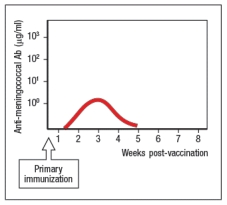 a) what is the predominant antibody isotype elicited by the primary immunization with these candidate vaccines? In which part of the body is that antibody primarily found?
Figure shows the responses to a primary, followed by a secondary immunization to each of the two candidate vaccines.
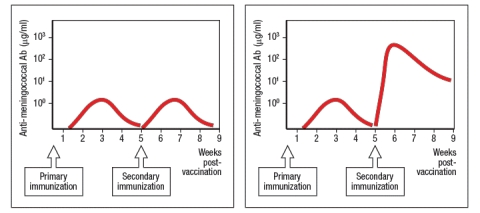 b) Which candidate vaccine elicits the preferred response? What are the three aspects of the preferred response that make it the candidate vaccine of choice?
The vaccine developers refuse to divulge the components of the candidate vaccines A and B.
c) What is the likely composition of each vaccine and what evidence from the information above are used to lead to your conclusions?
d) To confirm the choice of the preferred candidate vaccine, what type of additional information from the vaccine trials in mice shown above would support this conclusion? Name two additional features of the secondary antibody response to each candidate vaccine that could be assessed, and what results would be expected for each of the candidate vaccines.
e) To assess whether either candidate vaccine might provide mucosal immunity in addition to immunity in the bloodstream, what feature of the response to each vaccine should be examined?
a) what is the predominant antibody isotype elicited by the primary immunization with these candidate vaccines? In which part of the body is that antibody primarily found?
Figure shows the responses to a primary, followed by a secondary immunization to each of the two candidate vaccines.
b) Which candidate vaccine elicits the preferred response? What are the three aspects of the preferred response that make it the candidate vaccine of choice?
The vaccine developers refuse to divulge the components of the candidate vaccines A and B.
c) What is the likely composition of each vaccine and what evidence from the information above are used to lead to your conclusions?
d) To confirm the choice of the preferred candidate vaccine, what type of additional information from the vaccine trials in mice shown above would support this conclusion? Name two additional features of the secondary antibody response to each candidate vaccine that could be assessed, and what results would be expected for each of the candidate vaccines.
e) To assess whether either candidate vaccine might provide mucosal immunity in addition to immunity in the bloodstream, what feature of the response to each vaccine should be examined? (Essay)
4.9/5 (89)
(89) Studies show that about 50-100 different B cells initially seed each germinal center (d7 post-infection). These different B cells are represented by different colored circles in a white oval (germinal center) in Figure. Which of the choices shown best represents the B cell population that would be found in the same germinal center approximately two weeks later?

(Multiple Choice)
4.8/5 (88)
(88) Two different vaccines have been developed that protect vaccinated individuals against pneumococcal disease, a bacterial infection that causes pneumonia, meningitis and sepsis (blood stream infection). This disease is caused by the bacteria, Streptococcus pneumoniae. One vaccine, PPSV23, is a mixture of polysaccharides isolated from 23 different serotypes of S. pneumoniae. The second vaccine, PCV13, is a conjugate vaccine made from polysaccharides of 13 different serotypes of the bacteria conjugated to diphtheria toxoid (inactivated toxin protein). The PPSV23 vaccine is only given to adults, whereas infants and small children are given PCV13. This is because:
(Multiple Choice)
5.0/5 (77)
(77) Neutralizing antibodies are effective at preventing infection or toxicity mediated by pathogens or their toxic products. In fact, nearly all vaccines currently in use function by eliciting neutralizing antibodies. One example is the tetanus vaccine, in which neutralizing antibodies are generated against an inactivated form of the tetanus toxin (i.e., the tetanus toxoid). The most important feature of a neutralizing antibody is:
(Multiple Choice)
4.8/5 (84)
(84) 
Filters
- Essay(0)
- Multiple Choice(0)
- Short Answer(0)
- True False(0)
- Matching(0)