



 Chat with AI
Exam 14: Allergy and Allergic Diseases

Exam 1: Basic Concepts in Immunology44 Questions
Exam 2: Innate Immunity: the First Lines of Defense32 Questions
Exam 3: The Induced Responses of Innate Immunity39 Questions
Exam 4: Antigen Recognition by B-Cell and T-Cell Receptors28 Questions
Exam 5: The Generation of Lymphocyte Antigen Receptors33 Questions
Exam 6: Antigen Presentation to T Lymphocytes30 Questions
Exam 7: Lymphocyte Receptor Signaling42 Questions
Exam 8: Development and Survival of Lymphocytes37 Questions
Exam 9: T-Cell-Mediated Immunity37 Questions
Exam 10: The Humoral Immune Response30 Questions
Exam 11: Integrated Dynamics of Innate and Adaptive Immunity28 Questions
Exam 12: The Mucosal Immune System27 Questions
Exam 13: Failures of Host Defense Mechanisms43 Questions
Exam 14: Allergy and Allergic Diseases26 Questions
Exam 15: Autoimmunity and Transplantation31 Questions
Exam 16: Manipulation of the Immune Response34 Questions
Select questions type


The prevention of inflammatory immune responses to inhaled antigens in healthy individuals has mechanisms in common with those that prevent inflammatory immune responses to commensal microbes in the gut. One important component of immune regulation shared by these two situations is:
(Multiple Choice)
4.9/5  (67)
(67) Within minutes after encounter with an allergen, individuals with allergic rhinitis show symptoms of nasal itching, nasal congestion, sneezing, and a runny nose. These symptoms generally subside within 30 minutes, but reappear several hours later. Analysis of the nasal epithelium in such an individual 6 hours after allergen encounter would show:
(Multiple Choice)
4.9/5 (79)
(79) The 'hygiene hypothesis' has been proposed as an explanation for the rapid increase in allergies and asthma incidence in Western countries over the last half century. One line of evidence supporting this hypothesis is:
(Multiple Choice)
4.7/5 (77)
(77) Studies using mouse models of allergic asthma have provided information about the cell types and soluble mediators that contribute to this disease. One common experimental model uses airway exposure to protease allergens, such as papain from papaya or the house dust mite allergen. Interestingly, papain is able to induce allergic lung inflammation even in RAG-deficient mice. In this system, the type 2 cytokines, IL-5, IL-9, and IL-13, are likely coming from:
(Multiple Choice)
4.8/5 (88)
(88) Genetic variations in proteins involved in immune and inflammatory responses have been shown to be associated with the development of atopic dermatitis and other allergic diseases. However, several genes associated with these conditions do not affect the immune system directly. For example, among this latter group are genes that:
(Multiple Choice)
4.7/5 (84)
(84) T-bet and GATA-3 are transcription factors known to regulate the development of polarized subsets of CD4 T cells. To investigate the effects of altering the cytokines produced by CD4 effector T cells during chronic airway inflammation, transgenic mice were generated that constitutively express either T-bet or GATA-3 in all T cells. These strains of mice are referred to as T-bet-tg or GATA-3-tg, respectively. Wild-type, T-bet-tg and GATA-3-tg mice were then sensitized by intraperitoneal injection of chicken ovalbumin protein (OVA) in a TH2-inducing adjuvant. Three weeks later, mice were challenged daily by intranasal administration of OVA protein in saline for 8 weeks. Control mice were immunized and challenged with saline alone. One day following the final intranasal challenge with OVA or saline, the mice were euthanized, and their lungs were examined by histological analysis for the percentages of mucus-positive cells and for thickening of airway walls as a measure of airway remodeling. These data were quantified, and are shown in Figure Q25)A. Note that the airway remodeling is scored on a relative scale in arbitrary units (AU). 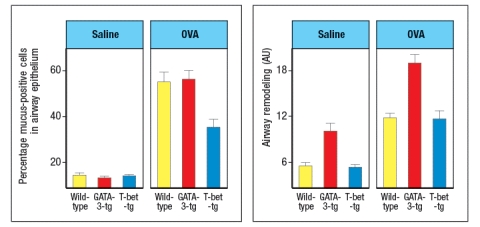 a) What is the effect of GATA-3-expressing T cells on the numbers of mucus-producing cells compared to its effect on airway remodeling?
b) What is the effect of enforcing T-bet expression in T cells on the numbers of mucus-producing cells compared to its effect on airway remodeling?
One day after the final challenge with intranasal OVA or saline, mice were also examined for the numbers of eosinophils in their lungs. Lung homogenates were also tested for cytokine levels by ELISA. These data are shown in Figure .
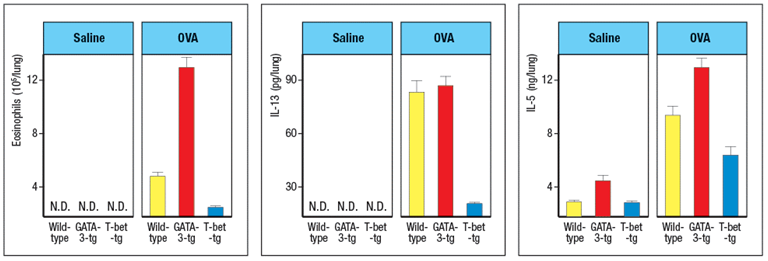 c) What is the effect of enforced expression of GATA-3 or T-bet in T cells on the numbers of eosinophils in the lung? Based on the cytokine data, which cytokine is likely contributing to this effect?
In a final experiment, mice are euthanized one day after the final saline or OVA administration, and lymphocytes are isolated from the lungs. The isolated lymphocytes are stimulated through their T-cell receptors to induce cytokine production from effector T cells. During this 5-hour in vitro stimulation to elicit cytokine production, the cells are also incubated with a protein secretion inhibitor. After the 5-hour incubation, the cells are stained with antibodies to CD3 and CD4, then the cells are fixed and permeabilized, and stained with antibodies to IFN- For IL-4. The percentages of CD4 T cells expressing each cytokine are shown in Figure .
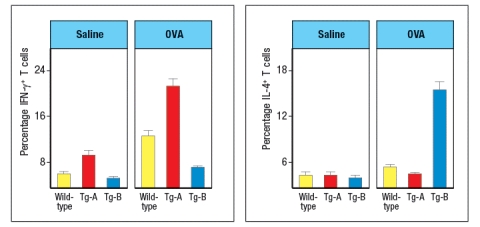 d) Based on these data, deduce whether Tg-A is the GATA-3-tg line or the T-bet-tg line, and similarly, deduce the identity of Tg-B. Explain your reasoning.
IL-12 is an important cytokine that induces T-bet up-regulation in CD4 T cells. If one discovered that polymorphisms in the IL-12 locus were linked to increased susceptibility to allergies and asthma based on GWAS (genome-wide association studies) data derived from human population cohorts, what difference would be expected when comparing the allele in healthy controls versus the allele found more frequently in asthma patients?
a) What is the effect of GATA-3-expressing T cells on the numbers of mucus-producing cells compared to its effect on airway remodeling?
b) What is the effect of enforcing T-bet expression in T cells on the numbers of mucus-producing cells compared to its effect on airway remodeling?
One day after the final challenge with intranasal OVA or saline, mice were also examined for the numbers of eosinophils in their lungs. Lung homogenates were also tested for cytokine levels by ELISA. These data are shown in Figure .
c) What is the effect of enforced expression of GATA-3 or T-bet in T cells on the numbers of eosinophils in the lung? Based on the cytokine data, which cytokine is likely contributing to this effect?
In a final experiment, mice are euthanized one day after the final saline or OVA administration, and lymphocytes are isolated from the lungs. The isolated lymphocytes are stimulated through their T-cell receptors to induce cytokine production from effector T cells. During this 5-hour in vitro stimulation to elicit cytokine production, the cells are also incubated with a protein secretion inhibitor. After the 5-hour incubation, the cells are stained with antibodies to CD3 and CD4, then the cells are fixed and permeabilized, and stained with antibodies to IFN- For IL-4. The percentages of CD4 T cells expressing each cytokine are shown in Figure .
d) Based on these data, deduce whether Tg-A is the GATA-3-tg line or the T-bet-tg line, and similarly, deduce the identity of Tg-B. Explain your reasoning.
IL-12 is an important cytokine that induces T-bet up-regulation in CD4 T cells. If one discovered that polymorphisms in the IL-12 locus were linked to increased susceptibility to allergies and asthma based on GWAS (genome-wide association studies) data derived from human population cohorts, what difference would be expected when comparing the allele in healthy controls versus the allele found more frequently in asthma patients? (Essay)
4.7/5 (77)
(77) 
Filters
- Essay(0)
- Multiple Choice(0)
- Short Answer(0)
- True False(0)
- Matching(0)