Exam 5: Integrals

arrow
  • Select Tags
search iconSearch Question
  • Select Tags

Use the Table of Integrals in your textbook to evaluate each of the following: (a) ∫e3xcos⁡2xdx\int e ^ { 3 x } \cos 2 x d x (b) ∫4x−x2dx\int \sqrt { 4 x - x ^ { 2 } } d x (c) ∫4x−25x2dx\int \sqrt { 4 x - 25 x ^ { 2 } } d x (d) ∫u3sin⁡udu\int u ^ { 3 } \sin u d u (e) ∫cos⁡4(2t)dt\int \cos ^ { 4 } ( 2 t ) d t (f) ∫1x2+2x+2dx\int \frac { 1 } { x ^ { 2 } + 2 x + 2 } d x (g) ∫9+4u2du\int \sqrt { 9 + 4 u ^ { 2 } } d u (h) ∫9−4u2du\int \sqrt { 9 - 4 u ^ { 2 } } d u (i) ∫4u2−9du\int \sqrt { 4 u ^ { 2 } - 9 } d u (j) ∫sin⁡2tcos⁡tesin⁡tdt\int \sin ^ { 2 } t \cos t e ^ { \sin t } d t

(Essay)
4.7/5
(86)

Find the value of the integral ∫141(1+x)21xdx\int _ { 1 } ^ { 4 } \frac { 1 } { ( 1 + \sqrt { x } ) ^ { 2 } } \frac { 1 } { \sqrt { x } } d x

(Multiple Choice)
4.9/5
(83)

Evaluate the improper integral ∫0414−xdx\int _ { 0 } ^ { 4 } \frac { 1 } { 4 - x } d x

(Multiple Choice)
4.8/5
(75)

Evaluate the improper integral ∫0∞cos⁡xdx\int _ { 0 } ^ { \infty } \cos x d x

(Multiple Choice)
4.8/5
(86)

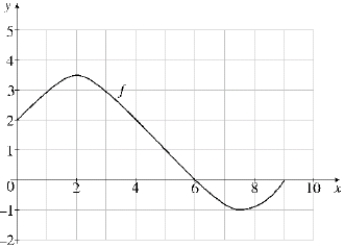
The graph of a function f is given below. List the following quantities from smallest to largest.  The graph of a function f is given below. List the following quantities from smallest to largest.   (a)  \int _ { 0 } ^ { 9 } f ( x ) d x  (b)  \int _ { 6 } ^ { 9 } f ( x ) d x  (c)  \int _ { 0 } ^ { 5 } f ( x ) d x  (d)  \int _ { 0 } ^ { 6 } f ( x ) d x  (e)  f ^ { \prime } ( 5 ) (a) ∫09f(x)dx\int _ { 0 } ^ { 9 } f ( x ) d x (b) ∫69f(x)dx\int _ { 6 } ^ { 9 } f ( x ) d x (c) ∫05f(x)dx\int _ { 0 } ^ { 5 } f ( x ) d x (d) ∫06f(x)dx\int _ { 0 } ^ { 6 } f ( x ) d x (e) f′(5)f ^ { \prime } ( 5 )
(Short Answer)
4.8/5
(70)

Use Simpson's Rule with n = 2 to approximate the integral ∫01x3dx\int _ { 0 } ^ { 1 } x ^ { 3 } d x

(Multiple Choice)
4.8/5
(98)

Find the value of the integral ∫08x3(1x23+1)dx\int _ { 0 } ^ { 8 } \sqrt [ 3 ] { x } \left( \frac { 1 } { \sqrt [ 3 ] { x ^ { 2 } } } + 1 \right) d x

(Multiple Choice)
4.8/5
(80)

Which one of the following integrals is improper?

(Multiple Choice)
4.8/5
(90)

Find the value of the integral ∫01x2(x3+1)2dx\int _ { 0 } ^ { 1 } \frac { x ^ { 2 } } { \left( x ^ { 3 } + 1 \right) ^ { 2 } } d x

(Multiple Choice)
4.9/5
(92)

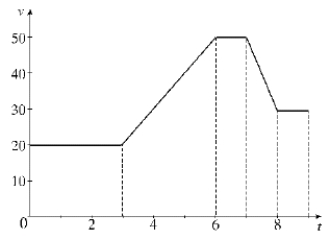
A dry ice puck is pushed across an uneven surface. Below is a graph of the velocity v (in cm/s) as a function of the time t (in seconds). Determine the total distance traveled by the puck for 0≤t≤90 \leq t \leq 9 .  A dry ice puck is pushed across an uneven surface. Below is a graph of the velocity v (in cm/s) as a function of the time t (in seconds). Determine the total distance traveled by the puck for  0 \leq t \leq 9  .

(Short Answer)
4.8/5
(77)

Find the value of the integral ∫−332x3−5x3dx\int _ { - 3 } ^ { 3 } \sqrt [ 3 ] { 2 x ^ { 3 } - 5 x } d x

(Multiple Choice)
4.7/5
(68)

Find the value of the integral ∫4−34+31x2−8x+17dx\int _ { 4 - \sqrt { 3 } } ^ { 4 + \sqrt { 3 } } \frac { 1 } { x ^ { 2 } - 8 x + 17 } d x

(Multiple Choice)
4.9/5
(88)

Find the value of the integral ∫03/2141−t2dt\int _ { 0 } ^ { \sqrt { 3 } / 2 } \frac { 1 } { 4 \sqrt { 1 - t ^ { 2 } } } d t

(Multiple Choice)
4.9/5
(100)

Find the partial fraction expansion of the rational function: xx2−5x+6\frac { x } { x ^ { 2 } - 5 x + 6 } .

(Multiple Choice)
4.9/5
(85)

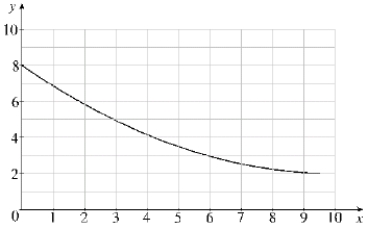
Given the graph below, use 5 rectangles to find an estimate for the area under the graph from x = 0 to x = 10. Find lower and upper estimates for the area. Given the graph below, use 5 rectangles to find an estimate for the area under the graph from x = 0 to x = 10. Find lower and upper estimates for the area.
(Essay)
4.9/5
(66)

Let f (x) = x2−2x ^ { 2 } - 2 on the interval [0,2]. Let the interval be divided into four equal subintervals. Find the value of the Riemann sum ∑i=14f(xi∗)Δxi if xi∗\sum _ { i = 1 } ^ { 4 } f \left( x _ { i } ^ { * } \right) \Delta x _ { i } \text { if } x _ { i } ^ { * } is the left endpoint of the subinterval.

(Multiple Choice)
4.9/5
(81)

Evaluate the following integrals: (a) ∫xex2dx\int x e ^ { x ^ { 2 } } d x (b) ∫cos⁡(ln⁡x)xdx\int \frac { \cos ( \ln x ) } { x } d x (c) ∫sec⁡2xtan⁡xdx\int \frac { \sec ^ { 2 } x } { \tan x } d x (d) ∫3x21+x6dx\int \frac { 3 x ^ { 2 } } { 1 + x ^ { 6 } } d x

(Essay)
4.9/5
(81)

Compute ddx∫cos⁡xx3e−t2dt\frac { d } { d x } \int _ { \cos x } ^ { x ^ { 3 } } e ^ { - t ^ { 2 } } d t

(Essay)
4.9/5
(83)

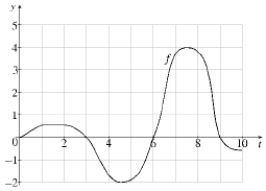
Let g(x)=∫0xf(t)dtg ( x ) = \int _ { 0 } ^ { x } f ( t ) d t where f is the function whose graph is shown below:  Let  g ( x ) = \int _ { 0 } ^ { x } f ( t ) d t  where f is the function whose graph is shown below:   (a) Use the Comparison Properties of Integrals to estimate the value of the following integrals: (i)  \int _ { 0 } ^ { 3 } f ( t ) d t  (ii)  \int _ { 3 } ^ { 6 } f ( t ) d t  (iii)  \int _ { 6 } ^ { 9 } f ( t ) d t  (iv)  \int _ { 9 } ^ { 10 } f ( t ) d t  (b) At what values of x does g have a local maximum or minimum? (c) At what values of x does g attain its absolute maximum or minimum? (a) Use the Comparison Properties of Integrals to estimate the value of the following integrals: (i) ∫03f(t)dt\int _ { 0 } ^ { 3 } f ( t ) d t (ii) ∫36f(t)dt\int _ { 3 } ^ { 6 } f ( t ) d t (iii) ∫69f(t)dt\int _ { 6 } ^ { 9 } f ( t ) d t (iv) ∫910f(t)dt\int _ { 9 } ^ { 10 } f ( t ) d t (b) At what values of x does g have a local maximum or minimum? (c) At what values of x does g attain its absolute maximum or minimum?
(Essay)
4.8/5
(94)

Compute ddx∫2ex2ln⁡(t)dt\frac { d } { d x } \int _ { 2 } ^ { e ^ { x ^ { 2 } } } \ln ( t ) d t

(Short Answer)
4.9/5
(78)
Showing 201 - 220 of 239
close modal

Filters

  • Essay(0)
  • Multiple Choice(0)
  • Short Answer(0)
  • True False(0)
  • Matching(0)