



 Chat with AI
Exam 2: The Chemical Basis of Life

Exam 1: Introduction to the Study of Cell and Molecular Biology72 Questions
Exam 2: The Chemical Basis of Life60 Questions
Exam 3: Bioenergetics,enzymes and Metabolism54 Questions
Exam 4: The Structure and Function of the Plasma Membrane114 Questions
Exam 5: Aerobic Respiration and the Mitochondrion98 Questions
Exam 6: Photosynthesis and the Chloroplast98 Questions
Exam 7: Interactions Between Cells and Their Environment97 Questions
Exam 8: Cytoplasmic Membrane Systems: Structure, function, and Membrane Trafficking208 Questions
Exam 9: The Cytoskeleton and Cell Motility136 Questions
Exam 10: The Nature of the Gene and the Genome94 Questions
Exam 11: Gene Expression: From Transcription to Translation109 Questions
Exam 12: Control of Gene Expression96 Questions
Exam 13: Dna Replication and Repair86 Questions
Exam 14: Cellular Reproduction100 Questions
Exam 15: Cell Signaling and Signal Transduction: Communication Between Cells106 Questions
Exam 16: Cancer74 Questions
Exam 17: The Immune Response95 Questions
Exam 18: Techniques in Cell and Molecular Biology144 Questions
Select questions type


What is the maximum number of 100 amino acid long polypeptides that could be made?
(Multiple Choice)
4.8/5  (74)
(74) What kind of bond results from an unequal sharing of electrons?
(Multiple Choice)
4.8/5 (73)
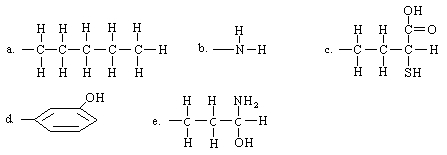
(73) Which of the groups below is capable of only hydrophobic interactions? Explain your answer.Which is capable of only hydrophilic interactions? Explain your answer.
(Essay)
4.9/5 (66)
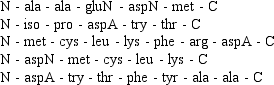
(66) Scientists have sequenced proteins by using specific proteases to "clip" a purified protein preparation between two specific amino acids,thus forming a number of moderately sized fragments; they have used acid hydrolysis to produce smaller fragments.Each fragment can then be sequenced by breaking the moderate fragments into dipeptides that are easily sequenced.The fragments below are obtained after the initial enzymatic cleavages.Can you deduce the sequence of the original polypeptide? (HINT: the original cleavages at specific locations differ depending on which proteolytic enzyme was used to create each fragment; this causes an overlap in the fragments' sequences.)The final polypeptide should have 18 amino acid residues.
(Essay)
4.7/5 (71)
(71) Why is hydrogen peroxide often used as a disinfectant and bleaching agent? How do cells generally rid themselves of hydrogen peroxide?
(Essay)
4.7/5 (74)
(74) Which polysaccharide bond cannot be broken by mammalian enzymes that normally digest polysaccharides?
(Multiple Choice)
4.9/5 (70)
(70) Some proteins have multiple binding partners.In some cases,they have several different binding interfaces and they are thus capable of binding a number of different binding partners at the same time.On the other hand,other such proteins have a single binding interface,which is capable of binding several different partners,but only one at a time.They can play central roles in such processes as cell division and gene expression.What are such proteins called?
(Short Answer)
4.8/5 (76)
(76) How do amino acids like hydroxylysine and thyroxine,which are not among the 20 amino acids that are inserted into proteins,get into proteins?
(Multiple Choice)
4.8/5 (75)
(75) A release of hydrogen ions to a solution would most likely ____________.
(Multiple Choice)
4.9/5 (84)
(84) Not all proteins are able to renature.Some proteins when exposed to heat or some other denaturing treatment are irreversibly denatured.What is an example of such a protein?
(Essay)
4.9/5 (72)
(72) When it was discovered that CJD could be acquired in addition to being inherited,why was it at first assumed that the infectious agent was a virus?
(Essay)
4.8/5 (80)
(80) It is thought that most human diseases leave telltale patterns among the thousands of proteins present in the blood or other bodily fluids.It was hoped that analysis of the proteins present in the blood would help in the diagnosis of human disease; however,thus far,searches for these proteins in blood or bodily fluids have been largely unsuccessful and their use in diagnostics largely unreliable.What are these telltale patterns of proteins called?
(Short Answer)
4.9/5 (79)
(79) An infectious agent is discovered that causes a particular disease.It has a relatively low molecular weight.Treatment with phenol or proteolytic enzymes,treatments that destroy proteins,render the infectious agent harmless,while treatment with nucleases and ultraviolet radiation,treatments that damage polynucleotides,has no effect.What is your interpretation of the above data and why?
(Essay)
4.8/5 (61)
(61) You treat a partially purified preparation of protein with a reagent that breaks bonds between sulfur atoms.Which level(s)of protein structure are likely to be affected the most?
(Essay)
4.9/5 (86)
(86) You are studying a protein.It binds to elongating polypeptide chains as they emerge from an exit channel within the ribosome's large subunit.It appears to prevent partially formed or nascent polypeptides from binding to other proteins in the cytosol,which might cause them either to aggregate or misfold.What kind of proteins is this likely to be? Another protein you are studying picks up larger proteins from Hsp70 family proteins.It is a cylindrical protein complex that contains chambers in which newly synthesized polypeptides can fold without interference from other cellular macromolecules.What is this protein called?
(Essay)
5.0/5 (80)
(80) The low-molecular-weight building blocks of polymers are called _______.
(Multiple Choice)
4.9/5 (82)
(82) 
Filters
- Essay(0)
- Multiple Choice(0)
- Short Answer(0)
- True False(0)
- Matching(0)