



 Chat with AI
Exam 2: The Chemical Basis of Life

Exam 1: Introduction to the Study of Cell and Molecular Biology72 Questions
Exam 2: The Chemical Basis of Life60 Questions
Exam 3: Bioenergetics,enzymes and Metabolism54 Questions
Exam 4: The Structure and Function of the Plasma Membrane114 Questions
Exam 5: Aerobic Respiration and the Mitochondrion98 Questions
Exam 6: Photosynthesis and the Chloroplast98 Questions
Exam 7: Interactions Between Cells and Their Environment97 Questions
Exam 8: Cytoplasmic Membrane Systems: Structure, function, and Membrane Trafficking208 Questions
Exam 9: The Cytoskeleton and Cell Motility136 Questions
Exam 10: The Nature of the Gene and the Genome94 Questions
Exam 11: Gene Expression: From Transcription to Translation109 Questions
Exam 12: Control of Gene Expression96 Questions
Exam 13: Dna Replication and Repair86 Questions
Exam 14: Cellular Reproduction100 Questions
Exam 15: Cell Signaling and Signal Transduction: Communication Between Cells106 Questions
Exam 16: Cancer74 Questions
Exam 17: The Immune Response95 Questions
Exam 18: Techniques in Cell and Molecular Biology144 Questions
Select questions type


Which of the following is not a macromolecule formed by polymerization?
(Multiple Choice)
5.0/5  (78)
(78) What enzyme is responsible for the destruction of a type of free radical formed when molecular oxygen picks up an extra electron?
(Short Answer)
4.9/5 (79)
(79) Since replication is a property characteristic of nucleic acids,how might a prion,which lacks nucleic acids,"replicate" itself?
(Essay)
4.8/5 (81)
(81) Why might an organism that had functional SOD but mutant catalase and/or glutathione peroxidase be at a disadvantage?
(Essay)
4.8/5 (87)
(87) Under which circumstances would electrons be most likely to be shared equally?
(Multiple Choice)
4.9/5 (71)
(71) Many so-called temperature-sensitive mutations have been discovered in a wide variety of organisms.These are proteins that are non-functional at higher temperatures,while,at lower temperatures (often just a few degrees lower),they function normally.For example,the coloration patterns in Siamese Cats arise from a temperature-sensitive mutation.An enzyme required for the synthesis of dark pigment is unable to function in areas close to the body where normal physiological temperatures prevail.However,at the tips of the ears,paws,the tip of the tail and other extremities where the temperature is slightly lower,the enzyme works correctly and dark pigment is produced.What is happening at the molecular level that explains this?
(Essay)
4.7/5 (84)
(84) What human disease was found to be similar to kuru in the brain abnormalities it caused? What disease in sheep contributes its name to the abnormal prion molecule,PrPSC? What have been the causes of outbreaks of acquired CJD?
(Essay)
4.7/5 (87)
(87) Which amino acid is most likely to be found in the core of a protein?
(Multiple Choice)
4.8/5 (74)
(74) The -pleated sheet is characterized by orientation of ______ the molecular axis.
(Multiple Choice)
5.0/5 (91)
(91) What kind of noncovalent interaction is typified by interactions between two molecules that are so close together that they can experience weak attractive forces bonding them together?
(Multiple Choice)
4.8/5 (77)
(77) In a living organism,where are ionic bonds most likely to be found?
(Multiple Choice)
4.8/5 (65)
(65) Which of the groups below is capable of only hydrophobic interactions? 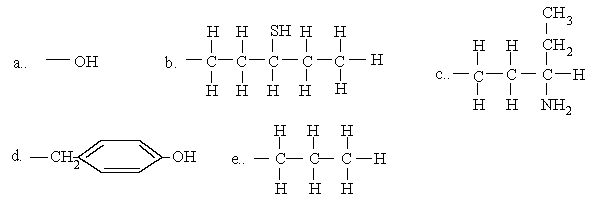
(Multiple Choice)
4.9/5 (72)
(72) What are some possible explanations for the branched structure of glycogen?
(Essay)
4.8/5 (80)
(80) The most electronegative atoms typically present in biological molecules are ____ and ____.
(Multiple Choice)
4.7/5 (91)
(91) Which of the following groups is capable of only hydrophilic interactions? 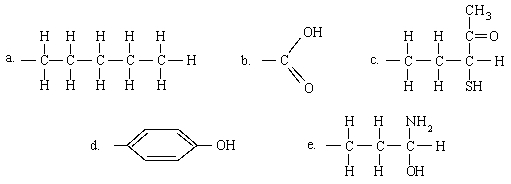
(Multiple Choice)
4.9/5 (78)
(78) An enzyme is placed in a solution containing urea.Assuming that this protein contains no disulfide linkages,is it reasonable to suspect that it will be totally denatured by the treatment? How could you know that the enzyme has,in fact,been denatured? Why does the urea denature the tertiary structure of the enzyme?
(Essay)
4.8/5 (73)
(73) What is some specific evidence that demonstrates the importance of superoxide dismutase in getting rid of superoxide free radicals?
(Essay)
4.8/5 (70)
(70) Given what you have learned about SOD,what do you hypothesize would happen to fruit flies that have been genetically engineered to produce large amounts of SOD? Why might houseflies that are kept caged and unable to fly live longer than those allowed to fly?
(Essay)
4.7/5 (83)
(83) 
Filters
- Essay(0)
- Multiple Choice(0)
- Short Answer(0)
- True False(0)
- Matching(0)