



 Chat with AI
Exam 5: Integration

Exam 1: Preliminaries101 Questions
Exam 2: Limits and Continuity105 Questions
Exam 3: Differentiation116 Questions
Exam 4: Applications of the Derivative118 Questions
Exam 5: Integration129 Questions
Exam 6: Applications of the Definite Integral85 Questions
Exam 7: Exponentials, Logarithms and Other Transcendental Functions66 Questions
Exam 8: Integration Techniques123 Questions
Exam 9: First-Order Differential Equations72 Questions
Exam 10: Infinite Series111 Questions
Exam 11: Parametric Equations and Polar Coordinates129 Questions
Exam 12: Vectors and the Geometry of Space107 Questions
Exam 13: Vector-Valued Functions103 Questions
Exam 14: Functions of Several Variables and Partial Differentiation112 Questions
Exam 15: Multiple Integrals92 Questions
Exam 16: Vector Calculus67 Questions
Exam 17: Second Order Differential Equations38 Questions
Select questions type


Approximate the area under the curve on the given interval using  rectangles and right-endpoint evaluation. Round to three decimal places.
 on
 ,

rectangles and right-endpoint evaluation. Round to three decimal places. on , (Multiple Choice)
4.9/5  (79)
(79) Compute the average value of the function on the given interval. 
(Multiple Choice)
5.0/5 (81)
(81) The following table shows the acceleration of a car moving in a straight line. If the car is traveling  ft/s at time
 , estimate the speed and distance traveled at each time.

ft/s at time , estimate the speed and distance traveled at each time. (Essay)
4.8/5 (74)
(74) Compute the average value of the function on the given interval. 
(Multiple Choice)
4.7/5 (92)
(92) Write the given (signed) area as an integral or sum of integrals. The area below the  -axis and above

-axis and above (Multiple Choice)
4.7/5 (67)
(67) List the evaluation points corresponding to the midpoint of each subinterval, and evaluate the corresponding Riemann sum. Round the sum to two decimal places. 
(Multiple Choice)
4.9/5 (79)
(79) Find a value of  that satisfies the conclusion of the Integral Mean Value Theorem.

that satisfies the conclusion of the Integral Mean Value Theorem. (Multiple Choice)
4.8/5 (81)
(81) 
Compute the sum of the form  for the given function and
 -values, with
 equal to the difference in adjacent
 's.
 ;

for the given function and -values, with equal to the difference in adjacent 's. ; (Multiple Choice)
4.8/5 (79)
(79) Evaluate the integral by computing the limit of Riemann sums. 
(Multiple Choice)
4.8/5 (79)
(79) Use the given information about  and its derivatives to determine whether (a) the Midpoint Rule would be exact, underestimate or overestimate the integral (or if there's not enough information to tell). Repeat for (b) the Trapezoidal Rule and (c) Simpson's Rule.

and its derivatives to determine whether (a) the Midpoint Rule would be exact, underestimate or overestimate the integral (or if there's not enough information to tell). Repeat for (b) the Trapezoidal Rule and (c) Simpson's Rule. (Essay)
4.8/5 (84)
(84) 
Suppose that a car has velocity  mph for
 hours, velocity
 mph for
 hours, velocity
 mph for
 minutes, and velocity
 mph for
 hours. Find the distance traveled. Round to two decimal places.
mph for hours, velocity mph for hours, velocity mph for minutes, and velocity mph for hours. Find the distance traveled. Round to two decimal places. (Multiple Choice)
4.7/5 (80)
(80) 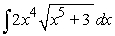

Use Part I of the Fundamental Theorem of Calculus to compute the integral exactly. 
(Multiple Choice)
4.7/5 (82)
(82) Compute the Trapezoidal Rule approximation by hand for  . Round to 3 decimal places.
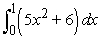
. Round to 3 decimal places. (Multiple Choice)
4.8/5 (83)
(83) 
Translate the following calculation into summation notation and then compute the sum. The sum of the squares of the first  positive integers.
 (Multiple Choice)
4.8/5 (77)
(77) Use the given velocity function and initial position to estimate the final position s(b). Round to three decimal places, if necessary.  , s(0) = 0, b = 10
 (Multiple Choice)
4.9/5 (82)
(82) 
Filters
- Essay(0)
- Multiple Choice(0)
- Short Answer(0)
- True False(0)
- Matching(0)