



 Chat with AI
Exam 14: Comparing Two Means

Exam 2: Data30 Questions
Exam 3: Surveys and Sampling28 Questions
Exam 4: Displaying and Describing Categorical Data32 Questions
Exam 5: Displaying and Describing Quantitative Data32 Questions
Exam 6: Scatterplots, Association, and Correlation32 Questions
Exam 7: Introduction to Linear Regression32 Questions
Exam 8: Randomness and Probability32 Questions
Exam 9: Random Variables and Probability Distributions28 Questions
Exam 10: Sampling Distributions28 Questions
Exam 11: Confidence Intervals for Proportions32 Questions
Exam 12: Testing Hypotheses About Proportions36 Questions
Exam 13: Confidence Intervals and Hypothesis Tests for Means36 Questions
Exam 14: Comparing Two Means32 Questions
Exam 15: Design of Experiments and Analysis of Variance Anova24 Questions
Exam 16: Inference for Counts: Chi-Square Tests26 Questions
Exam 17: Nonparametric Methods26 Questions
Exam 18: Inference for Regression32 Questions
Exam 19: Understanding Regression Residuals28 Questions
Exam 20: Multiple Regression22 Questions
Exam 21: Building Multiple Regression Models22 Questions
Exam 22: Time Series Analysis28 Questions
Exam 23: Decision Making and Risk32 Questions
Exam 24: Quality Control28 Questions
Exam 25: Exploring and Collecting Data32 Questions
Exam 26: Understanding Probability Distributions and Statistical Inference73 Questions
Exam 27: Exploring Relationships Among Variables40 Questions
Exam 28: Using Statistics for Decision Making26 Questions
Select questions type


Consider the following to answer the question(s) below:
Data were collected on annual personal time (in hours) taken by a random sample of 16 women and 7 men employed by a medium sized company. The women took an average of 24.75 hours of personal time per year with a standard deviation of 2.84 hours. The men took an average of 21.86 hours with a standard deviation of 3.29 hours. The Human Resources Department believes that women tend to take more personal time than men because they tend to be the primary child care givers in the family. 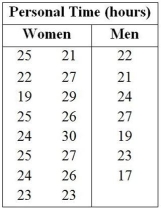 -Write the null and alternative hypotheses (assuming women are group 1 and men are group 2).
 (Short Answer)
4.9/5  (82)
(82) Consider the following to answer the question(s) below:
A company in the golfing industry is interested in testing its new driver to see if it has greater length off the tee than the best-selling driver. To do this, it has selected a group of golfers of differing abilities and ages. Its plan is to have each player use each of the two clubs to hit five balls. It will record the average length in yards of the drives with each club for each player.
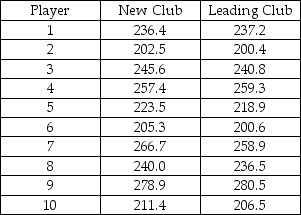 -The correct value of the test statistic is
 (Multiple Choice)
4.8/5 (79)
(79) Consider the following to answer the question(s) below:
A consumer group was interested in comparing the operating time of cordless toothbrushes manufactured by two different companies. They took a random sample of 18 toothbrushes from Company A and 15 from Company B. Each was charged overnight and the number of hours of use before needing to be recharged was recorded. Company A toothbrushes operated for an average of 119.7 hours with a standard deviation of 1.74 hours; Company B toothbrushes operated for an average of 120.6 hours with a standard deviation of 1.72 hours. Do these samples indicate that Company B toothbrushes operate more hours on average than Company A toothbrushes? 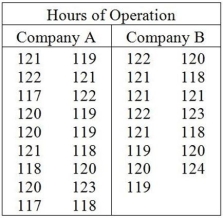 -Suppose that we test the hypotheses (assuming Company A is group 1 and Company B is group 2): H0 : µ1 - µ2 = 0 vs. HA : µ1 - µ2 ≠ 0. Provided that the P-value is greater than α = 0.05, we fail to reject the null hypothesis. If we want to construct a 95% confidence interval for the difference between the mean operating times of cordless toothbrushes of Company A and Company B, we will expect
 (Multiple Choice)
4.7/5 (84)
(84) Consider the following to answer the question(s) below:
A company in the golfing industry is interested in testing its new driver to see if it has greater length off the tee than the best-selling driver. To do this, it has selected a group of golfers of differing abilities and ages. Its plan is to have each player use each of the two clubs to hit five balls. It will record the average length in yards of the drives with each club for each player.
-The correct critical value for α = 0.05 is
-The correct critical value for α = 0.05 is (Multiple Choice)
4.8/5 (82)
(82) Consider the following to answer the question(s) below:
A consumer group was interested in comparing the operating time of cordless toothbrushes manufactured by two different companies. They took a random sample of 18 toothbrushes from Company A and 15 from Company B. Each was charged overnight and the number of hours of use before needing to be recharged was recorded. Company A toothbrushes operated for an average of 119.7 hours with a standard deviation of 1.74 hours; Company B toothbrushes operated for an average of 120.6 hours with a standard deviation of 1.72 hours. Do these samples indicate that Company B toothbrushes operate more hours on average than Company A toothbrushes? 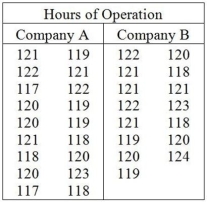 -Are the assumptions and conditions for carrying out the t-test for two means satisfied? Explain.
 (Essay)
4.8/5 (73)
(73) Consider the following to answer the question(s) below:
Data were collected on annual personal time (in hours) taken by a random sample of 16 women and 7 men employed by a medium sized company. The women took an average of 24.75 hours of personal time per year with a standard deviation of 2.84 hours. The men took an average of 21.86 hours with a standard deviation of 3.29 hours. The Human Resources Department believes that women tend to take more personal time than men because they tend to be the primary child care givers in the family.
-Create and interpret a 90% confidence interval.
-Create and interpret a 90% confidence interval. (Essay)
4.8/5 (80)
(80) Consider the following to answer the question(s) below:
A consumer group was interested in comparing the operating time of cordless toothbrushes manufactured by two different companies. They took a random sample of 18 toothbrushes from Company A and 15 from Company B. Each was charged overnight and the number of hours of use before needing to be recharged was recorded. Company A toothbrushes operated for an average of 119.7 hours with a standard deviation of 1.74 hours; Company B toothbrushes operated for an average of 120.6 hours with a standard deviation of 1.72 hours. Do these samples indicate that Company B toothbrushes operate more hours on average than Company A toothbrushes?
-State your conclusion using α = 0.05.
-State your conclusion using α = 0.05. (Essay)
4.8/5 (78)
(78) Consider the following to answer the question(s) below:
Data were collected on annual personal time (in hours) taken by a random sample of 16 women and 7 men employed by a medium sized company. The women took an average of 24.75 hours of personal time per year with a standard deviation of 2.84 hours. The men took an average of 21.86 hours with a standard deviation of 3.29 hours. The Human Resources Department believes that women tend to take more personal time than men because they tend to be the primary child care givers in the family. 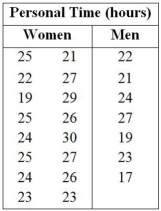 -Based on the data, the correct 90% confidence interval for the difference between women and men in the average number of hours of personal time taken per year is
 (Multiple Choice)
4.9/5 (87)
(87) Consider the following to answer the question(s) below:
Data were collected on annual personal time (in hours) taken by a random sample of 16 women and 7 men employed by a medium sized company. The women took an average of 24.75 hours of personal time per year with a standard deviation of 2.84 hours. The men took an average of 21.86 hours with a standard deviation of 3.29 hours. The Human Resources Department believes that women tend to take more personal time than men because they tend to be the primary child care givers in the family.
-Are the assumptions and conditions for carrying out the t-test for two means satisfied? Explain.
-Are the assumptions and conditions for carrying out the t-test for two means satisfied? Explain. (Essay)
4.8/5 (71)
(71) Consider the following to answer the question(s) below:
A consumer group was interested in comparing the operating time of cordless toothbrushes manufactured by two different companies. They took a random sample of 18 toothbrushes from Company A and 15 from Company B. Each was charged overnight and the number of hours of use before needing to be recharged was recorded. Company A toothbrushes operated for an average of 119.7 hours with a standard deviation of 1.74 hours; Company B toothbrushes operated for an average of 120.6 hours with a standard deviation of 1.72 hours. Do these samples indicate that Company B toothbrushes operate more hours on average than Company A toothbrushes?
-At α = 0.05,
-At α = 0.05, (Multiple Choice)
4.8/5 (84)
(84) Consider the following to answer the question(s) below:
A consumer group was interested in comparing the operating time of cordless toothbrushes manufactured by two different companies. They took a random sample of 18 toothbrushes from Company A and 15 from Company B. Each was charged overnight and the number of hours of use before needing to be recharged was recorded. Company A toothbrushes operated for an average of 119.7 hours with a standard deviation of 1.74 hours; Company B toothbrushes operated for an average of 120.6 hours with a standard deviation of 1.72 hours. Do these samples indicate that Company B toothbrushes operate more hours on average than Company A toothbrushes?
-The correct null and alternative hypotheses (assuming Company A is group 1 and Company B is group 2) are
-The correct null and alternative hypotheses (assuming Company A is group 1 and Company B is group 2) are (Multiple Choice)
4.9/5 (73)
(73) Consider the following to answer the question(s) below:
Data were collected on annual personal time (in hours) taken by a random sample of 16 women and 7 men employed by a medium sized company. The women took an average of 24.75 hours of personal time per year with a standard deviation of 2.84 hours. The men took an average of 21.86 hours with a standard deviation of 3.29 hours. The Human Resources Department believes that women tend to take more personal time than men because they tend to be the primary child care givers in the family.
-State your conclusion using α = 0.05.
-State your conclusion using α = 0.05. (Essay)
4.8/5 (77)
(77) 
Filters
- Essay(0)
- Multiple Choice(0)
- Short Answer(0)
- True False(0)
- Matching(0)