Multiple Choice
Consider the following to answer the question(s) below:
A consumer group was interested in comparing the operating time of cordless toothbrushes manufactured by two different companies. They took a random sample of 18 toothbrushes from Company A and 15 from Company B. Each was charged overnight and the number of hours of use before needing to be recharged was recorded. Company A toothbrushes operated for an average of 119.7 hours with a standard deviation of 1.74 hours; Company B toothbrushes operated for an average of 120.6 hours with a standard deviation of 1.72 hours. Do these samples indicate that Company B toothbrushes operate more hours on average than Company A toothbrushes? 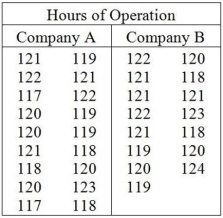
-Suppose that we test the hypotheses (assuming Company A is group 1 and Company B is group 2) : H0 : µ1 - µ2 = 0 vs. HA : µ1 - µ2 ≠ 0. Provided that the P-value is greater than α = 0.05, we fail to reject the null hypothesis. If we want to construct a 95% confidence interval for the difference between the mean operating times of cordless toothbrushes of Company A and Company B, we will expect
A) both the upper and lower limits be negative.
B) both the upper and lower limits to be positive.
C) that zero is not included in the interval.
D) that zero falls into the interval.
E) both the upper and lower limits be positive and fairly high.
Correct Answer:

Verified
Correct Answer:
Verified
Q19: Consider the following to answer the question(s)
Q20: Consider the following to answer the question(s)
Q21: Consider the following to answer the question(s)
Q22: Consider the following to answer the question(s)
Q24: Consider the following to answer the question(s)
Q28: Consider the following to answer the question(s)
Q29: Consider the following to answer the question(s)
Q32: A total of 23 Gossett High
Q32: A total of 23 Gossett High
Q32: Consider the following to answer the question(s)