



 Chat with AI
Exam 11: The Monetary System

Exam 1: Ten Principles of Economics439 Questions
Exam 2: Thinking Like an Economist615 Questions
Exam 3: Interdependence and the Gains From Trade527 Questions
Exam 4: The Market Forces of Supply and Demand697 Questions
Exam 5: Measuring a Nations Income518 Questions
Exam 6: Measuring the Cost of Living543 Questions
Exam 7: Production and Growth507 Questions
Exam 8: Saving, Investment, and the Financial System565 Questions
Exam 9: The Basic Tools of Finance510 Questions
Exam 10: Unemployment and Its Natural Rate698 Questions
Exam 11: The Monetary System517 Questions
Exam 12: Money Growth and Inflation484 Questions
Exam 13: Open-Economy Macroeconomics: Basic Concepts520 Questions
Exam 14: A Macroeconomic Theory of the Open Economy478 Questions
Exam 15: Aggregate Demand and Aggregate Supply563 Questions
Exam 16: The Influence of Monetary and Fiscal Policy on Aggregate Demand510 Questions
Exam 17: The Short-Run Tradeoff Between Inflation and Unemployment516 Questions
Exam 18: Six Debates Over Macroeconomic Policy372 Questions
Select questions type


If the reserve ratio is 6 percent, then $9,000 of additional reserves can create up to
(Multiple Choice)
4.9/5  (73)
(73) If the Fed sells government bonds to the public, then reserves
(Multiple Choice)
4.9/5 (78)
(78) As opposed to a payments system based on barter, a payments system based on money
(Multiple Choice)
4.8/5 (78)
(78) If the reserve ratio increased from 10 percent to 20 percent, the money multiplier would
(Multiple Choice)
4.8/5 (90)
(90) Suppose banks decide to hold more excess reserves relative to deposits. Other things the same, this action will cause the
(Multiple Choice)
4.8/5 (68)
(68) Draw a simple T-account for First National Bank which has $5,000 of deposits, a required reserve ratio of 10 percent, and excess reserves of $300. Make sure your balance sheet balances.
(Essay)
4.7/5 (62)
(62) If the reserve ratio is 5 percent, banks do not hold excess reserves, and people do not hold currency, then when the Fed purchases $20 million worth of government bonds, bank reserves
(Multiple Choice)
4.9/5 (77)
(77) Scenario 29-1.
The monetary policy of Namdian is determined by the Namdian Central Bank. The local currency is the dia. Namdian banks collectively hold 100 million dias of required reserves, 25 million dias of excess reserves, 250 million dias of Namdian Treasury Bonds, and their customers hold 1,000 million dias of deposits. Namdians prefer to use only demand deposits and so the money supply consists of demand deposits.
-Refer to Scenario 29-1 . Suppose the Central Bank of Namdia purchases 25 million dias of Namdian Treasury Bonds from banks. Suppose also that both the reserve requirement and the percentage of deposits held as excess reserves stay the same. By how much would the money supply of Namdia change?
(Multiple Choice)
4.7/5 (69)
(69) The banking system currently has $200 billion of reserves, none of which are excess. People hold only deposits and no currency, and the reserve requirement is 4 percent. If the Fed raises the reserve requirement to 10 percent and at the same time buys $50 billion worth of bonds, then by how much does the money supply change?
(Multiple Choice)
4.8/5 (87)
(87) Which of the following is not included in either M1 or M2?
(Multiple Choice)
4.8/5 (88)
(88) Table 29-5.
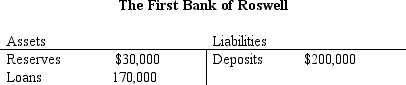 -Refer to Table 29-5. If the bank is holding $4,000 in excess reserves, then the reserve requirement with which it must comply is
 (Multiple Choice)
4.8/5 (83)
(83) 
Filters
- Essay(0)
- Multiple Choice(0)
- Short Answer(0)
- True False(0)
- Matching(0)