



 Chat with AI
Exam 11: The Monetary System

Exam 1: Ten Principles of Economics439 Questions
Exam 2: Thinking Like an Economist615 Questions
Exam 3: Interdependence and the Gains From Trade527 Questions
Exam 4: The Market Forces of Supply and Demand697 Questions
Exam 5: Measuring a Nations Income518 Questions
Exam 6: Measuring the Cost of Living543 Questions
Exam 7: Production and Growth507 Questions
Exam 8: Saving, Investment, and the Financial System565 Questions
Exam 9: The Basic Tools of Finance510 Questions
Exam 10: Unemployment and Its Natural Rate698 Questions
Exam 11: The Monetary System517 Questions
Exam 12: Money Growth and Inflation484 Questions
Exam 13: Open-Economy Macroeconomics: Basic Concepts520 Questions
Exam 14: A Macroeconomic Theory of the Open Economy478 Questions
Exam 15: Aggregate Demand and Aggregate Supply563 Questions
Exam 16: The Influence of Monetary and Fiscal Policy on Aggregate Demand510 Questions
Exam 17: The Short-Run Tradeoff Between Inflation and Unemployment516 Questions
Exam 18: Six Debates Over Macroeconomic Policy372 Questions
Select questions type


Table 29-1.
The information in the table pertains to an imaginary economy.
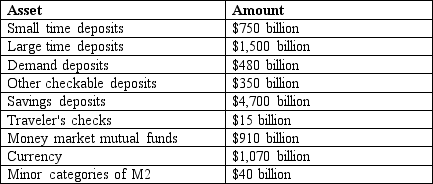 -Refer to Table 29-1. What is the value of M2 in billions of dollars?
 (Multiple Choice)
4.9/5  (83)
(83) Which of the following increases when the Fed makes open-market sales?
(Multiple Choice)
4.8/5 (86)
(86) Table 29-4.
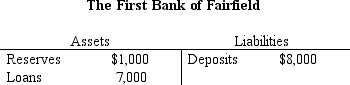 -Refer to Table 29-4. The reserve ratio for this bank is
 (Multiple Choice)
4.9/5 (85)
(85) The Federal Reserve primarily uses open-market operations to change the money supply.
(True/False)
4.9/5 (79)
(79) The reserve requirement is 4 percent, banks hold no excess reserves and people hold no currency. If the Fed sells $10,000 worth of bonds, what happens to the money supply?
(Multiple Choice)
4.9/5 (70)
(70) A bank has a 20 percent reserve requirement, $8,000 in loans, and has loaned out all it can given the reserve requirement.
(Multiple Choice)
4.8/5 (83)
(83) Scenario 29-2.
The Monetary Policy of Tazi is controlled by the country's central bank known as the Bank of Tazi. The local unit of currency is the taz. Aggregate banking statistics show that collectively the banks of Tazi hold 300 million tazes of required reserves, 75 million tazes of excess reserves, have issued 7,500 million tazes of deposits, and hold 225 million tazes of Tazian Treasury bonds. Tazians prefer to use only demand deposits and so all money is on deposit at the bank.
-Refer to Scenario 29-2. Assume that banks desire to continue holding the same ratio of excess reserves to deposits. What is the reserve requirement and the reserve ratio for Tazian Banks?
(Multiple Choice)
4.9/5 (66)
(66) All U.S. paper dollars read "This note is legal tender for all debts, public and private." This statement represents which characteristic of US currency?
(Multiple Choice)
4.9/5 (87)
(87) In a 100-percent-reserve banking system, if people decided to decrease the amount of currency they held by increasing the amount they held in checkable deposits, then
(Multiple Choice)
4.8/5 (66)
(66) The money multiplier is when the reserve ratio is 12.5 percent.
(Short Answer)
4.8/5 (78)
(78) Table 29-1.
The information in the table pertains to an imaginary economy.
-Refer to Table 29-1. What is the value of M1 in billions of dollars?
-Refer to Table 29-1. What is the value of M1 in billions of dollars? (Multiple Choice)
4.7/5 (78)
(78) You pay for cheese and bread from the deli with currency. Which function of money does this best illustrate?
(Multiple Choice)
4.7/5 (64)
(64) Which of the following can banks use to borrow from the Federal Reserve?
(Multiple Choice)
5.0/5 (75)
(75) How does the Fed Open Market Committee increase the money supply?
(Short Answer)
4.9/5 (69)
(69) If the Federal Reserve increases the interest rate on bank deposits at the Fed, banks will want to hold
(Multiple Choice)
4.8/5 (74)
(74) In recent years the Federal Open Market Committee has focused on a target for
(Multiple Choice)
4.7/5 (89)
(89) 
Filters
- Essay(0)
- Multiple Choice(0)
- Short Answer(0)
- True False(0)
- Matching(0)