



 Chat with AI
Exam 3: Systems Design: Job-Order Costing

Exam 1: Managerial Accounting and the Business Environment25 Questions
Exam 2: Managerial Accounting and Cost Concepts148 Questions
Exam 3: Systems Design: Job-Order Costing163 Questions
Exam 4: Systems Design: Process Costing106 Questions
Exam 5: Cost Behavior Analysis and Use119 Questions
Exam 6: Cost-Volume-Profit Relationship213 Questions
Exam 7: Variable Costing: a Tool for Management136 Questions
Exam 8: Activity Based Costing: a Tool to Aid Decision-Making77 Questions
Exam 9: Profit Planning144 Questions
Exam 10: Flexible Budgets and Performance Analysis294 Questions
Exam 11: Standard Costs and Operating Performance Measures163 Questions
Exam 12: Segment Reporting, Decentralization, and the Balanced Scorecard99 Questions
Exam 13: Relevant Costs for Decision Making131 Questions
Exam 14: Capital Budgeting Decisions138 Questions
Exam 15: How Well Am I Doing Statement of Cash Flows103 Questions
Exam 16: How Well Am I Doing Financial Statement Analysis207 Questions
Exam 17: Pricing Products and Services61 Questions
Exam 18: Profitability Analysis72 Questions
Exam 19: Further Classification of Labor Costs18 Questions
Exam 20: Cost of Quality24 Questions
Exam 21: the Predetermined Overhead Rate and Capacity25 Questions
Exam 22: Fifo Method72 Questions
Exam 23: Service Department Allocations51 Questions
Exam 24: Least-Squares Regression Computations14 Questions
Exam 25: Abc Action Analysis14 Questions
Exam 26: Using a Modified Form of Activity-Based Costing to17 Questions
Exam 27: Predetermined Overhead Rates and Overhead Analysis88 Questions
Exam 28: Journal Entries to Record Variances46 Questions
Exam 29: Transfer Pricing20 Questions
Exam 30: Service Department Charges34 Questions
Exam 31: The Concept of Present Value14 Questions
Exam 32: Income Taxes in Capital Budgeting Decisions33 Questions
Exam 33: The Direct Method of Determining the Net Cash Provided by42 Questions
Select questions type


Rappaport Corporation reported the following data for the month of February:  -The adjusted cost of goods sold that appears on the income statement for February is:
 (Multiple Choice)
4.9/5  (75)
(75) When completed goods are sold, the transaction is recorded as a debit to Cost of Goods Sold and a credit to Work in Process.
(True/False)
4.9/5 (72)
(72) Smalling Inc. has provided the following data for the month of November: 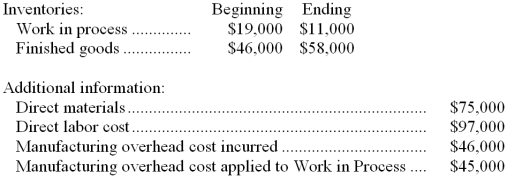 -The cost of goods manufactured for November is:
 (Multiple Choice)
4.9/5 (85)
(85) Eccles Corporation uses a job-order costing system and applies overhead to jobs using a predetermined overhead rate. During the year the company's Finished Goods inventory account was debited for $384,000 and credited for $325,900. The ending balance in the Finished Goods inventory account was $72,100. At the end of the year, manufacturing overhead was underapplied by $5,400.
-The balance in the Finished Goods inventory account at the beginning of the year was:
(Multiple Choice)
4.8/5 (76)
(76) The labor time ticket contains the details of how much time an employee takes on each task throughout the day.
(True/False)
4.9/5 (87)
(87) The Garnet Company uses a job-order costing system. The following data were recorded for February:  Overhead is charged to jobs at the rate of 140% of direct labor cost.
Jobs 1, 2, and 3 were completed during February and transferred to
finished goods. Job 3 has been delivered to the customer.
-The manufacturing costs added to jobs during the month totaled:
Overhead is charged to jobs at the rate of 140% of direct labor cost.
Jobs 1, 2, and 3 were completed during February and transferred to
finished goods. Job 3 has been delivered to the customer.
-The manufacturing costs added to jobs during the month totaled: (Multiple Choice)
4.9/5 (87)
(87) The sum of all amounts transferred from the Work in Process account and into the Finished Goods account represents the Cost of Goods Manufactured for the period.
(True/False)
4.8/5 (92)
(92) In a job-order costing system, the amount of overhead cost that has been applied to a job that remains incomplete at the end of a period:
(Multiple Choice)
4.8/5 (73)
(73) The actual manufacturing overhead incurred at Huberty Corporation during January was $73,000, while the manufacturing overhead applied to Work in Process was $78,000. The company's Cost of Goods Sold was $349,000 prior to closing out its Manufacturing Overhead account. The company closes out its Manufacturing Overhead account to Cost of Goods Sold. Which of the following statements is true?
(Multiple Choice)
4.8/5 (78)
(78) Eccles Corporation uses a job-order costing system and applies overhead to jobs using a predetermined overhead rate. During the year the company's Finished Goods inventory account was debited for $384,000 and credited for $325,900. The ending balance in the Finished Goods inventory account was $72,100. At the end of the year, manufacturing overhead was underapplied by $5,400.
-If the applied manufacturing overhead was $174,000, the actual manufacturing overhead cost for the year was:
(Multiple Choice)
4.7/5 (72)
(72) During August, Sherill Corporation incurred $78,000 of actual Manufacturing Overhead costs. During the same period, the Manufacturing Overhead applied to Work in Process was $81,000.
-The journal entry to record the incurrence of the actual Manufacturing Overhead costs would include a:
(Multiple Choice)
4.8/5 (79)
(79) Chaffey Inc. has provided the following data for the month of January. There were no beginning inventories; consequently, the direct materials, direct labor, and manufacturing overhead applied listed below are all for the current month.  Manufacturing overhead for the month was underapplied by $7,000.
The company allocates any underapplied or overapplied overhead among work in process, finished goods, and cost of goods sold at the end of the month on the basis of the overhead applied during the month in those accounts.
The work in process inventory at the end of January after allocation of any underapplied or overapplied overhead for the month is closest to:
Manufacturing overhead for the month was underapplied by $7,000.
The company allocates any underapplied or overapplied overhead among work in process, finished goods, and cost of goods sold at the end of the month on the basis of the overhead applied during the month in those accounts.
The work in process inventory at the end of January after allocation of any underapplied or overapplied overhead for the month is closest to: (Multiple Choice)
4.8/5 (84)
(84) For which situation(s) below would an organization be more likely to use a job-order costing system of accumulating product costs rather than a process costing system?
(Multiple Choice)
4.9/5 (83)
(83) Which of the following situations always results in underapplied overhead?
(Multiple Choice)
4.8/5 (71)
(71) Acer Corporation, which applies manufacturing overhead on the basis of machine-hours, has provided the following data for its most recent year of operations.  The estimates of the manufacturing overhead and of machine-hours were made at the beginning of the year for the purpose of computing the company's predetermined overhead rate for the year.
-The applied manufacturing overhead for the year is closest to:
The estimates of the manufacturing overhead and of machine-hours were made at the beginning of the year for the purpose of computing the company's predetermined overhead rate for the year.
-The applied manufacturing overhead for the year is closest to: (Multiple Choice)
4.8/5 (89)
(89) Mieras Inc. has provided the following data for the month of November. There were no beginning inventories; consequently, the direct materials, direct labor, and manufacturing overhead applied listed below are all for the current month.  Manufacturing overhead for the month was underapplied by $2,000.
The company allocates any underapplied or overapplied overhead among work in process, finished goods, and cost of goods sold at the end of the month on the basis of the overhead applied during the month in those accounts.
The journal entry to record the allocation of any underapplied or overapplied overhead for November would include the following:
Manufacturing overhead for the month was underapplied by $2,000.
The company allocates any underapplied or overapplied overhead among work in process, finished goods, and cost of goods sold at the end of the month on the basis of the overhead applied during the month in those accounts.
The journal entry to record the allocation of any underapplied or overapplied overhead for November would include the following: (Multiple Choice)
4.7/5 (75)
(75) Jarratt Inc., a manufacturing company, has provided the following data for the month of September. The balance in the Work in Process inventory account was $21,000 at the beginning of the month and $24,000 at the end of the month. During the month, the company incurred direct materials cost of $69,000 and direct labor cost of $31,000. The actual manufacturing overhead cost incurred was $54,000. The manufacturing overhead cost applied to Work in Process was $58,000. The cost of goods manufactured for September was:
(Multiple Choice)
5.0/5 (81)
(81) Freeman Company uses a predetermined overhead rate based on direct labor-hours to apply manufacturing overhead to jobs. At the beginning of the year, the company estimated manufacturing overhead would be $150,000 and direct labor-hours would be 10,000. The actual figures for the year were $186,000 for manufacturing overhead and 12,000 direct labor-hours. The cost records for the year will show:
(Multiple Choice)
5.0/5 (69)
(69) Jupiter Inc. has provided the following data for the month of August. There were no beginning inventories; consequently, the direct materials, direct labor, and manufacturing overhead applied listed below are all for the current month. 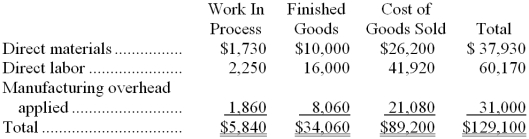 Manufacturing overhead for the month was underapplied by $2,000.
The company allocates any underapplied or overapplied overhead among work in process, finished goods, and cost of goods sold at the end of the month on the basis of the overhead applied during the month in those accounts.
-The journal entry to record the allocation of any underapplied or overapplied overhead for August would include the following:
Manufacturing overhead for the month was underapplied by $2,000.
The company allocates any underapplied or overapplied overhead among work in process, finished goods, and cost of goods sold at the end of the month on the basis of the overhead applied during the month in those accounts.
-The journal entry to record the allocation of any underapplied or overapplied overhead for August would include the following: (Multiple Choice)
4.9/5 (78)
(78) The following partially completed T-accounts summarize transactions for Faas Company during the year:  -The manufacturing overhead was:
 (Multiple Choice)
4.9/5 (90)
(90) 
Filters
- Essay(0)
- Multiple Choice(0)
- Short Answer(0)
- True False(0)
- Matching(0)