



 Chat with AI
Exam 14: Capital Budgeting Decisions

Exam 1: Managerial Accounting and the Business Environment25 Questions
Exam 2: Managerial Accounting and Cost Concepts148 Questions
Exam 3: Systems Design: Job-Order Costing163 Questions
Exam 4: Systems Design: Process Costing106 Questions
Exam 5: Cost Behavior Analysis and Use119 Questions
Exam 6: Cost-Volume-Profit Relationship213 Questions
Exam 7: Variable Costing: a Tool for Management136 Questions
Exam 8: Activity Based Costing: a Tool to Aid Decision-Making77 Questions
Exam 9: Profit Planning144 Questions
Exam 10: Flexible Budgets and Performance Analysis294 Questions
Exam 11: Standard Costs and Operating Performance Measures163 Questions
Exam 12: Segment Reporting, Decentralization, and the Balanced Scorecard99 Questions
Exam 13: Relevant Costs for Decision Making131 Questions
Exam 14: Capital Budgeting Decisions138 Questions
Exam 15: How Well Am I Doing Statement of Cash Flows103 Questions
Exam 16: How Well Am I Doing Financial Statement Analysis207 Questions
Exam 17: Pricing Products and Services61 Questions
Exam 18: Profitability Analysis72 Questions
Exam 19: Further Classification of Labor Costs18 Questions
Exam 20: Cost of Quality24 Questions
Exam 21: the Predetermined Overhead Rate and Capacity25 Questions
Exam 22: Fifo Method72 Questions
Exam 23: Service Department Allocations51 Questions
Exam 24: Least-Squares Regression Computations14 Questions
Exam 25: Abc Action Analysis14 Questions
Exam 26: Using a Modified Form of Activity-Based Costing to17 Questions
Exam 27: Predetermined Overhead Rates and Overhead Analysis88 Questions
Exam 28: Journal Entries to Record Variances46 Questions
Exam 29: Transfer Pricing20 Questions
Exam 30: Service Department Charges34 Questions
Exam 31: The Concept of Present Value14 Questions
Exam 32: Income Taxes in Capital Budgeting Decisions33 Questions
Exam 33: The Direct Method of Determining the Net Cash Provided by42 Questions
Select questions type


(Ignore income taxes in this problem.) Treads Corporation is considering the replacement of an old machine that is currently being used. The old machine is fully depreciated but can be used by the corporation for five more years. If Treads decides to replace the old machine, Picco Company has offered to purchase the old machine for $60,000. The old machine would have no salvage value in five years.
The new machine would be acquired from Hillcrest Industries for $1,000,000 in cash. The new machine has an expected useful life of five years with no salvage value. Due to the increased efficiency of the new machine, estimated annual cash savings of $300,000 would be generated.
Treads Corporation uses a discount rate of 12%.
-The net present value of the project is closest to:
(Multiple Choice)
4.8/5  (80)
(80) (Ignore income taxes in this problem.) Jones and Company has just purchased a new piece of equipment, the cost characteristics of which are given below:  The company uses a required rate of return of 10% and depreciates equipment using the straight-line method.
-The simple rate of return for the investment (rounded to the nearest tenth of a percent) is:
The company uses a required rate of return of 10% and depreciates equipment using the straight-line method.
-The simple rate of return for the investment (rounded to the nearest tenth of a percent) is: (Multiple Choice)
4.9/5 (83)
(83) (Ignore income taxes in this problem.) Romas Corporation uses a discount rate of 18% in its capital budgeting. Management is considering an investment in telecommunications equipment with a useful life of 8 years. Excluding the salvage value of the equipment, the net present value of the investment in the equipment is -$260,340.
Required:
How large would the salvage value of the telecommunications equipment have to be to make the investment in the telecommunications equipment financially attractive?
(Essay)
5.0/5 (84)
(84) (Ignore income taxes in this problem.) The Wisbley Company is contemplating the purchase of a helicopter for its executives to use in their business trips. This helicopter could be either purchased or leased from the manufacturer. The useful life of the helicopter is four years. Data concerning these two alternatives follow:  If the helicopter is leased, it would be returned to the manufacturer in four years. Wisbley's required rate of return is 22%.
-The present value of the salvage value of the helicopter, if the helicopter is purchased, would be:
If the helicopter is leased, it would be returned to the manufacturer in four years. Wisbley's required rate of return is 22%.
-The present value of the salvage value of the helicopter, if the helicopter is purchased, would be: (Multiple Choice)
4.9/5 (79)
(79) (Ignore income taxes in this problem.) Isomer Industrial Training Corporation is considering the purchase of new presentation equipment at a cost of $150,000. The equipment has an estimated useful life of 10 years with an expected salvage value of zero. The equipment is expected to generate net cash inflows of $35,000 per year in each of the 10 years. Isomer's discount rate is 16%. Isomer uses the straight-line method of depreciation for its assets.
-What is the simple rate of return of the presentation equipment?
(Multiple Choice)
4.8/5 (94)
(94) (Ignore income taxes in this problem.) Joe Flubup is the president of Flubup, Inc. He is considering buying a new machine that would cost $25,470. Joe has determined that the new machine promises an internal rate of return of 14%, but Joe has misplaced the paper which tells the annual cost savings promised by the new machine. He does remember that the machine has a projected life of 12 years. Based on these data, the annual cost savings are:
(Multiple Choice)
4.9/5 (83)
(83) (Ignore income taxes in this problem.) Whitmarsh Corporation is considering a project that would require an initial investment of $334,000 and would last for 9 years. The incremental annual revenues and expenses for each of the 9 years would be as follows: 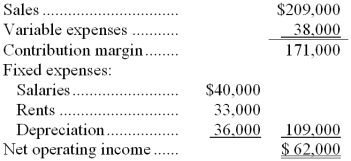 At the end of the project, the scrap value of the project's assets would be $10,000.
Required:
Determine the payback period of the project. Show your work!
At the end of the project, the scrap value of the project's assets would be $10,000.
Required:
Determine the payback period of the project. Show your work! (Essay)
4.9/5 (84)
(84) In capital budgeting decisions, a $10,000 decrease in annual cash outflows can be treated as if it is a $10,000 increase in annual cash inflows.
(True/False)
4.8/5 (82)
(82) (Ignore income taxes in this problem.) Highpoint, Inc., is considering investing in automated equipment with a ten-year useful life. Managers at Highpoint have estimated the cash flows associated with the tangible costs and benefits of automation, but have been unable to estimate the cash flows associated with the intangible benefits. Using the company's 10% discount rate, the net present value of the cash flows associated with just the tangible costs and benefits is a negative $184,350. How large would the annual net cash inflows from the intangible benefits have to be to make this a financially acceptable investment?
(Multiple Choice)
4.8/5 (86)
(86) (Ignore income taxes in this problem.) Denny Corporation is considering replacing a technologically obsolete machine with a new state-of-the-art numerically controlled machine. The new machine would cost $450,000 and would have a ten-year useful life. Unfortunately, the new machine would have no salvage value. The new machine would cost $20,000 per year to operate and maintain, but would save $100,000 per year in labor and other costs. The old machine can be sold now for scrap for $50,000. The simple rate of return on the new machine is closest to:
(Multiple Choice)
4.8/5 (81)
(81) When the net present value method is used, the internal rate of return is the discount rate used to compute the net present value of a project.
(True/False)
4.9/5 (88)
(88) (Ignore income taxes in this problem.) The management of Lassonde Corporation is considering the purchase of a machine that would cost $290,000, would last for 9 years, and would have no salvage value. The machine would reduce labor and other costs by $56,000 per year. The company requires a minimum pretax return of 8% on all investment projects.
-The net present value of the proposed project is closest to:
(Multiple Choice)
4.8/5 (88)
(88) (Ignore income taxes in this problem.) Treads Corporation is considering the replacement of an old machine that is currently being used. The old machine is fully depreciated but can be used by the corporation for five more years. If Treads decides to replace the old machine, Picco Company has offered to purchase the old machine for $60,000. The old machine would have no salvage value in five years.
The new machine would be acquired from Hillcrest Industries for $1,000,000 in cash. The new machine has an expected useful life of five years with no salvage value. Due to the increased efficiency of the new machine, estimated annual cash savings of $300,000 would be generated.
Treads Corporation uses a discount rate of 12%.
-The internal rate of return of the project is closest to:
(Multiple Choice)
4.8/5 (77)
(77) (Ignore income taxes in this problem.) The Becker Company is interested in buying a piece of equipment that it needs. The following data have been assembled concerning this equipment:  This equipment is expected to have a useful life of 6 years. At the end of the sixth year the working capital would be released for use elsewhere. The company's discount rate is 10%.
-The present value of the net cash flows (all cash inflows less all cash outflows) occurring during year 4 is:
This equipment is expected to have a useful life of 6 years. At the end of the sixth year the working capital would be released for use elsewhere. The company's discount rate is 10%.
-The present value of the net cash flows (all cash inflows less all cash outflows) occurring during year 4 is: (Multiple Choice)
4.7/5 (78)
(78) (Ignore income taxes in this problem) The management of Boie Corporation is considering the purchase of a machine that would cost $330,980 and would have a useful life of 6 years. The machine would have no salvage value. The machine would reduce labor and other operating costs by $76,000 per year. The internal rate of return on the investment in the new machine is closest to:
(Multiple Choice)
4.9/5 (82)
(82) (Ignore income taxes in this problem.) Stern Corporation is considering the purchase of a machine that would cost $270,000 and would last for 9 years. At the end of 9 years, the machine would have a salvage value of $38,000. By reducing labor and other operating costs, the machine would provide annual cost savings of $54,000. The company requires a minimum pretax return of 16% on all investment projects.
-The present value of the annual cost savings of $54,000 is closest to:
(Multiple Choice)
4.9/5 (67)
(67) When using internal rate of return to evaluate investment projects, if the internal rate of return is less than the required rate of return, the project would be accepted.
(True/False)
4.9/5 (82)
(82) The payback period is the length of time it takes for an investment to recoup its initial cost out of the cash receipts it generates.
(True/False)
5.0/5 (69)
(69) Screening decisions follow preference decisions and seek to rank investment proposals in order of their desirability.
(True/False)
4.8/5 (78)
(78) An investment project that requires a present investment of $210,000 will have cash inflows of "R" dollars each year for the next five years. The project will terminate in five years. Consider the following statements (ignore income tax considerations):
I. If "R" is less than $42,000, the payback period exceeds the life of the project.
II. If "R" is greater than $42,000, the payback period exceeds the life of the project.
III. If "R" equals $42,000, the payback period equals the life of the project.
Which statement(s) is (are) true?
(Multiple Choice)
4.8/5 (66)
(66) 
Filters
- Essay(0)
- Multiple Choice(0)
- Short Answer(0)
- True False(0)
- Matching(0)